
Both tools help marketers understand and improve visibility in AI search, but they do it in different ways. Semrush One combines full SEO tooling with AI visibility in one subscription, which suits teams that want a single search stack. Profound focuses only on AI answer engines and goes deeper on AI-specific analytics for larger or more advanced teams.
AI search is hard to track and even harder to identify performance. Tools like ChatGPT, Perplexity, Gemini, and Google’s AI features might show your content or brand, but you mostly find them through manual checks. You can’t easily tell which engines show your brand, which prompts trigger you, how often you appear, or whether that visibility is improving or dropping over time.
That need for clarity is where tools like Semrush One and Profound come in. To help brands understand where they appear across answer engines, how LLMs describe their brand, and what to change to improve it.
Quick verdict:
- Choose Semrush One if you want one platform that covers SEO and AI search together, with Google data, site audits, and AI visibility reports in the same workflow.
- Choose Profound if you already have your SEO tools in place and want deeper AI-only analytics, multi-engine tracking, and AI-specific features like Agent Analytics and shopping visibility.
What Does Each Tool Do & Who Are They For?
Both Semrush One and Profound track how brands show up in AI search results and answer engines. They collect prompts, citations, and visibility data, then turn that into reports for marketing and SEO teams. The difference is scope: Semrush One covers SEO and AI search; Profound focuses purely on AI.
Semrush One overview
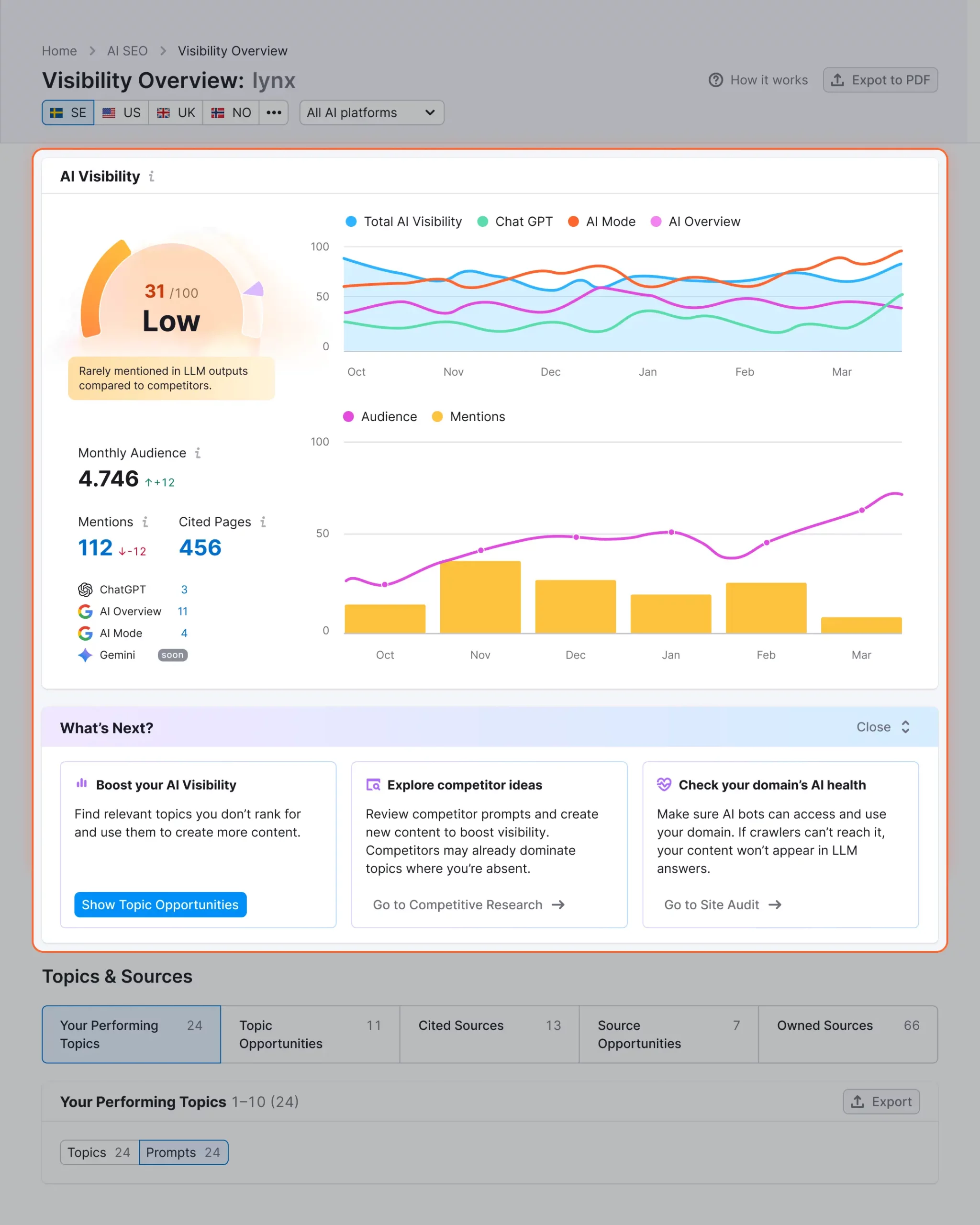
Semrush One is a bundled subscription that includes the full Semrush SEO Toolkit plus the AI Visibility Toolkit. You get keyword research, competitive analysis, backlink data, position tracking, and site audits, plus AI reports that show how often your brand appears in AI Overviews and major answer engines.
The offer is structured in three tiers (Starter, Pro+, Advanced), each increasing limits on domains, prompts, and tracked keywords. Because AI visibility is built into the same platform as SEO, teams can see how technical fixes, content changes, and link building affect both Google rankings and AI answer coverage.
Semrush One fits teams that want a single search platform, do not want to manage separate tools for SEO and AI visibility, and need to show performance across ‘all of search’ in one set of reports.
Read the full Semrush One review.
Semrush One key features:
- Combines full SEO Toolkit and AI Visibility Toolkit under one subscription
- Tracks Google search plus major AI engines (including AI Overviews) for the same domains
- Uses large keyword, backlink, and prompt databases to power both SEO and AI reports
- Includes site audits with AI crawler checks and daily position tracking
- Provides prompt tracking and AI visibility dashboards on all Semrush One plans
Profound overview
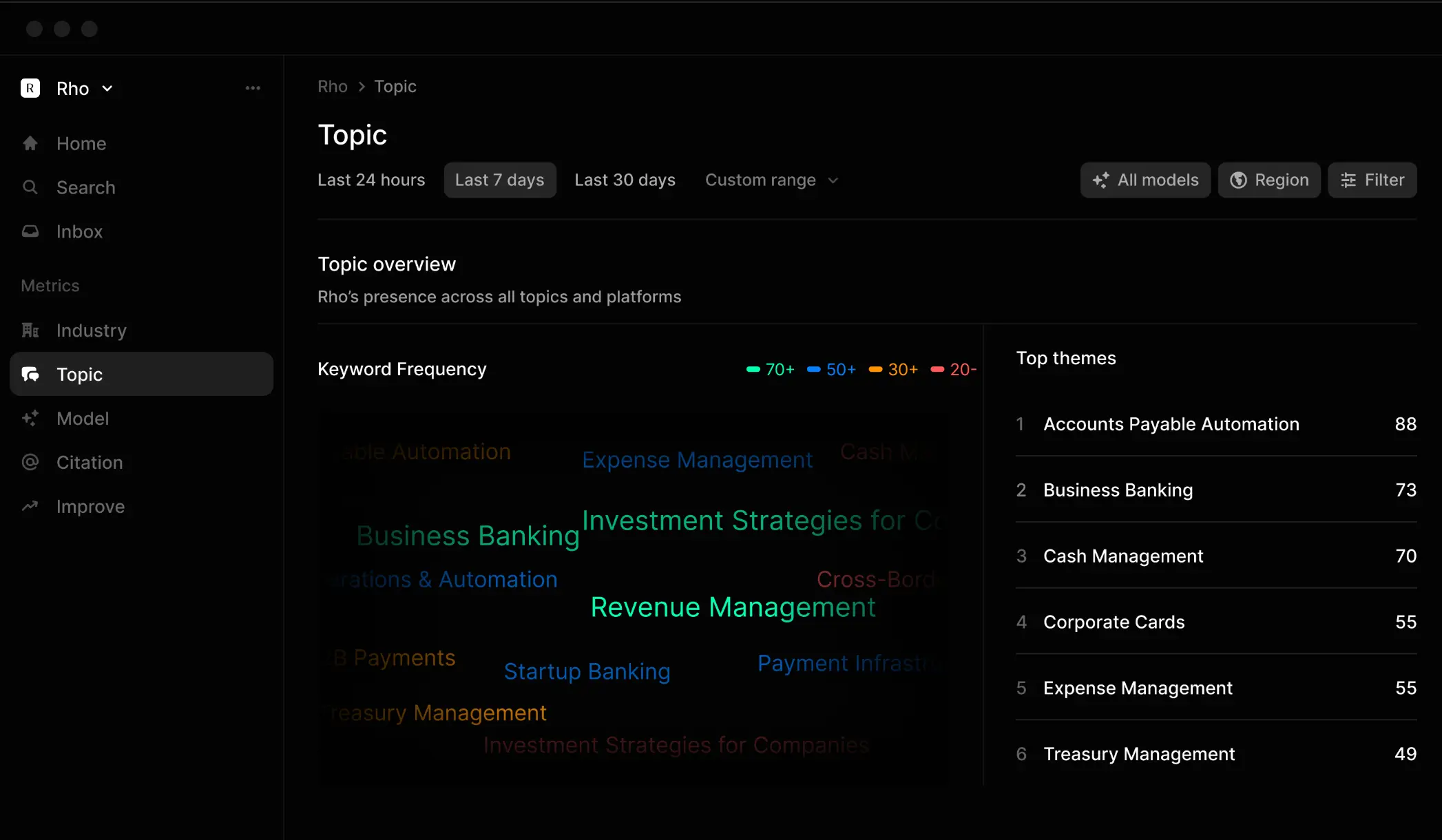
Profound is an AI visibility platform built only for answer engines. It tracks how systems like ChatGPT, Perplexity, Gemini, Google AI Overviews, Copilot, and others mention your brand, which sources they cite, and how often you appear compared to competitors.
Plans are split into Starter, Growth, and Enterprise. Starter focuses mainly on ChatGPT and a smaller number of prompts. Growth and Enterprise add more platforms, more prompts, detailed analytics, and features such as Agent Analytics and AI shopping visibility.
Profound does not offer keyword research, backlinks, or classic rank tracking. It assumes you are already using another SEO tool.
Profound fits teams that only want to monitor AI search, have budget for a dedicated AI analytics product, and want to push into questions like which AI agents crawl their site, how AI-sourced traffic behaves, and monitor AI shopping.
Profound key features:
- AI-only visibility platform with no traditional SEO features
- Tracks brand visibility and citations across multiple AI answer engines and modes
- Offers detailed modules like Answer Engine Insights, Prompt Volumes, Agent Analytics, and Shopping
- Starts with ChatGPT-focused tracking, with broader engine coverage on Growth and Enterprise
- Fits growth and enterprise teams that can act on AI analytics and plug data into existing reporting stacks
| Feature | Semrush One | Profound |
|---|---|---|
| AI Search Coverage | Tracks Google AI Overviews and major AI answer engines alongside Google search. | Focuses on AI answer engines only, with broader engine options on higher tiers. |
| SEO & Analytics Scope | Full SEO toolkit for keywords, backlinks, rankings, and audits plus AI visibility. | AI visibility and analytics only, no keyword research, backlinks, or rank tracking. |
| AI Visibility & Metrics | Prompt tracking and AI visibility dashboards tied to existing SEO metrics. | Answer Engine Insights, Prompt Volumes, Agent Analytics, and Shopping reporting. |
| Auditing & AI Readiness | Site Audit checks technical issues and AI crawler access for tracked sites. | Shows how AI agents crawl and cite your content, with less focus on full-site audits. |
| Pricing & Plans | Starter, Pro+, and Advanced plans bundle SEO and AI search in one subscription. | Starter, Growth, and Enterprise plans priced for AI-only analytics and workflows. |
| Best Fit | Teams that want one platform for SEO and AI search visibility. | Mature teams adding deep AI visibility on top of an existing SEO stack. |
Which Tool Covers More Of AI Search and LLMs?
Semrush One covers classic Google search and major LLMs in one workflow. From the Starter plan, you can see how you show up in Google AI Overviews, AI Mode, ChatGPT, Perplexity, and Gemini, tied back to the same domains and projects you track for SEO.
Profound focuses only on AI engines. It looks at how models like ChatGPT, Google AI Mode, Google AI Overviews, Gemini, Copilot, Perplexity, Grok, Meta AI, DeepSeek, and Claude talk about your brand, but multi-LLM coverage is available only in higher tiers. The Starter plan is really only ChatGPT.
If you want broad AI coverage with the same tool you already use for search, Semrush One is the better choice. Profound makes more sense when AI search is already a defined channel and you are ready to pay for deeper coverage across platforms.
Semrush One’s AI search coverage
Semrush One is built to cover ‘every search channel’ in a single subscription. It combines Google SEO with AI discovery, so you do not need a separate AEO tool.
Semrush One AI coverage features
- Tracks AI visibility across Google AI Overviews, AI Mode, ChatGPT, Perplexity, and Gemini.
- Includes multiple AI platforms on all Semrush One plans, not just at the high end.
- Uses a large prompt database to report on visibility and prompt trends across those engines.
- Lets you see SEO rankings and AI visibility for the same domains inside one project.
Semrush One wins on coverage when you want reliable tracking of SEO performance, plus the main LLMs.
Profound’s AI search coverage
Profound is an AI visibility product first. It does not track organic rankings in Google, but it goes a bit deeper into answer engines and models, especially at the enterprise level.

Profound AI coverage features
- Starter plan focuses on ChatGPT visibility and a limited prompt set.
- Growth and Enterprise add more engines, including Google AI Mode, Google AI Overviews, Gemini, Copilot, Perplexity, Grok, Meta AI, DeepSeek, and Claude.
- Designed for daily or near-daily tracking of prompts and citations across those engines.
Profound’s larger LLM list starts to matter when you already have SEO covered elsewhere, you care about smaller or newer AI engines, and you have the budget and team capacity to act on that extra volume of AI data.
Which Tool Gives You Stronger AI Analytics & Data?
Semrush One’s analytics are centered on visibility, sentiment, and competitive position in AI answers. You get clean metrics and dashboards that summarize how often your brand appears, how AI describes it, and where competitors are ahead, all built on Semrush’s prompt and AI answer datasets.
Profound focuses its analytics on raw AI demand and behavior. It analyzes hundreds of millions of real AI conversations and large prompt runs across answer engines, then turns that into Prompt Volumes, Answer Engine Insights, the Profound Index, and agent-level logs.
Semrush One AI analytics and data
Semrush One’s AI Visibility Toolkit is built for marketers who want summarized, decision-ready AI metrics. Reports like Visibility Overview, Brand Performance, Prompt Research, Competitor Research, and Prompt Tracking all sit in one place and use consistent metrics.
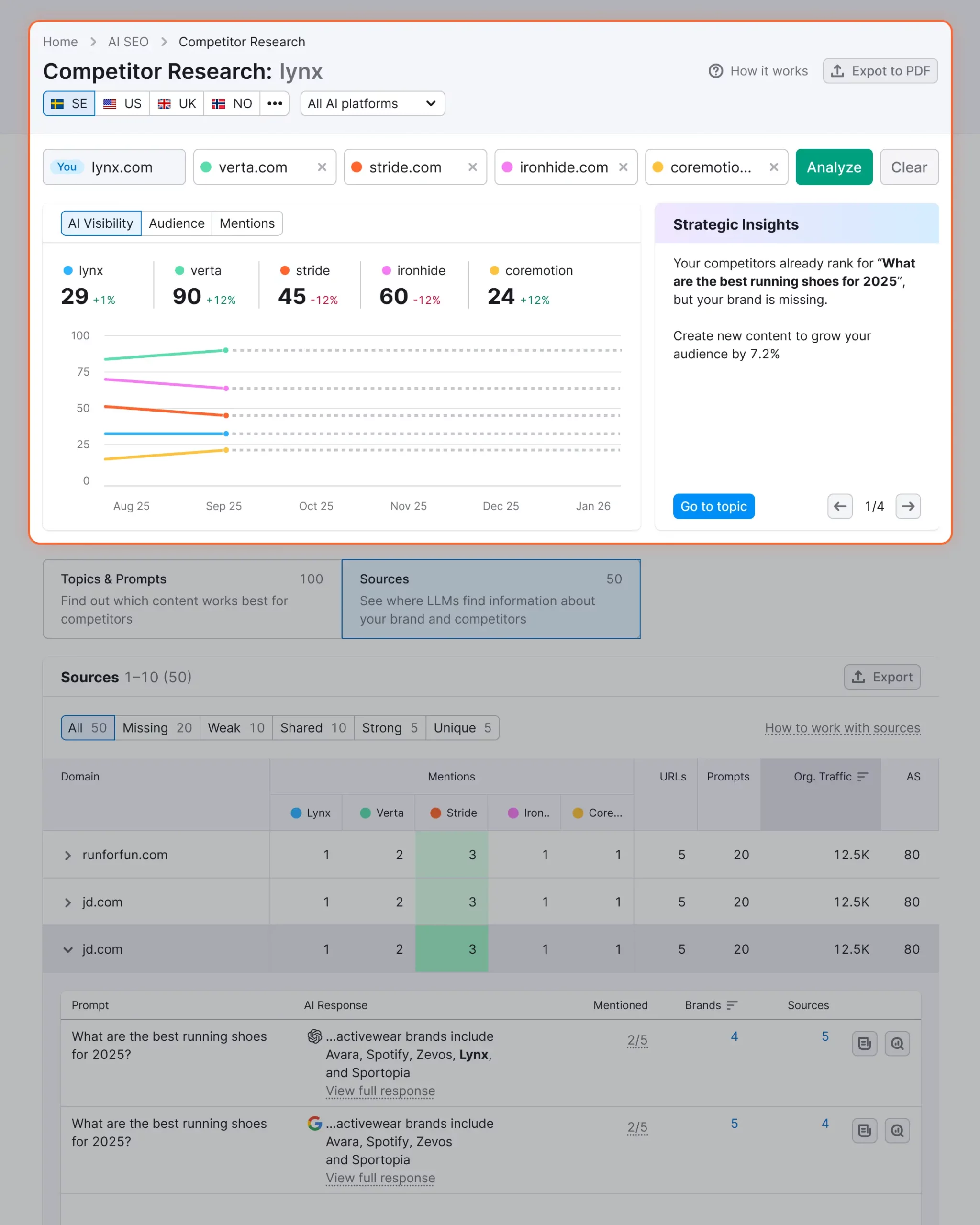
The toolkit uses Semrush’s AI visibility metrics to keep things readable: visibility score, AI share of voice, sentiment, and narrative drivers. You can quickly see how your brand’s AI visibility is trending, how it compares to competitors, and which prompts or topics deserve attention next.
Semrush One AI analytics and data features
- Visibility Overview: high-level visibility score, share of voice, and trend lines across supported AI platforms
- Brand Performance: sentiment, narrative drivers, and “how AI talks about you” vs competitors
- Prompt Research: prompt-level data (volume, difficulty, related prompts) to find new AI opportunities
- Competitor Research: side-by-side comparison of AI visibility for your brand and named competitors
- Prompt Tracking: daily visibility for selected prompts in ChatGPT Search and Google AI Mode, tied to your domains
- AI Visibility metrics library: defined metrics for visibility, share of voice, and sentiment so teams use the same numbers in reporting
Semrush One wins when you want AI analytics that marketers can read and act on quickly. It gives you defined metrics (visibility, share of voice, sentiment) and ready-made reports around prompts, brands, and competitors, so you can answer ‘where are we showing up and how is that changing?’ without building custom models or dashboards.
Profound AI analytics and data
Profound’s analytics are built from large-scale prompt and conversation data. Prompt Volumes uses hundreds of millions of anonymized AI conversations to show what people actually ask, by topic, region, and trend, across engines like ChatGPT, Gemini, Claude, and Perplexity.

Answer Engine Insights then shows how often your brand appears in AI answers, what those answers say, and which domains drive the citations. On top of that, the Profound Index gives a public, industry-level view of which brands lead in AI visibility, refreshed regularly and grounded in tracked prompts.
Agent and log-based datasets add another layer. Agent Analytics ingests structured request logs from platforms like Vercel and other CDNs to identify AI crawlers, track which URLs they request, and tie that behavior to AI-generated visits.
Profound AI analytics and data features
- Prompt Volumes: AI search volume and trends built from 400M+ real AI conversations, with filters by topic, region, and demographics
- Answer Engine Insights: per-engine visibility, answer content, and citation breakdowns for your brand and topics
- Profound Index: public and private brand-level AI visibility benchmarks by category, powered by tracked prompts and Prompt Volumes
- Agent Analytics: server-side tracking of AI crawlers (bot IDs, IP ranges, hit frequency, URLs accessed)
- AI demand and sentiment views: prompt-level demand, sentiment, and intent data to shape campaigns and experiments
Profound wins when you need to work directly with AI demand and behavior data. It is better for teams that want to analyze prompts, engines, answers, and agents in detail, compare brands at a dataset level, and plug that raw AI visibility data into their own experimentation and BI workflows.
Which Tool Gives Better AI Visibility Metrics and Prompt Insights?
Both tools track how often your brand appears in AI answers and which prompts drive that exposure, but they structure the data differently. Semrush One covers visibility scores, prompt tracking, and brand perception you can read next to SEO metrics, so you can link AI exposure back to pages and keywords you already track.
Profound goes deeper into AI-only analytics. It adds dedicated modules for prompt demand, answer content, citations, engines, and agents, so you can dig into how specific questions, models, and crawlers behave over time.
Semrush One’s AI visibility and prompt tracking
Semrush One’s AI Visibility Toolkit gives you a set of structured reports: Visibility Overview, Brand Performance, Prompt Research, Competitor Research, and Prompt Tracking. All of them sit on top of a large prompt dataset and are tied back to your domains.

Prompt Tracking lives inside Position Tracking and monitors your daily presence for specific prompts in ChatGPT Search and Google AI Mode. Brand Performance reports show how often AI tools mention your brand, how they describe it, and sentiment and share of voice over time.
Visibility Overview and Prompt Research use a 150M+ prompt index to show which queries already pull you in and where you are absent but relevant.
Semrush One AI visibility and prompt features
- Prompt Tracking for custom prompts with daily visibility in ChatGPT Search and Google AI Mode
- Visibility Overview showing prompts that include your brand, prompts where you should appear, and overall AI visibility trends
- Brand Performance with sentiment, share of voice, and narrative drivers across AI platforms
- Prompt Research using a large prompt database (volume, difficulty, related prompts) to find new opportunities
- Competitor-focused views to see where rivals are cited in AI and which prompts they dominate
Semrush One wins on AI visibility when you want clear, brand-level metrics rather than raw prompt logs. It suits teams that care about visibility scores, sentiment, and share of voice across key LLMs, and want to quickly see which prompts and narratives to prioritize next.
Profound’s AI visibility metrics and prompt insights
Profound’s reporting focuses on prompt demand, answer content, and engine behavior. Answer Engine Insights tracks how often your brand appears in AI-generated answers, what the models say, and which sources they cite, so you can see top-citing websites and benchmark against competitors.
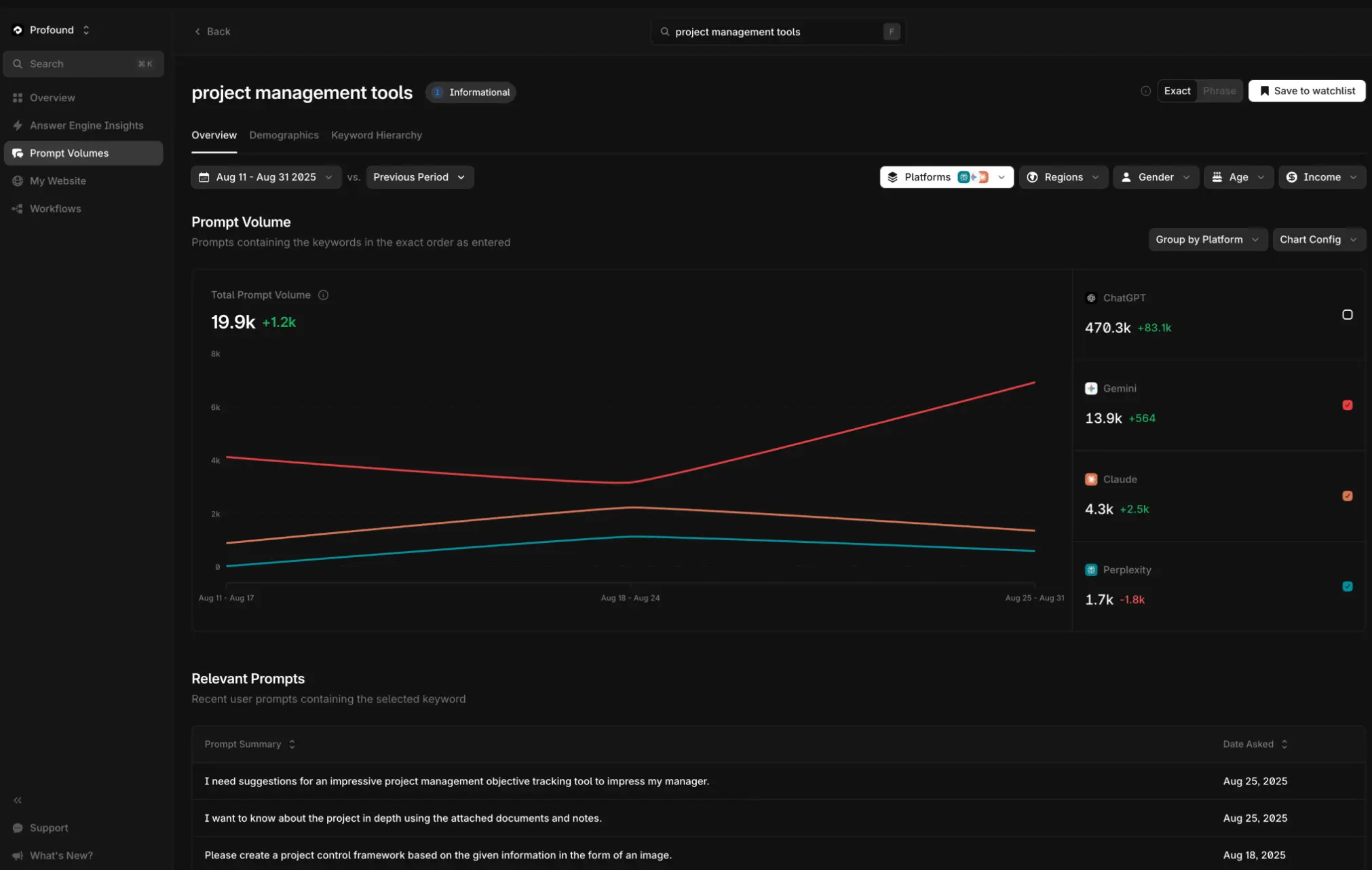
Prompt Volumes estimates AI search volume using hundreds of millions of anonymized conversations, showing which questions people ask across ChatGPT, Google, Perplexity, and other engines, plus trends, sentiment, and intent.
Shopping and placement tracking modules monitor how often your products appear in AI-powered shopping units, including ChatGPT Shopping, and how that changes over time.
Profound AI visibility and prompt features
- Answer Engine Insights to track appearance frequency, answer content, and top citations across AI engines
- Prompt Volumes to quantify AI search demand, trends, and sentiment for specific topics and questions
- Granular prompt tracking across supported engines, with daily cadence on higher tiers
- Agent and traffic analytics (via Agent Analytics and related views) to see how AI systems crawl and drive visits
- Shopping visibility for AI shopping surfaces (including ChatGPT Shopping), with placement tracking and “what’s working” views
Profound wins on AI visibility when you need to break performance down by prompt, engine, and citation in detail. It suits teams that treat prompts like keywords, comparing demand, wording, and answer content across many LLMs to design specific tests and content changes.
Which Tool Is Better For Site Health and AI Crawler Behavior?
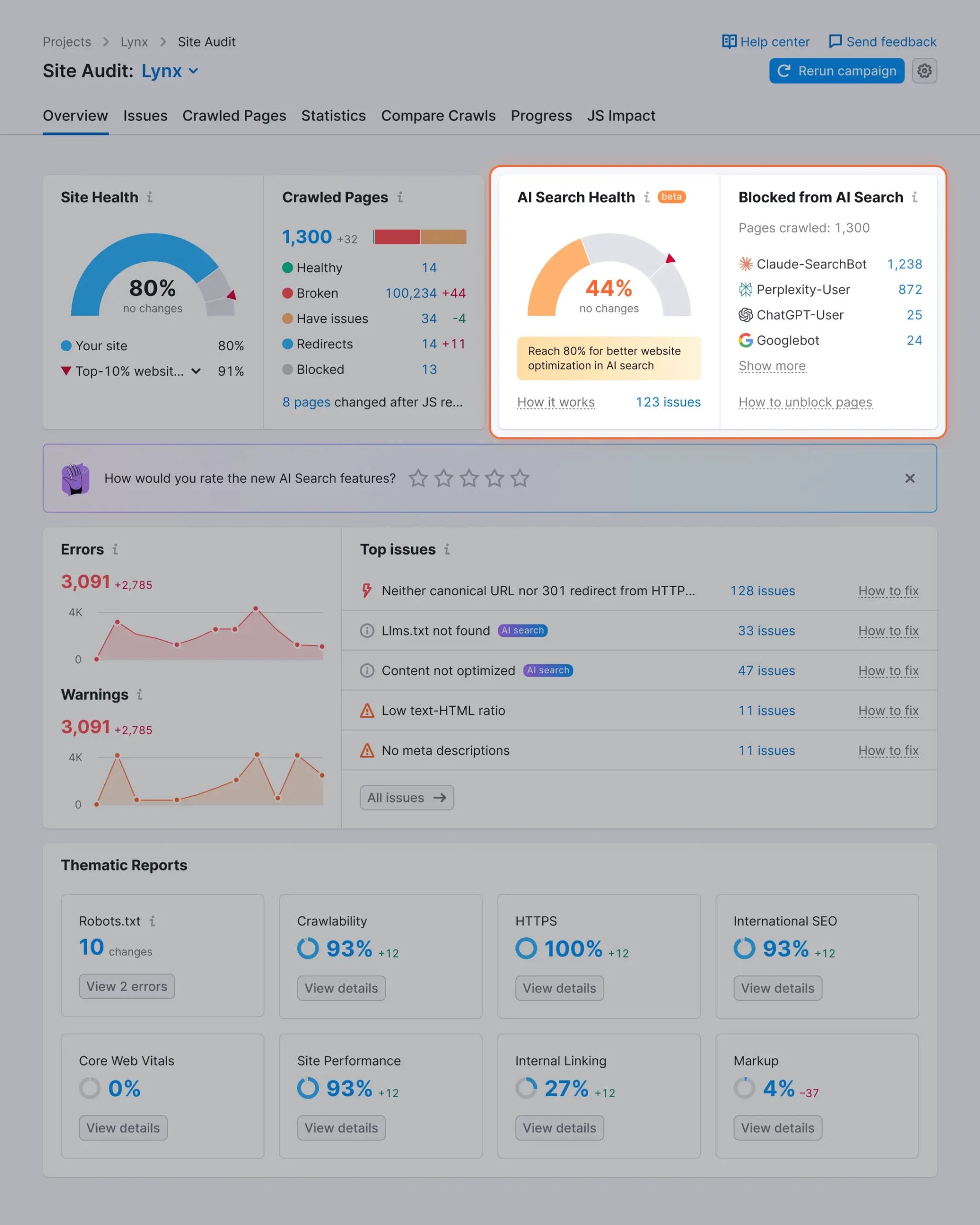
Semrush One’s Site Audit includes AI Search Health checks that show whether AI crawlers like ChatGPT (OAI-SearchBot), Google AI, Perplexity, and others can access and use your content, and which technical issues might block that. You see this alongside your usual SEO issues and scores.
Profound focuses on agent-level analytics. Its Agent Analytics feature reads server-side logs to show when AI crawlers hit your site, which pages they fetch, and how that activity connects to AI-generated referrals. It shows AI crawl and indexing problems but does not run a full SEO audit on the site.
If you want one place to see SEO issues and AI crawler access, Semrush One is stronger. Profound is better when you want detailed behavior data for AI crawlers and AI traffic.
Semrush One’s site health and AI search diagnostics
Semrush One uses Site Audit as the hub for both SEO and AI search health. The AI Search Health widget scores how well your site is set up for AI platforms and flags issues that limit your presence in AI answers. It checks crawlability, structured data, internal links, robots.txt and llms.txt rules, and whether key AI bots like OAI-SearchBot, Google AI, Perplexity, and Claude are blocked or restricted.

Because this lives inside the same audit as your other SEO checks, you can pick up AI problems in the usual crawl, fix them at the same time.
Semrush One site health and AI crawler features
- Site Audit with AI Search Health score for each site
- Checks for blocked AI crawlers (e.g., OAI-SearchBot, Google AI, Perplexity) in
robots.txt - Issue lists focused on AI search visibility (crawlability, schema, internal links,
llms.txt) - ‘Blocked from AI Search’ widget showing pages and bots affected
- One audit workflow that covers both SEO issues and AI search issues
Semrush One wins when you want AI crawl issues to show up in the same audit as your normal SEO problems. It fits teams that need one crawl to flag blocked AI bots, missing schema, and weak internal links, then fix those issues once for both rankings and AI visibility.
Profound’s agent-level insights for AI crawlers
Profound’s Agent Analytics is built to show how AI systems actually interact with your site. It connects to CDNs and hosting platforms, parses server logs, and identifies AI user agents and IP ranges so you can see which bots are real, how often they visit, and which pages they pull into answers.

The tool shows crawl frequency, AI indexing issues, and AI-attributed traffic, but it does not replace a full SEO audit. You still need another platform to check broken pages, internal linking, and broader technical SEO. Profound’s strength here is precision on AI bots and referrals rather than general site health.
Profound crawler and agent analytics features
- Agent Analytics dashboard for AI crawler visibility and frequency
- Server-side tracking to avoid missing non-JavaScript AI bot visits
- Identification of which AI engines and agents hit which pages
- Reporting on AI-generated referrals and attributed human traffic
- Signals about crawl and indexing problems that affect AI engines but not full-site SEO checks
Profound wins when you need detailed records of what AI agents actually do on your site. It fits teams that work with server and CDN logs, want to see which AI bots hit which URLs, and need to trace AI visits and crawl patterns back to specific agents.
Which Pricing Model Delivers Better Value?
Semrush One bundles full SEO and AI visibility into three tiers, with prompt tracking and multi-LLM coverage included from the Starter plan at around $165/month on annual billing. You pay once for rankings, audits, and AI visibility in the same platform.
Profound prices AI visibility as a stand-alone product. The Starter plan is cheaper on paper (around $99/month) but is limited to ChatGPT. Multi-LLM tracking and most of the advanced AI features only unlock on Growth at $399/month and Enterprise, which suits teams that already budget separately for SEO and AI analytics.
If you want one subscription to cover search as a whole, Semrush One is better value. Profound makes more sense once AI visibility is a separate budget line with clear owners and KPIs.
Semrush One plans and what you get
Semrush One is structured around three tiers: Starter, Pro+, and Advanced. All three include the full SEO Toolkit plus the AI Visibility Toolkit, so you are not paying extra just to add AI search tracking on top of SEO.
Prompt tracking, AI visibility reports, and multi-LLM coverage (Google, ChatGPT, Perplexity, Google AI Mode, Gemini, etc.) are available from Starter. Higher tiers mainly increase limits and come with more advanced SEO and reporting features.
Semrush One pricing and value
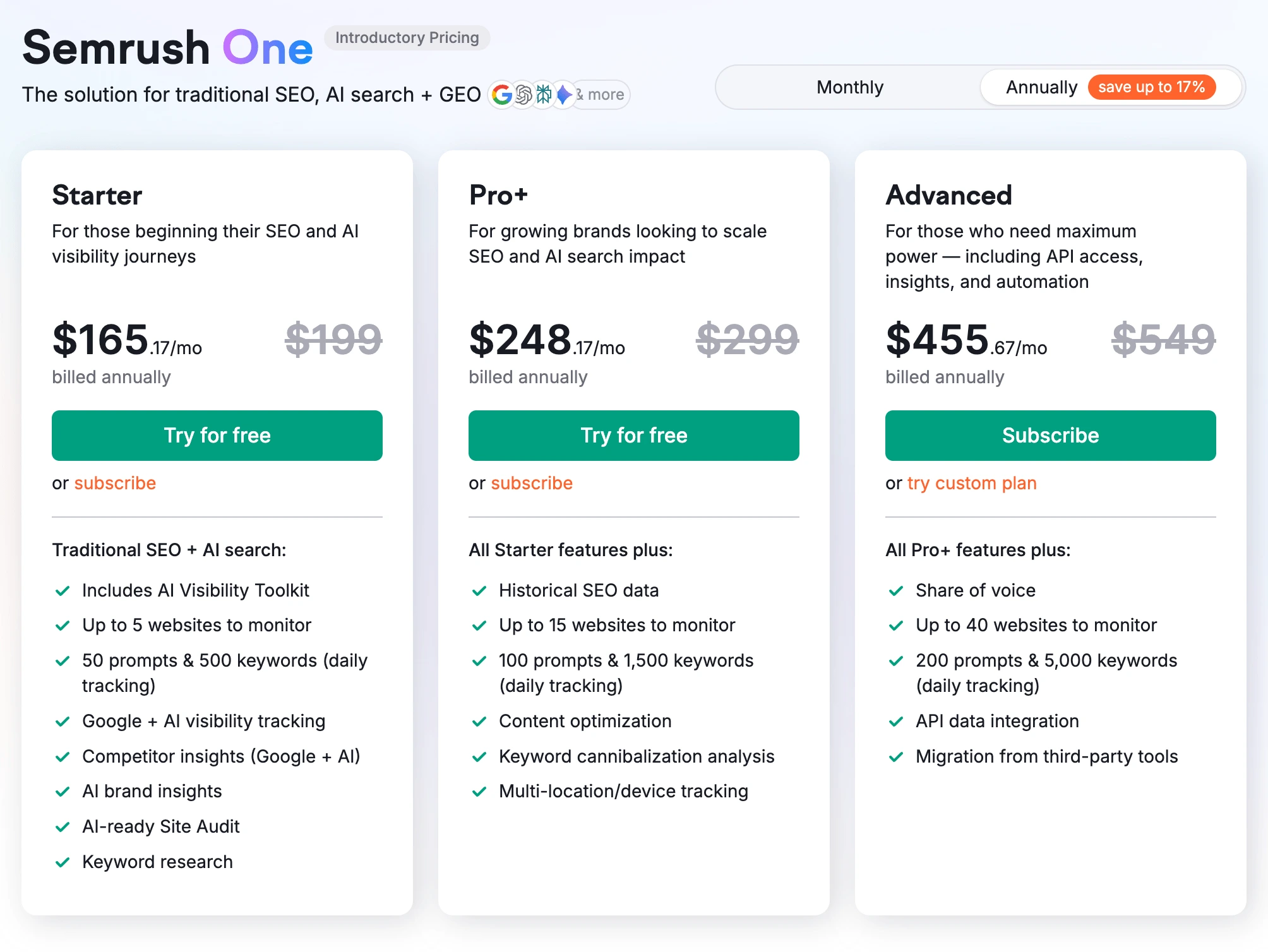
- Starter ($165/month): Combined SEO + AI visibility, prompt tracking included, multiple AI engines, core SEO tools (keywords, backlinks, audits).
- Pro+ ($248/month): Adds stronger content optimization, historical SEO data, multi-location and device tracking, and more Share of Voice style reporting.
- Advanced: Adds higher limits, Share of Voice (SEO + AI) at scale, API access, and more flexible reporting for larger teams.
- Combined value: Replaces a separate SEO platform and an AI visibility tool for many teams, which lowers total cost and reduces tool sprawl.
Semrush One wins on pricing when you want AI visibility bundled into the same subscription as SEO. You get multi-LLM tracking from Starter, and you only move up tiers when you need higher limits or more advanced reporting.
Profound plans and what you get
Profound sells AI visibility as its own platform with Starter, Growth, and Enterprise tiers. Pricing scales with the number of engines, prompts, and advanced modules you need, such as Prompt Volumes, Agent Analytics, and Shopping.
Starter is positioned as a low-commitment entry point but is ChatGPT-only. Growth adds a small multi-engine setup, and Enterprise is where you get full engine coverage, API, SSO, and all advanced workflows.
Profound pricing and value

- Starter ($99/month): ChatGPT-only tracking, limited prompts, basic AI visibility reports, no SEO tooling.
- Growth ($399/month): Adds Perplexity and Google AI Overviews, more prompts, and content generation/optimization quotas; still AI-only.
- Enterprise (custom pricing): Unlocks 10+ engines, all-time history, Shopping, Agent Analytics, API, SSO, and higher-volume analytics tuned for large brands.
- Positioning: Designed as an additional AI analytics line item on top of an existing SEO stack, which makes sense for larger or more mature teams rather than small budgets.
Profound wins on pricing when AI visibility is a separate budget with clear owners. Starter works for light ChatGPT monitoring, but most serious use cases land on Growth or Enterprise, where the higher spend buys multi-LLM coverage, Prompt Volumes, Agent Analytics, and Shopping data.
Which Tool Is Better For Different Team Sizes & Workflows?
Semrush One is the default fit for most marketing and SEO teams. It gives you rankings, audits, content tools, and AI visibility in one platform, so you can keep reporting and workflows simple even if you only have one or two people owning ‘all of search.’
Profound fits larger or more advanced teams that already run a separate SEO stack and want AI visibility as its own analytics program. It makes more sense when you have dedicated owners for AI search, data resources, and clear KPIs that justify another specialist tool.
Semrush One fit by team type
Semrush One works well when you want one hub for SEO and AI search. In-house teams can keep everything in a single project per site, while agencies can standardize their stack across clients without adding an extra AI-only platform.
Because Semrush One already includes keyword research, rank tracking, site audits, content tools, and AI visibility, most teams can cover their core needs without changing workflows or adding separate contracts.
Semrush One is a strong fit for:
- In-house SEO and content teams that own both Google rankings and AI visibility
- Marketing teams that need one search report for leadership instead of multiple tools
- Agencies managing multiple clients that want a standardized SEO + AI stack
- Smaller teams that cannot support separate SEO, AI analytics, and data tools
- Any team that prefers “one main search platform” rather than stitching tools together
Semrush One works best for teams that want most people using the same tool every day. It suits lean in-house groups and agencies that need shared projects, shared reports, and minimal training across writers, SEOs, and marketers.
Profound fit by team type
Profound is better suited to teams that already have SEO tools in place and now want to go deeper on AI visibility. It assumes you have the basics covered and are ready to treat LLMs as their own channel with separate goals, dashboards, and experimentation.
This usually means growth, data, or dedicated AI search teams in larger organizations. They are comfortable adding another analytics product, linking it into existing BI tools, and using the extra AI detail to guide content and product decisions.
Profound is a strong fit for:
- Growth and data teams that need engine-level and prompt-level AI reporting
- Enterprises with dedicated AI search, GEO, or experimentation roles
- Brands that already pay for a separate SEO platform and want AI-only analytics on top
- Teams that care about agent-level logs, AI-sourced traffic patterns, and shopping visibility
- Organizations where AI visibility has its own roadmap, KPIs, and budget
Profound works best for teams with specialists who live in analytics. It suits orgs with growth or data teams that are comfortable adding another reporting environment and using its exports and dashboards to run ongoing AI search experiments.
Additional Features Worth Noting
Both tools have extra features that sit outside the core prompt and visibility tracking. These don’t influence the purchase on their own, but they help with how easy it is to turn AI data into research, briefs, or experiments.
Semrush One’s additional features
Semrush One’s AI Visibility Toolkit includes reports that go beyond ‘where do we appear’ and move into ‘what people ask’ and ‘how AI describes us.’ These go alongside the visibility and prompt tracking views.
Semrush One AI extras
- Narrative and perception reports: Brand Performance includes
PerceptionandNarrative Driversviews that show how AI platforms describe your brand, which themes show up most often, and how that differs from competitors. - Questions report: Lists the questions AI tools ask about your brand and category, so you can see which topics matter and where you lack content or coverage.
- Topic and prompt opportunities: Visibility Overview and AI Analysis highlight topics and prompts with strong AI demand where you are not yet mentioned, which is useful for roadmap and brief planning.
- Trending AI topics and competitors: AI Analysis surfaces trending prompts and topics in AI tools and shows which brands already capture that demand.
- AI KPIs and exports: The toolkit supports AI visibility scores, AI share of voice, and exportable AI reports that you can plug into existing reporting without building everything from scratch.
These features help you move from ‘we appear X% of the time’ to ‘here are the questions, themes, and gaps we should plan around.’ They suit teams that treat AI visibility data as input for topic research, messaging, and roadmap decisions.
Profound’s additional AI features

Profound has several features that sit outside of its main monitoring modules and add more research, content, and benchmarking options.
Profound AI extras
- Workflows: Drag-and-drop workflows that turn AI visibility signals into AI-ready content, using templates built from highly cited pages and deep research steps (citations, Perplexity research, summarizing, drafting).
- Conversation Explorer: A research tool (on higher tiers) that analyzes hundreds of millions of AI conversations and lets you see how people phrase questions in AI, including trends and demographic breakdowns.
- Profound Index: A public leaderboard that ranks brands by AI visibility across models, useful for benchmarking your brand against others in your category.
- Black Friday Index and thematic indices: Event-focused indices (for example, Black Friday) that show which products and brands lead AI shopping in specific periods or verticals.
- Research Hub and partner data: A growing library of AI search studies, plus datasets like the Profound Index and shopping reports that teams can use to inform wider strategy, not just day-to-day monitoring.
These features show that Profound is more than a dashboard and can be used for research and execution. They suit teams that want to study AI demand and benchmarks at scale, then spin that into structured workflows and content designed to win more citations in AI systems.
Final Verdict: Semrush One vs Profound. Which Should You Choose?
If you want one platform for SEO and AI search visibility, choose Semrush One. If you already have an SEO stack and need deeper AI-only analytics across many engines, choose Profound.
| Use Case | Best Choice | Why It Fits |
|---|---|---|
| Single brand with one main site | Semrush One | One subscription covers keyword research, rank tracking, site audits, and AI visibility. |
| Small marketing or SEO team | Semrush One | Less tool sprawl and simpler reporting than running separate SEO and AI platforms. |
| Agencies managing multiple clients | Semrush One | Standardized SEO + AI stack per client, with shared workflows and dashboards. |
| Teams with a strong existing SEO stack | Profound | Adds AI-only analytics on top of tools you already trust for rankings and links. |
| Enterprise growth and data teams | Profound | Engine-level, prompt-level, and agent-level AI data for custom dashboards and models. |
| Brands reporting on “all of search” | Semrush One | Combines Google SEO metrics and AI visibility in one workflow and one report set. |
| Brands treating AI search as its own channel | Profound | Dedicated AI visibility, Prompt Volumes, Answer Engine Insights, and Shopping modules. |
| Budget-conscious teams | Semrush One | Starter tier can replace both an SEO platform and a basic AI visibility tool. |
| Teams experimenting with AI crawlers and traffic logs | Profound | Agent Analytics and log-based tracking expose how AI agents hit and use your site. |
Semrush One suits marketers who want a single search platform. It covers keyword research, content, backlinks, site audits, and AI visibility in one subscription, so you do not have to stack separate SEO and AI tools or explain three dashboards to stakeholders.
- Full SEO toolkit plus AI Visibility Toolkit in all Semrush One tiers
- Prompt tracking and multi-engine AI visibility available from Starter
- Site Audit and AI Search Health connect technical fixes to AI and SEO outcomes
- Best for in-house teams and agencies that want clear reporting and manageable tooling
Choose Semrush One when:
- You want one platform to own SEO and AI search visibility.
- You are replacing or consolidating existing SEO tools and do not want an extra AI-only product.
- Your team is small or mid-sized and needs simple workflows and clear reporting.
- You report on search as a whole and need rankings, site health, and AI visibility in one place.
Profound fits teams that treat AI visibility as its own analytics program. It assumes you already have SEO covered and adds deeper AI reporting across engines, prompts, agents, and shopping surfaces.
- AI platform with Answer Engine Insights, Prompt Volumes, and Agent Analytics
- Growth and Enterprise tiers unlock multi-engine coverage, Shopping, API, and SSO
- Designed to plug into CDNs, analytics tools, and internal BI for custom reporting
- Best for growth, data, and enterprise teams with defined AI search KPIs
Choose Profound when:
- You already pay for a separate SEO stack and do not want to change it.
- You have dedicated people or teams responsible for AI search experimentation and reporting.
- You need engine-level, prompt-level, and agent-level AI data for internal dashboards.
- You are ready to treat AI visibility as its own channel with separate budget and targets.
Take action
- Start with Semrush One if you want to cover SEO and AI search visibility in one platform and keep your stack lean.
- Add Profound when your AI search program outgrows “good enough” metrics and you need a dedicated AI analytics layer on top of your existing SEO tools.
How I compared these tools:
I’ve used both Semrush One and Profound across client projects, affiliate sites, and larger content-operations workflows. This comparison combines my own use with findings from feature updates, case studies, and testing.
FAQ: Semrush One vs Profound
If you want structured AI visibility reports that plug into everyday SEO work, Semrush One is usually the better default. It gives you prompt tracking, visibility scores, sentiment, and competitor views in the same interface you already use for rankings and audits. Profound is a better fit when you need deeper AI data by prompt, engine, and agent and have someone dedicated to working with that data.
Semrush One focuses on the major AI surfaces most marketers care about (Google AI modes, ChatGPT, Perplexity, Gemini) and tracks them in standardized AI Visibility reports. Profound supports more engines and modes at the higher tiers, adding things like Copilot, Claude, Grok, Meta AI, DeepSeek, and detailed engine-by-engine breakdowns for teams that need that breadth.
For most teams that also need SEO, Semrush One Starter is more cost-effective because it combines SEO tools and multi-engine AI visibility in one subscription. Profound Starter is cheaper but narrower (ChatGPT-focused), and the powerful multi-engine features sit in Growth and Enterprise, which only make sense when AI search has its own budget and clear owner.
Semrush One’s AI Visibility Toolkit adds reports like Visibility Overview, Brand Performance, Prompt Research, Competitor Research, and Prompt Tracking. You can see which prompts include your brand, how often you appear in AI answers, how AI describes you, which competitors dominate key prompts, and where you have clear AI visibility gaps to target.
Yes. In Semrush One, AI Visibility sits on top of your existing SEO data. Prompt Tracking connects AI prompts to tracked domains and keywords, and AI Search Health lives inside Site Audit. That means you can move directly between “this page lost rankings,” “this prompt stopped citing us,” and “this technical issue is likely blocking AI systems.”
For most small to mid-sized teams, Semrush One Starter is enough to get meaningful AI search coverage. You get multi-engine AI visibility reports, prompt tracking, and AI Search Health checks, along with core SEO features. You only really need Pro+ or Advanced when you hit limits on domains, prompts, keywords, or need higher-end reporting and API access.
Semrush One uses AI Search Health inside Site Audit to highlight problems that can limit presence in AI answers. It checks whether key AI bots are blocked in robots.txt or llms.txt, whether important pages are discoverable, and whether schema and internal links are set up in a way that helps AI systems use your content.
Profound tracks how AI systems handle your brand across prompts, answers, engines, agents, and AI-driven traffic. You can see which prompts trigger you, which engines surface you, how often you appear, what the answers say, which URLs are cited, and how AI-generated traffic flows back to your site.
Profound is best for growth, data, and marketing teams that already have SEO tools in place and now want a dedicated AI analytics product. It suits organizations that run structured AI search experiments, build internal dashboards, and need specific metrics like engine-level visibility, Prompt Volumes, agent behavior, and AI shopping exposure.
Profound’s Agent Analytics connects to CDNs and hosting platforms to read server-side logs. It identifies AI user agents and IP ranges, shows which bots hit which URLs and how often, and ties that to AI-generated referrals. This helps you see which agents matter, where crawl gaps exist, and how AI exposure turns into visits and sessions.