
AI visibility is the thing every marketer is scrambling for at the moment.
Being the brand that’s mentioned when the intent is there, getting cited as a source, and covering every topic surrounding its niche.
But the problem is AI visibility isn’t easy to understand, unlike traditional search. There are too many variables that impact performance – some of which we have no insight into.
One of the obvious assumptions is that larger brands should have an advantage. They usually have more search demand, more mentions, more links, more press, more content, and more authority.
But that’s not always the case, like I found with GEICO in this case study.
TL;DR
I used Semrush One to compare five major US car insurance brands:
- State Farm
- GEICO
- Progressive
- Allstate
- USAA
The analysis used Semrush One’s AI Visibility data for the US market, across AI platforms including ChatGPT, Gemini, Google AI Mode, and Google AI Overviews.
I looked at:
- AI Visibility scores
- Audience estimates
- Brand mentions
- Prompt-level appearances
- Topic clusters
- Source-domain data
The aim was to compare how similar brands were performing in AI search and identify any factors that didn’t explain performance patterns.
The result wasn’t straightforward.
State Farm had the highest overall AI Visibility score. But the more interesting gap was between GEICO and Allstate.
GEICO had the smallest audience footprint in the comparison set. Allstate had the largest. Yet GEICO appeared more often across several different AI visibility factors, especially prompt-level mentions, Google AI Overviews, and core auto-insurance topics.
That gap led to the focus of this case study: what GEICO appears to be doing differently, and what marketers can learn from it.
The Headline Data Findings:
| Brand | Audience | Dashboard mentions | AI Visibility |
|---|---|---|---|
| State Farm | 444.2M | 100.1K | 92 |
| Progressive | 443.7M | 74.9K | 86 |
| Allstate | 489M | 56.8K | 83 |
| GEICO | 246.7M | 58.9K | 82 |
| USAA | 322.8M | 37.7K | 82 |
At dashboard level, State Farm leads. That part isn’t surprising.
The anomaly is that Allstate has almost twice GEICO’s audience, but GEICO has more dashboard mentions.
Allstate: 489M audience / 56.8K mentions
GEICO: 246.7M audience / 58.9K mentions
Alone, that doesn’t prove anything. But the pattern was stronger when I looked at prompt-level and topic-level data.
GEICO Overperforms In Prompt-Level Mentions
Across the prompt data, GEICO appeared most often.
| Brand | Prompt-level mentions | Mention rate |
|---|---|---|
| GEICO | 2,122 | 81.9% |
| State Farm | 1,958 | 75.5% |
| Progressive | 1,875 | 72.3% |
| USAA | 1,695 | 65.4% |
| Allstate | 1,073 | 41.4% |
This is the clearest evidence that GEICO is being shown more often than its audience size would suggest.
GEICO had the smallest audience in the comparison set, but the highest prompt-level mention rate. Allstate had the largest audience, but appeared in less than half of the prompts.
The platform split is also important. GEICO was strongest in Google AI Overviews, while State Farm performed better across ChatGPT, Gemini, and Google AI Mode.
| Platform | State Farm | GEICO | Progressive | Allstate | USAA |
|---|---|---|---|---|---|
| ChatGPT | 90.8% | 81.2% | 77.9% | 52.9% | 50.8% |
| Gemini | 92.9% | 81.2% | 77.8% | 30.5% | 69.9% |
| Google AI Mode | 81.9% | 63.5% | 56.7% | 29.7% | 70.3% |
| Google AI Overview | 70.2% | 85.0% | 73.4% | 43.2% | 65.9% |
This suggests GEICO’s advantage isn’t the same across all AI systems. It appears strongest in the AI channel most closely tied to search-result synthesis: Google AI Overviews.
It also restates that AI models all act differently with search and citations.
The Topic Data Shows Where GEICO Wins
To avoid broad brand noise, I limited the analysis to core auto-insurance topics. This excluded irrelevant or weakly related topics such as jobs, S&P 500 prompts, general company lists, unrelated finance prompts, and corporate queries.
The core auto-insurance topic set showed:
| Brand | Core topic mentions | Share |
|---|---|---|
| GEICO | 10,090 | 25.5% |
| Progressive | 9,706 | 24.5% |
| State Farm | 7,621 | 19.2% |
| USAA | 6,140 | 15.5% |
| Allstate | 6,058 | 15.3% |
This is where the finding becomes stronger.
GEICO represented only 12.7% of the audience share in the comparison set, but 25.5% of core auto-insurance topic mentions.
That’s roughly 2x over-indexing against its audience footprint.
Allstate showed the opposite pattern. It had 25.1% of audience share, but only 15.3% of core topic mentions.
The study isn’t showing that bigger insurance brands get more AI visibility. It shows that some brands are being connected to specific answer spaces more efficiently.
The Topic Split Is Important
GEICO didn’t win every topic.
| Topic | Winner | Mentions |
|---|---|---|
| Car and Auto Insurance Services | GEICO | GEICO 5,621 vs Progressive 5,131 vs State Farm 4,273 |
| Affordable Car Insurance Options | GEICO | GEICO 1,101 vs USAA 1,003 vs State Farm 874 vs Allstate 236 |
| Auto Insurance Discounts and Savings | GEICO | GEICO 47 vs Progressive 28 vs Allstate 21 |
| Car Insurance Liability and Cost | Progressive | Progressive 766 vs GEICO 738 |
| Car and Auto Insurance Comparison | Progressive | Progressive 126 vs GEICO 114 |
| Gap Insurance in Auto Coverage | Progressive | Progressive 279 vs Allstate 175 |
| Non-Owner Car Insurance | Progressive | Progressive 350 vs GEICO 265 |
| Comprehensive Car Insurance | Progressive | Progressive 186 vs Allstate 115 |
This tells a more precise story.
GEICO wins cheap, broad, and savings-led topics. Progressive wins more technical coverage topics. State Farm wins the overall dashboard. Allstate underperforms relative to audience size.
That distinction matters for marketers. AI visibility isn’t one score. It’s topic-specific.
Why GEICO Appears To Overperform
GEICO appears to have a strong answer-engine footprint with:
- Cheap car insurance
- Affordable auto insurance
- Savings
- Discounts
- Quotes
- Digital self-service
This shows up in three places:
- GEICO’s owned content.
- Third-party review and comparison sources.
- GEICO’s wider brand and entity footprint.
It doesn’t prove causation. It does show a pattern marketers should care about: GEICO is repeatedly connected to the same commercial answer.
1. GEICO turns commercial pages into answer hubs
GEICO has a dedicated page for Cheap Car Insurance / Affordable Auto Insurance.
The page directly uses the language of cheap auto insurance, affordable auto insurance, lower rates, discounts, savings, budget, and free quotes.
It also includes a section on how to lower car insurance rates, with examples such as multi-car discounts, bundling, paying in full, defensive driving, clean driving records, deductibles, safety features, and vehicle choice.
But notice how the page is almost over-optimized based on SEO/GEO practices – Headings with keywords/key information, bullet lists, and internal linking.
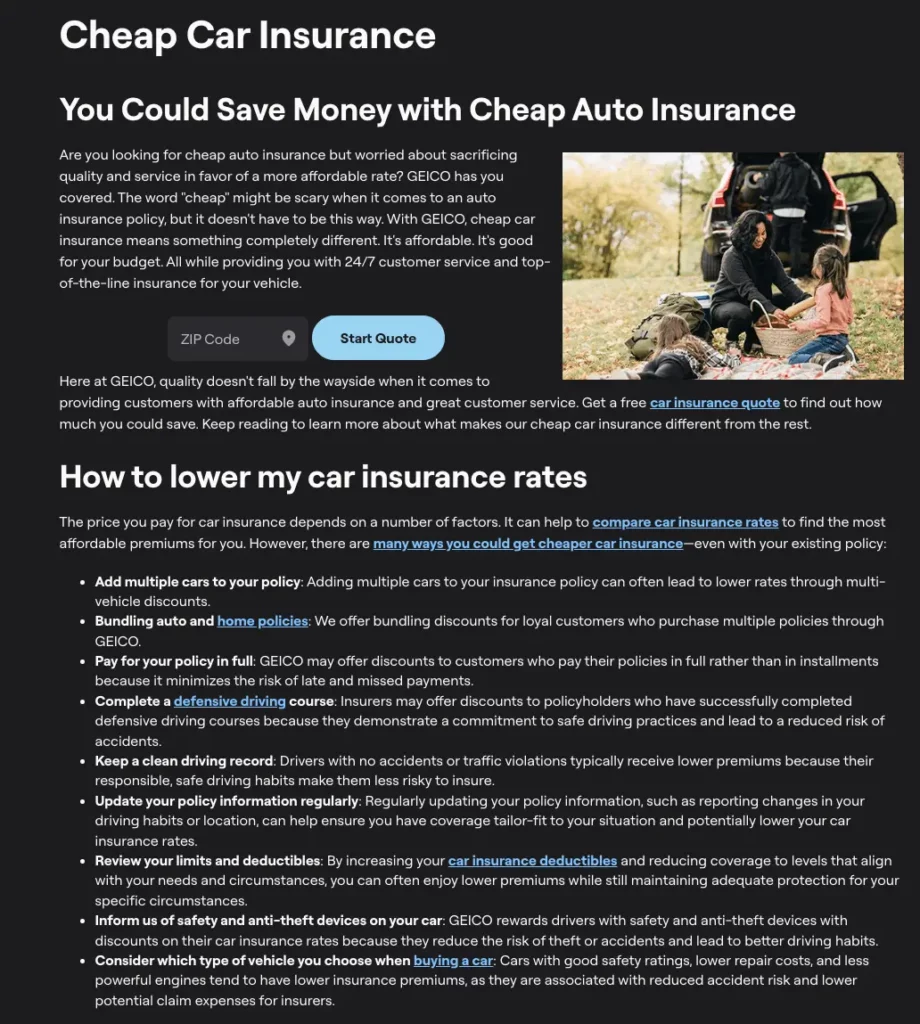
They also have a detailed FAQ section:
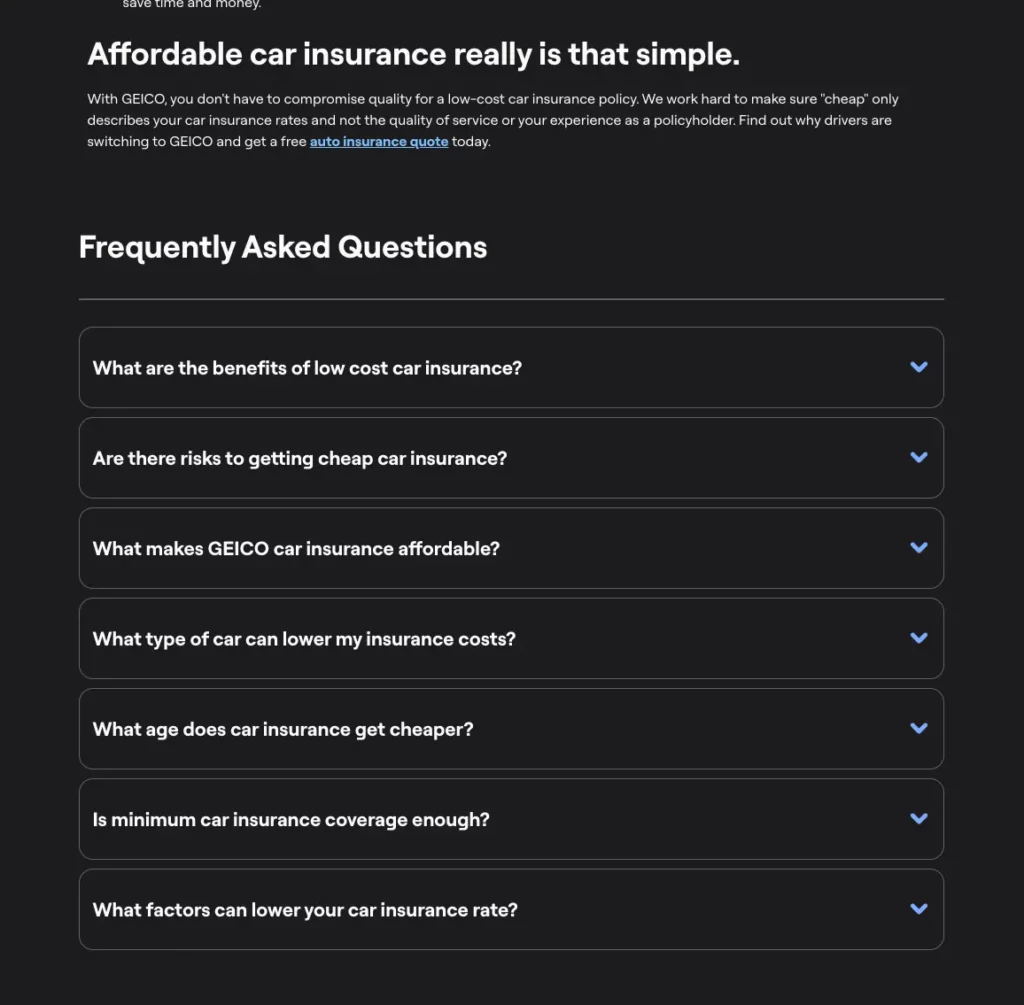
The page matches directly to the topic where GEICO overperformed: Affordable Car Insurance Options.
Allstate also has a cheap car insurance page, so this isn’t about Allstate ignoring the topic. But Allstate’s page is more mixed. It combines affordability with premium protection, 24/7 service, discounts, Drivewise, broader coverage language, and protection messaging.
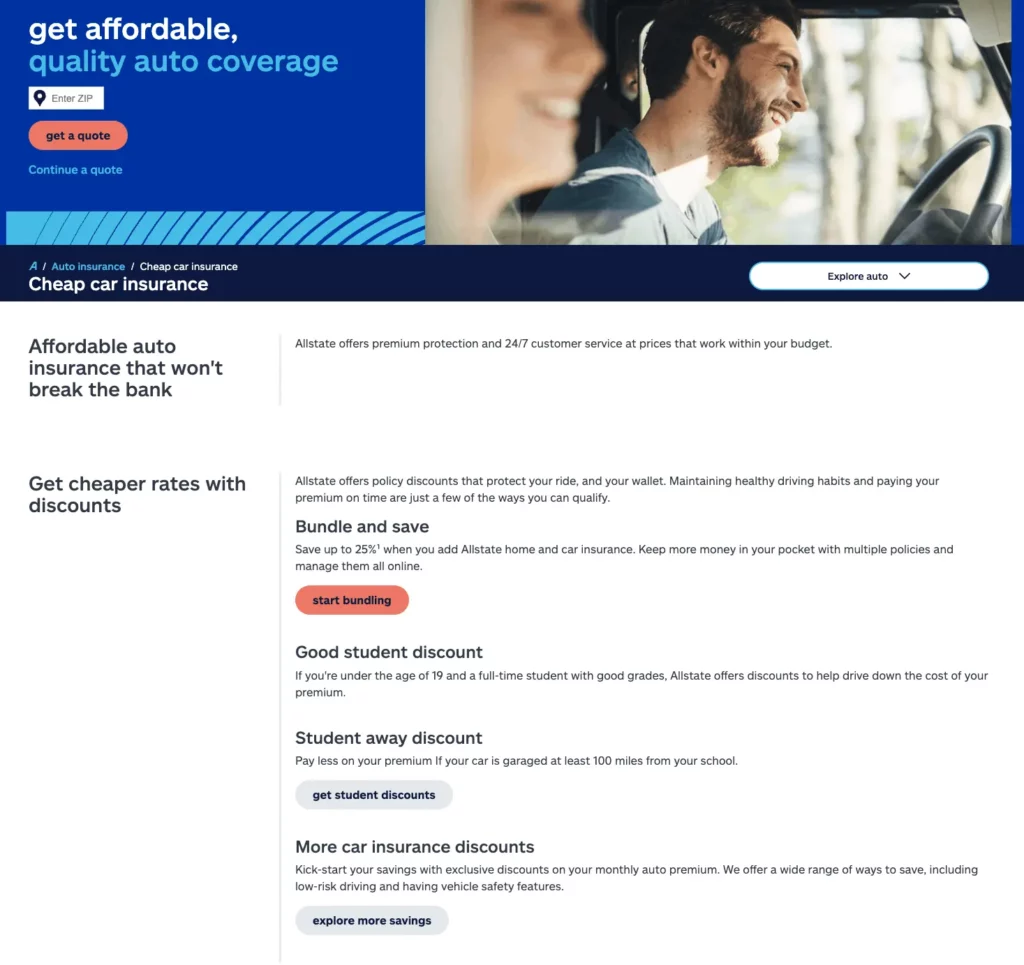
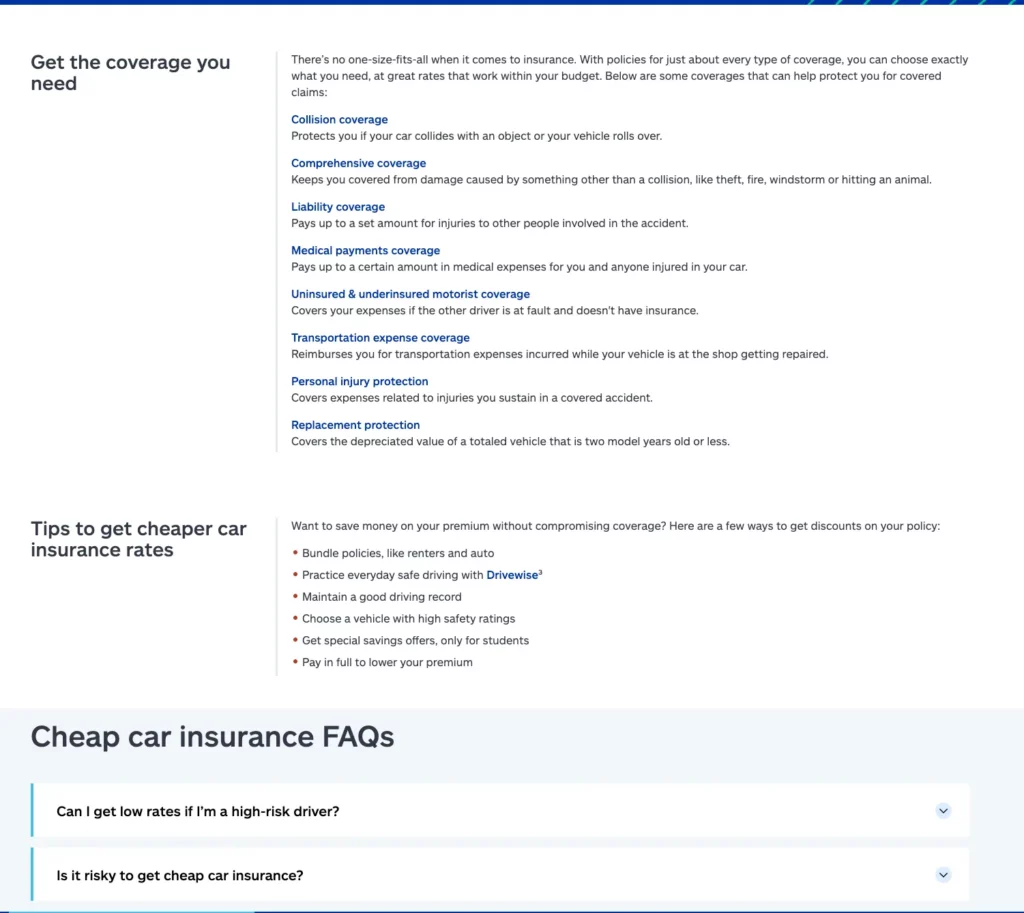
For AI search, GEICO’s page gives systems clearer answer fragments around affordability. Allstate’s page answers the same broad topic, but it dilutes the message across protection, coverage, discounts, and service.
That may be good for conversion, not as an answer source for cheap-car-insurance prompts.
2. GEICO has a tighter internal answer graph
The stronger owned-content difference is GEICO’s discount architecture.
GEICO has a dedicated discounts section covering car insurance discounts, multi-policy discounts, membership and employee discounts, military discounts, federal employee discounts, student discounts, drivers over 50, and defensive driving discounts.
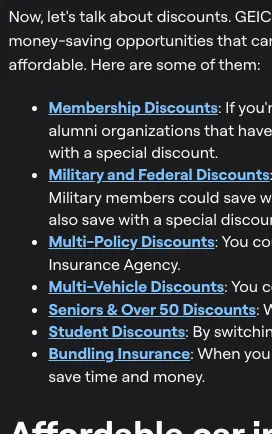
The page also says members of more than 800 groups may qualify for membership and employee discounts.
GEICO also has specific pages for military and federal employee discounts. Its military page includes a dedicated military quote flow, the 1-800-MILITARY phone line, military discount, emergency deployment discount, and eligibility language for veterans, active duty service members, National Guard, and reserves.
Its federal employee page connects GEICO’s company history to government employees and states that federal employees may qualify for cost-saving discounts based on grade or organization membership.
This creates a useful entity graph around savings.
| Entity / intent | GEICO content example |
|---|---|
| Cheap car insurance | Cheap Car Insurance / Affordable Auto Insurance page |
| Discounts | Car insurance discounts and premium reductions |
| Military drivers | Military car insurance and discounts |
| Federal employees | Federal employee insurance discounts |
| Students | Student discount content |
| Membership groups | Membership and employee discounts |
| Ways to save | GEICO “Ways to Save” hub |
These pages are specific answer targets – in addition to being clearer for users.
An AI system answering ‘what companies offer military car insurance discounts?’ or ‘which insurer has good student discounts?’ has multiple GEICO-specific pages and third-party confirmations to pull from.
Allstate has discount and Drivewise content too. Its Drivewise page is detailed and useful, explaining that drivers can get a personalized rate based on driving behavior and may save for safer driving.
But that builds a different association: safe driving and personalized pricing, not broad cheap-car-insurance savings. If there’s slight ambiguity in the language used, AI usually reasons with itself to exclude those results if other clearer results exist.
3. GEICO’s brand advantage is message consistency.
GEICO doesn’t appear to win because its brand is bigger. It benefits because its brand meaning is more tightly connected to the topic clusters where it overperformed: cheap car insurance, savings, discounts, and quotes.
Allstate isn’t a weak brand. Kiplinger’s 2026 ranking, based on Insurance Information Institute market-share data, lists Allstate as the fourth-largest personal auto insurer in the US, with 10.2% market share. Berkshire Hathaway/GEICO is listed slightly ahead, with 11.6% market share.
Both are major national insurers, so this isn’t a case of one obscure brand beating a household name.
Allstate also has strong advertising equity. MarketCast’s 2025 insurance mascot research found that Allstate’s Mayhem ranked first in ad likeability and most memorable ads. It also ranked above norm for ad breakthrough and message recall. So Allstate’s brand assets are not weak or invisible.
But the meaning of that brand asset is different.
Allstate’s campaign was created to push against a market dominated by price messaging. The point of the campaign was to remind people not to buy insurance only on price, but to make sure they are properly covered. The page frames Mayhem around risk, chaos, protection, coverage, and being ‘better protected.’
GEICO’s public positioning is much more price-led.
Investopedia’s analysis of GEICO’s marketing strategy says GEICO has focused strategically on consumer savings, competitive pricing, and advertising built around messages such as ‘Fifteen minutes could save you 15% or more’ and ‘Real service, real savings.’
It also notes that GEICO’s direct model relies heavily on advertising instead of traditional storefronts, and that this supports a lower-price positioning.
That gives the two brands different public meanings:
| Brand | Stronger public association | Why it matters for AI search |
|---|---|---|
| GEICO | Savings, lower prices, discounts, quick quotes, direct insurance | Matches affordable and savings-led car insurance prompts |
| Allstate | Protection, risk, Mayhem, coverage, Good Hands, Drivewise | Strong brand equity, but less directly aligned with cheap/affordable prompt clusters |
This helps explain the data pattern.
GEICO didn’t outperform because it was clearly the bigger or more reputable brand. Allstate has scale, visibility, and a memorable campaign. GEICO’s advantage is that its brand message is more directly aligned with the answer space where it showed up more often.
That answer space isn’t ‘best insurer overall.’ It is more specific:
- Affordable car insurance
- Auto insurance discounts
- Savings-led insurance shopping
- Quick quote intent
- Broad car insurance services
This is why the brand layer is important. AI systems are not only retrieving pages. They are also working with repeated associations across brand messaging, third-party sources, comparison pages, ads, app listings, and owned content.
In this case, GEICO’s repeated association is easier to use in affordable car insurance answers:
GEICO = savings-led car insurance.
Allstate’s association is strong, but broader:
Allstate = protection-led insurance.
Both are valid brand positions. But in this dataset, GEICO’s position lines up more closely with the topics where it overperformed. That’s the point to make.
4. GEICO’s name and history support long-tail savings entities
GEICO also has a name-level entity advantage.
GEICO stands for Government Employees Insurance Company. Its federal employee page directly connects the company’s founding to federal employees and says the company continues to support federal employees with cost-saving discounts.
That creates long-tail relevance around queries such as:
- Car insurance for federal employees
- Federal employee insurance discounts
- Government employee car insurance
- Military car insurance discounts
- Membership-based insurance discounts
Allstate doesn’t have the same name-level connection to a specific discount audience. Its strongest public assets are wider trust and protection assets: Good Hands, Mayhem, Drivewise, agents, and claims.
Again, that doesn’t mean Allstate has weak branding. It means GEICO has more specific retrievable entities around discount-led insurance.
5. Third-party sources reinforce GEICO’s position
This is where the evidence gets stronger.
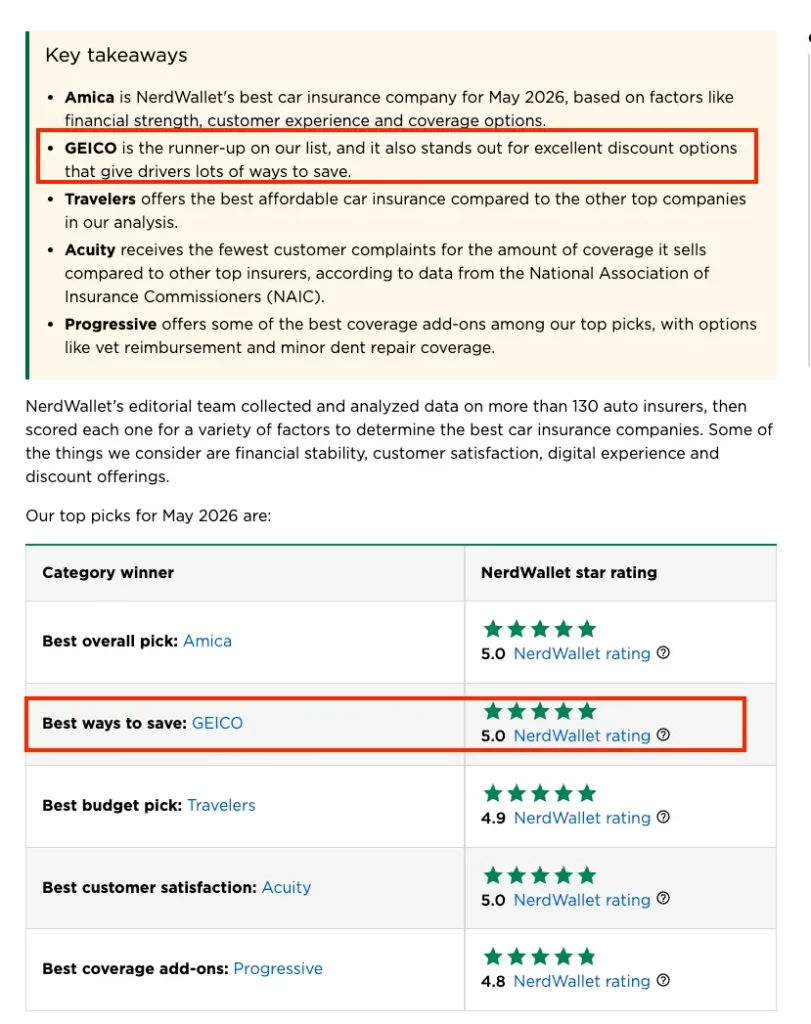
NerdWallet’s 2026 best car insurance analysis names GEICO as ‘Best ways to save.’ It says GEICO stands out for discount options and notes discounts for things like driving a new car, being a federal employee, serving in the military, and getting a quote online.
The Zebra’s direct GEICO vs Allstate comparison is even clearer. It chooses GEICO, lists GEICO at $79/month for full coverage versus $124/month for Allstate, and says GEICO comes out ahead on cheaper rates, customer service, digital experience, and trust scores.
AI answers are often informed by third-party sources, not just brand websites. In the data, major comparison and review publishers were prominent: NerdWallet, Bankrate, MarketWatch, Forbes, and The Zebra.
Across those source-domain snapshots, State Farm had the highest absolute source mentions. But when normalized against audience size, GEICO was the strongest.
| Brand | Review-source mentions | Mentions per 1M audience |
|---|---|---|
| GEICO | 42,007 | 170.3 |
| USAA | 37,758 | 117.0 |
| State Farm | 47,972 | 108.0 |
| Progressive | 43,304 | 97.6 |
| Allstate | 29,607 | 60.5 |
This supports the central finding: GEICO isn’t always the absolute leader, but it gets more AI-source value relative to its size.
The reason appears to be consistency across parties. GEICO says savings on its own site. Review publishers repeat the savings association. Comparison pages reinforce it. App listings support the digital/self-service angle. The brand name and history support federal employee and military discount entities.
That’s a stronger footprint than a single SEO page.
This links into AI favoring listicles and comparison pages as sources of information. An Evertune study found that half of the unique URLs cited in a dataset were listicles, and across nearly 400 million citations, 63% of citations pointed to listicles.
The study also found that listicles accounted for 40–65% of the most-cited URLs across every model, and that 71–86% of those listicles were ranked lists.
Pages like The Zebra’s GEICO vs Allstate comparison do the kind of work AI systems prefer: they compare brands directly, use structured sections, include pricing data, assign scores, and make a clear recommendation.
GEICO’s advantage is that third-party comparison content also frames GEICO around cheaper rates, discounts, and value, giving AI systems structured external evidence to reuse.
6. Progressive proves this is topic-specific
Progressive is important because it explains why GEICO isn’t ‘preferred’ by AI systems.
Progressive won several coverage-specific topics: liability, gap insurance, non-owner insurance, comprehensive coverage, and comparison.
That matches Progressive’s content footprint.
Its coverage hub breaks down many auto insurance coverage types and add-ons, including liability, uninsured and underinsured motorist coverage, medical payments, PIP, comprehensive, collision, loan/lease payoff, rental reimbursement, roadside assistance, trip interruption, custom parts, rideshare, pet injury coverage, and deductible savings.
Which makes the topic split logical.
| Topic type | Brand fit |
|---|---|
| Coverage types/add-ons / technical insurance products | GEICO |
| Protection/agents / Drivewise / broader safety messaging | Progressive |
| Overall dashboard visibility | State Farm |
| Protection / agents / Drivewise / broader safety messaging | Allstate |
That’s the most useful marketing lesson from the study. AI visibility follows the concepts a brand is most often associated with.
7. Allstate’s issue is diluted alignment.
Allstate isn’t absent. It has the largest audience in the set and strong brand assets.
But its public footprint is more spread out. Allstate has protection-led messaging, Drivewise, agent support, Good Hands, Mayhem, claims, coverage, bundling, and broader insurance protection.
That may be good brand strategy. But it is less tightly aligned with the affordable car insurance topic clusters where GEICO overperformed.
Allstate’s cheap car insurance page does target affordability, but it also emphasizes premium protection, service, coverage types, bundling, students, Drivewise, safe driving, and protection.
Allstate’s auto page also frames the product around flexible coverage, claims support, personalized protection, trusted digital tools, and keeping vehicles and drivers protected.
In comparison, GEICO’s owned and earned footprint repeatedly says the same things:
- Cheap
- Affordable
- Discounts
- Savings
- Quote
- Military
- Federal employee
- Student
- Low rates
- Direct digital insurance
That repeated association appears to be the difference.
What This Shows About AI Search Visibility
This case study shows why AI visibility cannot be judged from a single score.
State Farm had the highest overall AI Visibility score, but GEICO was stronger in prompt-level mentions, Google AI Overviews, and core auto-insurance topic mentions. Progressive also performed better than GEICO in several technical coverage topics. The visibility pattern changed depending on the topic, platform, and source type.
AI search doesn’t work like a standard ranking report. A brand can be visible overall but weaker in the topics that matter commercially. Another brand can have a smaller audience footprint but appear more often because it is more strongly associated with a specific buyer intent.
For marketers, there are five takeaways.
1. AI visibility is topic-specific
GEICO didn’t win every category. It won affordability and savings-led topics. Progressive won more technical coverage topics. State Farm led the overall dashboard.
That shows why a single AI Visibility score isn’t enough. Brands need to know where they are visible, not just whether they are visible.
2. The clearest brand association often wins
GEICO’s advantage wasn’t that it had the biggest footprint. It was that its footprint was more tightly connected to affordable car insurance, discounts, savings, and quotes.
That’s the pattern marketers should look for. AI systems need a clear association to retrieve and repeat. If a brand’s message is spread across too many themes, it may struggle to become the obvious answer for a specific prompt group.
3. Third-party sources inform the answer
AI answers are not built only from brand websites. Review sites, listicles, comparison pages, and publisher rankings can influence how a brand is described.
In this case, third-party sources repeatedly connected GEICO with savings and cheaper rates. That external confirmation gives AI systems more structured evidence to reuse.
4. Owned content still matters, but only when it supports the answer
GEICO’s owned pages work because they support the same answer across multiple entry points: cheap car insurance, discounts, military discounts, federal employee discounts, student discounts, and quote-led content.
This isn’t about publishing more content, but building a connected answer footprint around the topics where the brand wants to be shown.
5. Marketers need to audit the full answer footprint
The important question isn’t: Do we rank?
It’s: ‘What answer is the market teaching AI systems to associate with our brand?’
That means auditing owned pages, comparison sites, review publishers, listicles, brand messaging, topic coverage, and the sources AI systems cite.
GEICO’s performance suggests that AI visibility is less about being the biggest brand and more about being the clearest answer for a specific buyer need.
Conclusion
State Farm had the highest overall AI Visibility score, but GEICO was the more interesting case. It had the smallest audience footprint in the comparison set, yet led on prompt-level mentions, Google AI Overview mention rate, and core auto-insurance topic mentions.
The likely reason is consistency. GEICO’s owned content, discount structure, brand message, and third-party comparison coverage all reinforce the same answer: affordable car insurance, savings, discounts, and quotes.
For marketers, the takeaway is: AI visibility is topic-specific. The brands that appear most often are not always the largest. They are often the brands most clearly connected to the answer being generated.