
Search demand continues to rise globally, but AI Overviews, zero-click behavior, and ongoing core updates are causing a stir with SEO. Visibility now depends on showing up where users act and being cited in AI and social platforms that are driving new discovery.
Organic traffic still outperforms most channels for revenue impact, but the margin for error has reduced. Thin content is filtered out, authority gaps are exposed, and technical or mobile weaknesses cut performance further. AI-driven features continue to draw attention from standard listings, creating both risk and new opportunities.
The SEO statistics here outline the real state of SEO. They show how dominant Google remains, how traffic patterns shift under AI, why most content gains no visibility, and what factors consistently drive results. They also track how budgets, tools, and AI adoption are changing the industry.
This page is built for CMOs, growth leaders, marketers, and SEOs who need reliable SEO stats to guide budget, strategy, and execution.
State of SEO: What’s Working, What’s Changing
Google still controls over 90% of search, but traffic flows are changing. AI Overviews and zero-click results move attention away from sites and are disrupting clicks, which forces teams to plan new methods of visibility.
The quality bar is higher than ever. Core and spam updates cut thin or unoriginal (fully AI) content, rewarding pages that show expertise. E-E-A-T has evolved significantly over recent years. Social platforms are also becoming increasingly important in strategies to drive traffic and build authority, especially Reddit.
Local intent drives nearly half of all queries, and SERP features like snippets, map packs, and shopping units now decide where clicks happen. CTR patterns are messy, with more value locked into fewer positions.
Links still matter, but authority is earned differently. Content that is useful, in-depth, and clear attracts backlinks and engagement, which leads to stronger rankings. But being first to trends and new topics is more important now than ever.
Budgets confirm the importance of SEO. Companies continue to fund SEO even in volatile conditions, with teams adopting AI-driven workflows to speed research, execution, and monitoring while keeping strategy intact.
Top 10 SEO Stats
| Statistic | Insight |
|---|---|
| Google holds 90%+ of global search market share. | Google remains the primary method of user search. |
| The #1 organic result captures 39.8% of clicks. | Rankings at the very top drive the bulk of traffic. |
| 96.55% of pages get no Google traffic. | Most content never earns visibility without authority. |
| Organic search delivers 44.6% of revenue across industries. | SEO isn’t just about traffic, it’s tied directly to revenue. |
| The top 3 results capture 68.7% of clicks. | Marginal rank improvements turn into big gains. |
| 46% of Google searches are local. | Local intent dominates purchase-driven behavior. |
| Google organic drives 57.8% of global web traffic. | Search remains the top acquisition engine worldwide. |
| Long-form content (3,000+ words) earns 3× more traffic & 3.5× more backlinks. | Depth consistently outperforms shorter pieces. |
| March 2024 core update cut low-quality content by 45%. | Google removes thin, unoriginal pages. |
| Mobile devices generate 60% of all website traffic. | Ensure mobile experience is clean and frictionless for users. |
Search Engine Usage & Market Share
Google still dominates discovery. Its share of global search remains high, even as AI assistants and niche engines expand. Market share has dipped slightly in some periods, but the reality for marketers is the same: if you don’t compete on Google, you’re leaving most of the market untouched.
What has changed is how users interact with results. AI-generated answers and richer SERP features reduce clicks before they reach a site. When an AI summary appears, CTR’s drops. Zero-click behavior is increasing across regions. Visibility now means more than rankings. Brands must secure responses in AI overviews and answer engines, in addition to an omnichannel approach across social platforms.
Search is also blending with AI across Search, Chrome, Shopping, and YouTube. Consumer use of conversational, AI-assisted discovery continues to grow, and Google is embedding those features deeper into its ecosystem.
Marketers must structure content for extraction, build entity-level authority, and optimize for AI engines. Google’s market share defines the scale of opportunity. The job is to secure the positions where users act.
- Google holds 91.54% of the global search engine market share. (source)
- Google organic search drives 57.8% of the world’s web traffic. (source)
- Google handled 81,000 searches per second in 2020, up from 63,000 in 2016. (source)
- That’s 4.9 million searches per minute in 2020, up from 3.8 million in 2016. (source)
- Or 292 million per hour in 2020, up from 228 million in 2016. (source)
- Totalled up, that’s 7 billion searches per day in 2020, up from 5.5 billion in 2016. (source)
- This equals 212 billion per month in 2020, up from 167 billion in 2016. (source)
- And 2.55 trillion searches per year in 2020, up from 2.00 trillion in 2016. (source)
Over 90% of the search market belongs to Google.
- On average, an internet user makes 4 Google searches per day. (source)
- Daily Google searches are estimated at roughly 1.7 billion. (source)
- In the U.S., only 15% of users search more than once per day. (source)
- Google’s index contained 58 billion unique pages in 2020, up 38.1% in five years. (source)
- Back in 2013, Google reported 30 billion pages indexed and crawled 100 billion pages per month. (source)
- Global desktop market share: Google 82.74%, Bing 9.55%, Yahoo 2.95%, Yandex 2.34%, DuckDuckGo 0.67%, Baidu 0.63%. (source)
- Right now, there are 99,000+ Google searches every second. (source)
- 68% of online experiences begin with a search engine.
- In terms of market share, Google owns 89.74% globally.
- Bing sits at 3.97% and Yandex at 2.56% of the market.
- On mobile, Google commands 93.88% market share.
Daily Google searches are estimated at roughly 1.7 billion.
- Google processes 8.5+ billion searches per day. (source)
- The typical internet user performs 3–4 searches per day across search engines. (source)
- Organic search is the #2 traffic channel at 29% share.
- 93% of online experiences start with a search engine. (source)
- 59% of web users will use a search engine every day. (source)
- 53% of U.S. consumers research purchases via a search engine. (source)
- 63% of shopping journeys start online. (source)
- 83% of searches use Google as a preferred method compared to other engines. (source)
- 91% of online adults use search engines to find information. (source)
- Over 90% of the search market belongs to Google. (source)
- 44% of users stick to a single search engine. (source)
- Over 1 billion people use Google each month. (source)
- Google processes over 70,000 searches annually. (source)
Ranking Factors & Algorithm Updates
Algorithm updates run continuously. Google raises the quality bar through constant iteration, with more weight on originality, first-hand insights, and technical strength. Content that looks manufactured, recycled, or produced only by AI without human perspective is downgraded or ignored in both rankings and AI summaries.
E-E-A-T has adjusted slightly. Authority still matters, but ‘Experience’ now carries greater weight. Content backed by real experiences, reputable authors, case studies, and demonstrated outcomes is preferred. Thin articles, generic AI text, or superficial overviews with no evidence of expertise are filtered out more aggressively than before.
Technical signals still carry importance. Ranking requires speed, clear architecture, structured data, and a good user experience. Mobile performance and logical site design are now minimum standards. With AI Overviews and zero-click searches rising, pages that load slowly, can’t be parsed, or lack credibility are removed from visibility.
- Google relies on 200+ signals in its ranking algorithm. (source)
- High-quality content, page experience, and links rank as Google’s top three factors.
- Google rolled out 4 core updates in 2024.
- The March 2024 update cut unoriginal, low-quality content by 45%. (source)
- In 2022, Google reported 4,000+ improvements to Search. (source)
- Google released seven updates in total in 2024.
62% of B2B marketers claim that SEO algorithms are important.
- Of the 2024 updates, four were core and three were spam updates.
- 40% of marketers say algorithm changes are their biggest SEO challenge. (source)
- 62% of B2B marketers claim that SEO algorithms are important. (source)
- 44% of survey respondents believe algorithm changes and generative AI will positively impact search. (source)
Keywords & Search Intent
With AI tools changing behavior, queries that reveal clear intent, informational, navigational, commercial, or transactional, drive how results are ranked and displayed. Matching intent is still essential for visibility, engagement, and traffic.
Intent itself is more complex than before. Queries are layered, with users combining goals such as research plus purchase or local plus informational. Content must account for these overlaps. Segmenting only by keyword length or category means you fall behind. Strategy requires mapping content to intent stages and delivering structured answers, not just keyword matches.
AI platforms are also reshaping how intent is expressed and rewarded. AI Overviews, answer engines, and conversational search prioritize concise, clear, and extractable content. Keyword-rich pages without structure are ignored. A long-tail query or precise phrase now has greater value than a generic, high-volume keyword.
- 49% of U.S. consumers use Google when they start online shopping. (source)
- In the U.S., 88.2% of queries contain 3 words or fewer. (source)
- Over 29% of keywords (10K+ monthly searches) are three or more words long. (source)
- About 8% of all searches are questions. (source)
- 70% of users type queries with more than three words. (source)
- Users average 3–4 searches per day. (source)
- B2B shoppers conduct about 12 searches before interacting with a website. (source)
50% of searches contain more than four words.
- 71% of B2B buyers start their research on a search engine. (source)
- Before contacting a company, 47% of users engage with 3–5 pieces of content. (source)
- 50% of searches contain more than four words. (source)
- 15% of Google queries have never been searched before.
- Titles that use question keywords have a CTR of 15.5% CTR.
- Non-question keyword titles have a 16.3% CTR.
70% of users type queries with more than three words.
- A URL with a related keyword results in a 45% higher CTR.
- 39% of marketers say keyword research is the hardest SEO task. (source)
- Businesses with strong keyword targeting rank about 1.5 positions higher than competitors. (source)
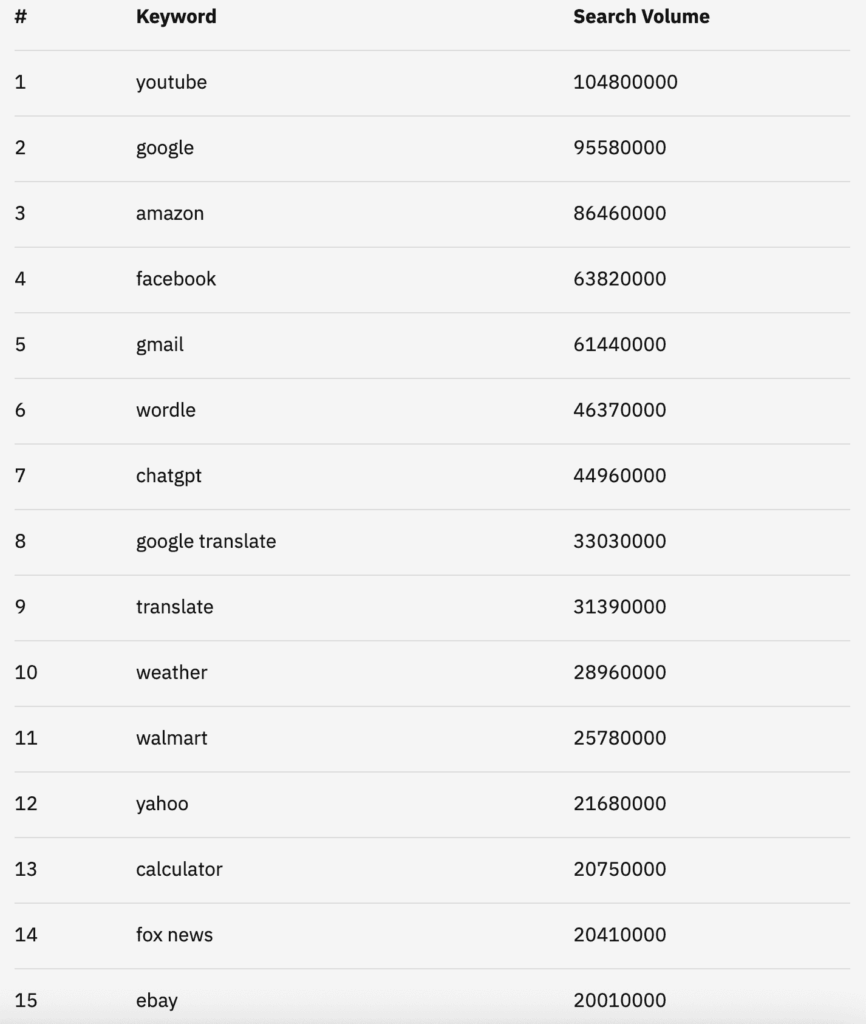
- YouTube was the most searched keyword in 2024 with 173,700,000 searches.
- YouTube was still the most searched keyword in 2025 with 104,800,000 searches.
- Google was the second most searched keyword with 95,580,000 searches.
- Amazon was the third most searched keyword with 86,460,000 searches.
- Facebook was the fourth most searched keyword with 63,820,000 searches.
Content Performance & SERP Features
Organic visibility depends on how content appears in results, not only where it ranks. Rich features such as snippets, AI Overviews, image and video blocks, maps, shopping carousels, and answer boxes decide who gets attention and clicks. A high rank alone doesn’t guarantee traffic unless content is optimized for instant-answer features.
Zero-click searches are hitting all-time highs, especially for non-branded informational queries. AI Overviews and direct answers satisfy intent inside the SERP. Users often stop there, reducing click-through but increasing impressions. Brands that become sources inside these modules get more visibility.
CTR from standard organic links is declining on queries that trigger AI Overviews. Content must be built for answer engines: fast-loading, clearly formatted, and aligned with the GEO and AEO practices. Engagement signals such as dwell time, bounce, and scroll depth, along with placement in rich features, are still important.
- The #1 Google result captures 27.6% of all clicks. (source)
- 49% of marketers say organic search delivers the best ROI of any channel. (source)
- Page-one organic results average 1,447 words per page. (source)
- The first five organic results take 69.1% of all clicks. (source)
- 12.3% of search queries show a featured snippet. (source)
- Before clicking a result, 18% of searchers refine and enter a new query. (source)
- 75% of searchers never look past page one. (source)
The top organic link averages a 39.8% CTR, while the first ad gets 2.1%.
- 21% of people click more than one result on a SERP. (source)
- The top organic link averages a 39.8% CTR, while the first ad gets 2.1%. (source)
- Organic search drives 44.6% of revenue across major industries. (source)
- Results in positions 1–3 generate a combined 36% CTR. (source)
- 99.58% of featured snippets already rank in the top 10 results. (source)
- Strong brand affinity can boost CTR by 2–3x. (source)
- Visitors from search view 3–3.5 pages per session. (source)
- For domains in the top 3, the average bounce rate is 49%. (source)
- The average time on page for a top-10 result is 3:10. (source)
- Organic search sends 300% more traffic than social media. (source)
- 96.55% of pages get no Google traffic at all. (source)
- Search engines (Google, YouTube, Bing, Yahoo) drive 70.6% of all website traffic. (source)
- In Google results (source):
– 87.6% contain little/no AI content
– 12.4% contain high AI
– 3.0% are pure AI-generated.
Featured snippets post the highest CTR at 42.9%.
- Categories with the most AI-generated content (source):
– commerce 7.98%
– Local 4.96%
– Productivity 3.93%
– Crypto 3.26%. - Lowest AI presence (source):
– Food 0.94%
– Travel 1.70%
– News 1.79%. - Google AI Overviews (AIO) appear for only 8.71% of keywords. (source)
- An AIO contains 4,342 characters on average. (source)
- 52% of sources cited in AIOs already rank in the top 10.
- Across clicks, organic results account for 94% overall.
- Featured snippets post the highest CTR at 42.9%.
- The top organic result attracts 19× more clicks than the top paid result.
- When the #1 organic is also a featured snippet, its CTR rises to 42.9%.
- Jumping from position #2 to #1 gets roughly 74.5% more clicks.
- Moving up one position increases CTR by 32.3% on average.
- Rich results get 58% of clicks; non-rich get 41%.
- The #1 organic result is 10× more likely to get a click than position #10.
Only 0.78% of users click on page two.
- Only 0.78% of users click on page two.
- Google’s top three organic spots capture 68.7% of clicks.
- 25.02% of top-ranking pages do not have meta descriptions.
- Transactional keywords in thought-leadership blogs deliver 748% ROI.
- When there’s no featured snippet, 26% of clicks go to the first result. (source)
- 19% of featured snippets appear for question queries. (source)
- After a snippet, 19% of clicks go to the first result. (source)
- 17% of snippets are triggered by prepositions. (source)
- 12% of searches generate featured snippets. (source)
- 52% of users feel search results have become more relevant and useful. (source)
- On desktop, the #1 organic position averages a 34% CTR. (source)
- Improving rank by one spot boosts CTR by 30% on average. (source)
- From search, users visit an average of 3 pages per session. (source)
- 22% of pages published in the last year now rank on page one.
- The average page-one article runs 1,890 words.
- Content over 3,000 words earns 3× more traffic than 1.4k-word pieces.
- Long-form (3,000+ words) gets 4× more shares and 3.5× more backlinks.
Backlinks & Authority
Backlinks are still a core ranking signal. Relevance, authority, and credibility of linking domains carry more value than volume. Search engines are better at detecting spam, manipulative schemes, and irrelevant sources. What counts is whether a link is editorially placed, contextually aligned, comes from a site with real content and audience, and supports a brand’s expertise.
Link building has also become closely tied to brand visibility and digital PR. Mass outreach and generic guest posting deliver little value. The campaigns that work are those built on expert commentary, original research, news hooks, influencer partnerships, and content strong enough to be cited. These links support rankings, but they also build trust and increase the odds of being referenced inside AI-driven results.
Budgets reflect the long-term nature of link building. A strong profile takes months to deliver impact, with many teams reporting measurable results after three to six months. Costs for editorial placements continue to rise. Targeting fewer, highly relevant, and harder-to-earn links now delivers more value than chasing large volumes of lower-quality placements.
- Over 66% of pages don’t have any backlinks pointing at them. (source)
- The #1 ranking page picks up an extra 5% to 14.5% dofollow links each month. (source)
- Roughly 43.7% of top-ranking pages participate in reciprocal linking. (source)
- Companies that blog earn 97% more backlinks than those that don’t. (source)
- SEO practitioners still cite high-quality content as the #1 way to win backlinks. (source)
- In general, pages with more backlinks attract more organic traffic from Google. (source)
An estimated 95% of pages have zero backlinks at all.
- An estimated 95% of pages have zero backlinks at all.
- Among the top 100 ranking domains, 92.3% have at least one backlink.
- The top ranking result has about 3.8× more backlinks than those in positions 2–10.
- About 41% of SEOs say link building is the toughest part of the job. (source)
- Long-form content (3,000+ words) earns 77.2% more backlinks than short-form pieces (under 1,000 words). (source)
- Roughly 26% of pages have fewer than three backlinks. (source)
- The average cost quoted for a backlink is $361. (source)
Technical & Mobile SEO
More than 70% of websites are indexed mobile-first, and Google evaluates the mobile version before anything else. If a mobile site is slow, broken, missing structured data, or lacks content quality with desktop, SEO performance declines.
Technical quality on phones is a requirement. Pages that load slowly, move during use, or rely on heavy resources face penalties in both user experience and rankings. Core Web Vitals remain central to Google’s performance assessment. Non-optimized images, heavy scripts, and complex DOMs impact mobile experience, driving higher bounce rates and weaker engagement signals.
Well-optimized mobile sites are more likely to appear on page one, earn placement in mobile SERP features, and retain users long enough to convert. Regular monitoring, speed audits, and responsive design are minimum standards. Marketers who are behind on mobile optimization risk losing rankings, traffic, and conversions.
- 60% of pages ranking in Google’s top 10 are 3+ years old. (source)
- 83.58% of all Google visitors arrive via mobile. (source)
- 60% of users say they discovered a new company or product via smartphone search. (source)
- 54% of the world’s web traffic comes from mobile devices. (source)
- On mobile, the #1 organic result gets 6.74% of clicks vs 8.17% on desktop. (source)
- 87% of smartphone owners use a search engine daily. (source)
- Voice search now makes up 20% of mobile queries. (source)
- Organic CTR on mobile is roughly 50% lower than on desktop. (source)
- Mobile accounts for 53.59% of global searches and tablets 1.82%. That’s 55.41% for mobile devices overall. (source)
- 61% say that they are more likely to buy from a mobile-friendly site. (source)
- 58% of Google searches are made using smartphones. (source)
40% of users bounce if a site takes over 3 seconds to load.
- 51% find new products or companies through mobile search. (source)
- Roughly 30% of all mobile searches are location-related. (source)
- Mobile devices generate 60% of all website traffic.
- 56% of shoppers use their phone in-store to shop or research.
- 40% of people search only on smartphones daily. (source)
- In 2024, users spent 4h 39m/day on their phones (excluding calls).
- 72.6% of internet users only use smartphones to access the web.
- 92.3% of users access the internet using a mobile phone.
- 40% of users bounce if a site takes over 3 seconds to load. (source)
- Nearly 70% of local search queries originate on mobile.
- 50–60 characters is the optimal URL length. (source)
Local SEO
Local intent is one of the strongest in search. About 46% of Google queries now include a local reason. Almost half of users are searching for businesses, services, or information nearby. If listings, maps, business profiles, or location-specific content are not optimized, demand is lost.
Local searches also convert quickly. Consumers who search ‘near me’ or check local businesses on their phones visit, call, or purchase within a day. Local SEO is drives immediate results. Optimizing Google Business Profile, maintaining accurate NAP, managing reviews, and earning placement in map packs are essential.
Consumer trust, mobile behavior, and Google’s features are what authority means locally. Reviews, profile completeness, proximity, and relevance are core signals. Businesses that invest in reputation management, keep profiles current, publish local content, and deliver a good mobile experience have the advantage. The gap between well-optimized local businesses and poorly optimized ones is larger than in previous years.
- 46% of all Google searches are for a local business or service. (source)
- 25% of small-business websites are missing an H1 tag. (source)
- After a ‘near me’ search on a smartphone, 76% of people visit a business within 1 day. (source)
- 28% of local searches end in a purchase. (source)
- There are 97 billion local searches each month. (source)
- Across a year, monthly local searches add up to 1.17 trillion. (source)
- Yelp appears in the top 5 results for 92% of queries that include a city + business category. (source)
- Users conduct 3.2 billion local searches per day. (source)
- That’s 37,000 local searches every second. (source)
- 88% of local business searches on mobile result in a call or visit within 24 hours. (source)
- 78% of people buy locally after searching. (source)
42% of local searchers click a result in the Google Map Pack.
- 99% of consumers read reviews when shopping online.
- 56% of individuals shop both online and locally offline. (source)
- 18% of local mobile searches lead to a purchase within one day. (source)
- 86% of people look up a business location on Google Maps. (source)
- 42% of local searchers click a result in the Google Map Pack.
- 46% trust online reviews as much as personal recommendations.
- 43% of small-business owners planned to invest in website performance in 2025.
- 32.8% of internet users go on to visit a local business. (source)
- 97% of consumers learn about a local business online the most. (source)
- Local search on Google drives 1.5 billion location visits each month. (source)
- When a business includes product images, 72% of local searchers visit within a five-mile radius. (source)
- 56% of local retailers still haven’t claimed their Google Business Profile. (source)
Voice & Video Search
About 20.5% of people globally use voice search, and there are 8.4 billion voice assistants in use. In the U.S., more than 150 million adults use voice assistants. Spoken queries are conversational, questions, and often local or action-driven. Visibility for voice is not the same as ranking for typed searches. Strategies must account for how assistants access natural language and deliver direct answers.
Audiences expect video inside search engines as much as on social platforms. YouTube continues to anchor video discovery, while video snippets, carousels, thumbnails, and embedded answers are now standard SERP features. Video must be optimized: relevant titles, accurate descriptions, clean captions, strong thumbnails, and quality production. Reports consistently show video’s rising impact on traffic, engagement, and conversions.
Voice and video together require a different approach to structure. Content that is concise, conversational, and easy to extract is prioritized. FAQ-style pages, Q&A formats, and clear phrasing improve voice optimization. Video optimized with clear structure, strong visual cues, and schema markup improves search performance.
- 40.7% of Google Home voice answers come from featured snippets (based on 10,000 results). (source)
- The average reading level for a voice result is 9th grade. (source)
- A typical voice answer is just 29 words long. (source)
- Voice results usually load in 4.6 seconds. (source)
- Voice results also load 52% faster than the average page. (source)
- Voice search accounts for 20% of all Google searches mobile. (source)
- 70.4% of voice search result pages are served over HTTPS. (source)
- The average page behind a voice answer is 2,312 words.
- Roughly 75% of voice answers originate from the top 3 desktop results for that query. (source)
- 36.4% of voice results use Schema, vs a 31.3% global average. (source)
27% of the world’s population uses voice search on mobile.
- On mobile, voice queries are 3× more likely to be local compared to typed searches. (source)
- 35% of U.S. citizens owned a smart speaker in 2022, up from 21% in 2019. (source)
- The average Google voice result attracts 1,199 Facebook shares and 44 Tweets. (source)
- 27% of the world’s population uses voice search on mobile. (source)
- Of 4.3B smartphone users, 1.16B+ use voice tech weekly. (source)
- Around 100M people in the U.S. own a smart speaker. (source)
- Among device owners (source):
– Amazon Echo 65%
– Google Home 26%
– Apple HomePod 19%
– Google Nest 16%
– Bose 16%
– JBL Link 12%. - There are 8.4B voice assistants in use today.
- 1B+ voice searches occur every month.
- 71% of internet users prefer voice to typing for queries.
- Mobile users are 3× more likely to use voice. (source)
- 50% of mobile users do a daily voice search. (source)
- The global voice recognition market was $12B in 2022 and is set to hit ~$50B by 2029. (source)
- 55% of American households were projected to have at least one smart speaker by 2023. (source)
51% of people say they’re more likely to share content that includes video.
- An analysis of 1.3M YouTube videos found strong correlations between comments, views, shares, likes and higher rankings. (source)
- 68.2% of first-page YouTube results are HD. (source)
- Pages with video earn more backlinks and see a 157% boost in search traffic. (source)
- 87% of marketers say video helped increase sales; 53% say it reduced support queries. (source)
- Videos generally rank higher when they convert viewers into subscribers.
- No correlation was found between keyword-optimized descriptions and higher YouTube rankings.
- 51% of people say they’re more likely to share content that includes video. (source)
- In 2023, there were 3.86B videos on YouTube, uploaded by 61.4M creators. (source)
- YouTube sees 500+ hours/minute uploaded, 720,000 hours/day. (source)
- On Facebook, daily video views exceed 8B, with 100M hours watched per day. (source)
Google shows video thumbnails in 26% of search results.
- 85% of Facebook videos are watched with sound off. (source)
- 1 in 5 Facebook videos are live. (source)
- 98% of Facebook video views are on mobile. (source)
- Video pages see a 41% higher CTR than text-only pages.
- Google shows video thumbnails in 26% of search results.
- Video content is 50× more likely to rank top on page one.
- With 5.8 million global searches, ‘ASMR’ was YouTube’s most searched term in 2024.
- 89% of businesses used video in their 2024 marketing
- 68% planned to include it in 2025.
SEO Industry, Tools & AI (Usage/Trends)
SEO is a technology investment as much as a marketing channel. Tool adoption is expanding and AI is built into daily workflows. From content generation to technical audits and competitive analysis, teams are scaling output and improving precision through AI tools. The market has responded with a surge of SEO-AI tools, which continue to grow in both capability and adoption.
Two out of three SEO specialists now report performance gains after using generative AI. Teams using AI effectively see improvements in organic traffic, conversion rates, and content production speed. Large organizations are leading adoption, applying AI beyond content to technical SEO, schema, structural fixes, competitive gap analysis, and optimization for voice and video.
Expectations are higher as a result. Tools and AI are now standard, so the differentiator is quality of execution. Teams are judged on how well they prompt, review, refine, and apply AI output, not on the size of their tool stack. Marketers face stronger pressure to show pipeline and revenue impact alongside rankings and traffic.
Efficiency, accountability, integration across tools, and adaptability are a competitive advantage.
- The median salary for an SEO specialist comes in around $69.8k per year. (source)
- In the U.S., the average SEO salary is about $70.3K annually.
- 63% report Google AI Overviews (AIO) have boosted organic traffic, visibility, or rankings since May 2024.
- Typical hourly rates for SEO services fall between $100–150.
- Common monthly retainers land in the $500–1,000 range.
- Brand awareness via SEO was a shared priority across roles in 2024.
- 48.9% of SEO pros anticipated budget increases in 2024.
- By the end of 2025 global SEO services market was projected to hit $146.96 billion.
- Search interest for ‘ChatGPT’ peaked at 100 (index) in June 2024. (source)
- 54% of ChatGPT queries are run with SearchGPT off. (source)
- 65% say AI tools help improve SEO results. (source)
65% of small business owners have worked with an SEO provider.
- 67% of businesses see higher content quality when working with AI. (source)
- 50% of SEO pros believe social media search will improve search. (source)
- 48% of SEO marketers expect AI Overviews to enhance future search traffic. (source)
- Firms spending $500/month on SEO are 75% more likely to be unhappy than those spending more. (source)
- 65% of small business owners have worked with an SEO provider. (source)
- Among SMBs using SEO, 60% also run PPC. (source)
- 74% of small businesses plan to invest in SEO. (source)
- 38% of marketers cite budget as their biggest SEO challenge.
- Only 30% would recommend their SEO provider to a friend or co-worker. (source)
- 2% of U.S. SMBs spend $25,000+ annually on SEO services. (source)
- 14% of U.S. SMBs spend $5,000 annually on SEO. (source)
- $79B is the estimated overall spend on SEO services. (source)
- For U.S. SMBs, the average monthly SEO cost is about $497. (source)
- 40% of revenue is driven by organic traffic. (source)
AI & SEO
Google’s AI Overviews (AIOs) are a core part of search now. In the U.S., 13.14% of desktop queries triggered an AI Overview in March, up from 6.49% in January. Global rates are higher, and growth continues. More searches begin with AI-generated summaries, changing where users look first and whether they click at all.
AI Overviews correlate with declines in click-through, especially for non-branded and informational queries. Pages in the #1 organic spot see CTR drops of around 34.5% when AIOs are present. Other data shows CTR declines of 15–20% across broader keyword sets. Brands relying only on rank are seeing a decline in traffic unless they adjust to the way AIOs work.
Google reports more than 2 billion people use AI Overviews monthly. This reach brings both risk and opportunity. Content that is cited inside summaries retains visibility. Content that is generic, poorly structured, or lacking authority is excluded.
- AI Overviews (AIO) now appear on 13.39% of queries in the U.S., accounting for 7.6% of searches. (source)
- 15% of U.S. adults say they’ve seen AIOs; awareness is 33% overall and 32% among ages 18–29 (vs 5% for 65+). (source)
- Following Google’s March 2025 core update, the overlap between AIO citations and top-10 organic results dipped from 16% to 15%, with industry shifts (e.g., +6.6 pp in Travel)(source).
- Over 90% of AI search referrals come from desktop (source).
- Google search impressions are showing up 49% YoY but CTR down 30% after AIO’s expansion. (source)
- An analysis of 8,000+ AI citations across engines reveals how intent (B2B vs. B2C) supports which sources get cited. (source)
- 52% of AIO sources come from pages already in Google’s top 10. (source)
CTRs dropped 70% for some publishers when AIO appeared.
- 82% of AIO citations point to non-homepages; just 0.5% of citations are homepages. (source)
- CTRs dropped 70% for some publishers when AIO appeared. (source)
- Certain sites saw up to 79% traffic drops on queries where AIO shows. (source)
- AIOs often cite social/user-generated sources; Reddit emerged as a top destination post-AIO launch. (source)
- Marketers broadly expect AI search to impact discovery and are adapting content operations. (source)
- Zero-click searches are rising, aligning with AIO’s answer-in-SERP behavior and reduced outbound clicks. (source)
GEO & AEO
Generative and answer engine optimization have moved into SEO strategy. As users adopt AI search on platforms like Perplexity, ChatGPT, and Gemini, visibility depends on being cited in AI responses. Brands optimizing for GEO and AEO with clear structure, entity signals, and authoritative sources are reporting gains in visibility and intent-driven traffic.
Lead attribution data supports this. Companies report that leads originating from AI recommendations convert at higher rates than those from traditional search. While traffic loss is a concern when AI summaries or answer engines appear above content, brands included inside these responses are getting visibility and avoiding the largest declines.
GEO and AEO must be integrated into content strategy, production, and technical SEO. Structured formats such as FAQs and clear answers, trusted sourcing, entity alignment, and schema are suggested optimization techniques. Monitoring AI citations, testing how content shows in generative engines, and adapting now separates brands that maintain visibility from those that disappear.
- Content tweaks can boost visibility by up to 40% in generative engines, including tests on Perplexity. (source)
- Large-scale tracking shows AIO availability fluctuates by intent; informational queries trigger AIO far more often than transactional ones. (source)
- Across multiple studies, AIOs cite top-ranking pages disproportionately; 52% of citations coming from top-10 results. (source)
- 82% of AIO citations come from deeper pages, with 0.5% pointing to homepages. (source)
- Traffic drops as much as 79% when AIO appears. (source)
- AIO appearance rates in the U.S. hover under 15% overall right now. (source)
- AIO can suppress CTR by up to 70% on some SERPs.
What These SEO Stats Tell Us
Headlines often claim SEO is dead and that AI has killed organic traffic. AI Overviews are rising fast, where 13.14% of U.S. queries triggered them in March 2025, up from about 6.5% earlier in the year. When they appear, the #1 organic result loses about 34–35% of its CTR in most studies. That impact is there, but it does not mean SEO is gone. It now means taking an omnichannel approach and treating other platforms and search and discovery.
Organic search continues to drive traffic, conversions, and ROI across industries. Demand remains strong and is still growing. At the same time, generic or poorly structured content is demoted. Authority, depth, mobile performance, user experience, and engagement signals decide which content is used, clicked, or cited in AI summaries.
Visibility is no longer about being on page one. Success now means appearing where users take action, including in AI sources. Zero-click content and AI Overviews are absorbing traffic that once went to organic results. Some news publishers report up to 79% traffic loss on queries with AI Overviews.
Marketers and businesses don’t need to throw out their SEO strategy. It requires a modern upgrade to factor in AI and changes Google has pushed over the last couple of years and will push in the upcoming ones.
FAQ – The Impact of SEO
Over 90% of global searches still happen on Google, making it the single most important channel for online discovery.
Yes. The #1 organic result captures nearly 40% of clicks. Even as AI shifts behaviors, being in the top block delivers the bulk of traffic.
About 96% of pages receive zero Google traffic. Authority, backlinks, and depth remain prerequisites for breaking through.
Absolutely. Organic traffic drives more than 40% of revenue across major industries, proving SEO goes beyond awareness to conversions.
Links remain a ranking lever, but they’re increasingly won through content usefulness, engagement, and reference value, not raw volume.
Essential. Mobile generates 60% of website traffic, and most searches start on smartphones. Sites that fail on speed and UX lose visibility.
Local intent is huge. Nearly half of searches carry a local signal, and results in map packs or local listings drive both visits and purchases.
AI Overviews reduce organic CTR on affected queries, but they also cite authoritative content. That means teams need to optimize for inclusion in AI answers as much as for rankings.
SEO drives traffic through rankings. AEO wins zero-click answers like snippets. GEO earns citations inside AI-generated responses. Modern visibility demands all three.
Yes. Organic remains one of the most cost-effective growth channels. The key is adapting workflows to AI and focusing on authority-driven content.