
Marketers are measuring AI citations like rankings that can hold for a period of time. The problem is they aren’t like that at all.
SISTRIX data published on May 1, 2026 tracked 82,619 prompts, 1,548,213 snapshots, 6 countries, 3 platforms, and 17 weeks of AI search results.
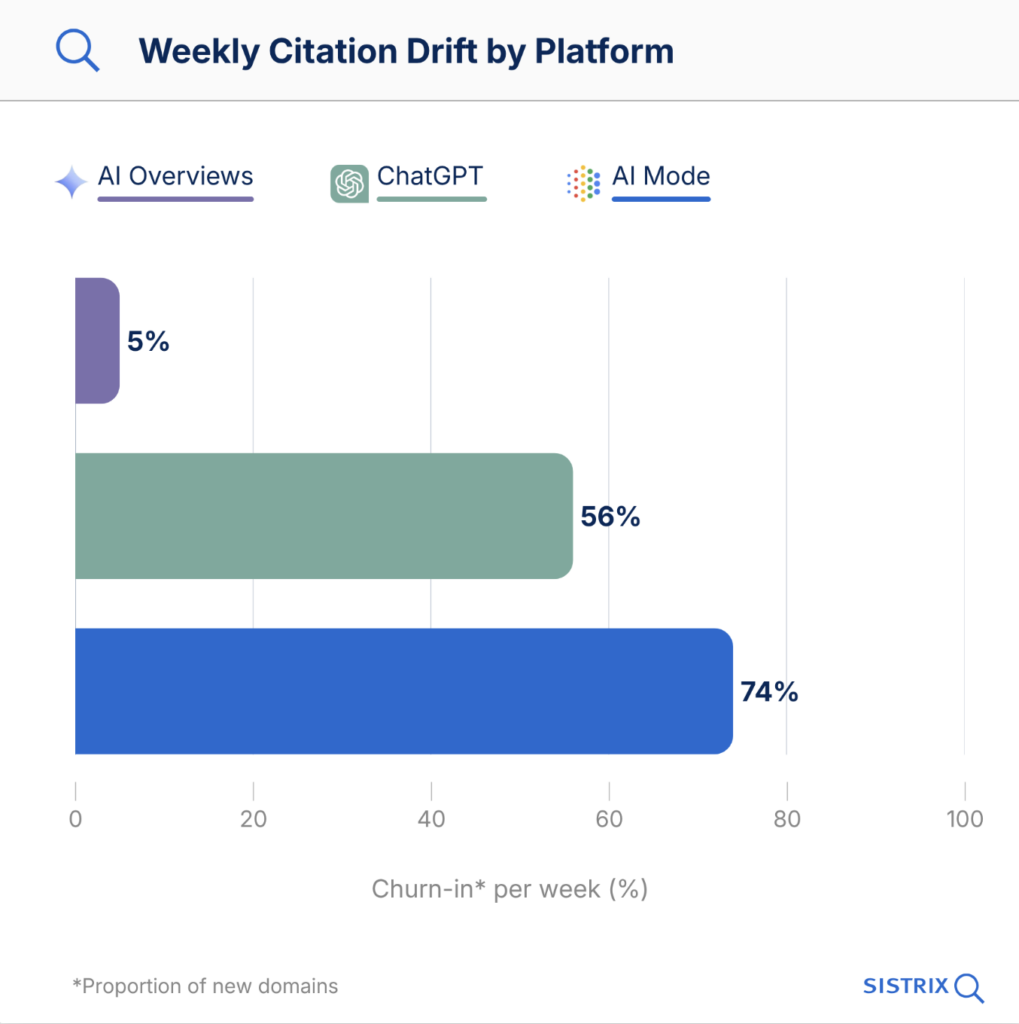
The main finding: Google AI Mode replaces 56% of cited domains every week. ChatGPT Search replaces 74%. At the URL level, weekly drift reaches 85%.
That means a citation isn’t a position you hold. It’s an appearance inside a changing answer set.
So it’s better to look at whether you are getting cited for the prompts that influence buyers, and understand the assets are earning that visibility, instead of winning a citation.
AI citation isn’t like traditional search. Tracking needs to focus on recurrence, from single prompts to prompt sets, and from vanity reporting to content decisions.
One AI Citation Doesn’t Mean You Have AI Visibility
A one-time citation tells you one thing: the AI was willing to use your domain or page once.
Which isn’t completely useless – it means the content is eligible for retrieval. But it doesn’t tell you whether your brand has lasting visibility.
If Google AI Mode changes 56% of cited domains weekly and ChatGPT changes 74%, a one-week citation isn’t a celebration. It should trigger a follow-up test.
Take every new AI citation and put it into a recurrence tracker. Run the same prompt again weekly for at least four weeks – in a fresh AI account or use a tool. Track whether the same domain appears, whether the same URL appears, and whether competitor domains appear more consistently than yours.
Use this classification:
- 1 appearance in 4 weeks: eligible, but unstable
- 2 appearances in 4 weeks: emerging visibility
- 3 appearances in 4 weeks: recurring visibility
- 4 appearances in 4 weeks: strong short-term visibility
- 6+ appearances in 8 weeks: stable visibility candidate
That gives the team a standard to go by and ensures better tracking going into optimization.
Track Domain Recurrence Before URL Recurrence
URL-level drift is 85%. If your page gets cited once, don’t assume that page is now the preferred source.
The system may cite a different page from your site next week. Or it may cite a competitor. Or it may drop the whole category of source and use a different type of asset.
Start with domain recurrence first and create a table with these fields:
- Prompt
- Platform
- Your domain cited: yes or no
- Cited URL
- Page type
- Same domain as last week: yes or no
- Same URL as last week: yes or no
- Competitor domains cited
- Notes on answer angle
Then diagnose what you see.
If your domain recurs but the URL changes, don’t assume that’s a failure. It usually means the system sees your site as relevant but hasn’t fully decided on the clearest page.
Next, choose the page you want cited and make it easier for AI crawlers.
That means you should:
- Consolidate overlapping articles
- Add internal links from related posts to the preferred page
- Rewrite the preferred page intro so it answers the prompt directly
- Add a short definition or summary block near the top
- Include the specific entities buyers use, such as product category, use case, audience, integrations, and alternatives
- Update title tags and H1s so the page purpose is obvious
If your domain doesn’t recur, page-level edits are too small. You need more coverage. Build or improve the asset set around that topic: product page, comparison page, use case page, documentation, glossary or reference page, and at least one supporting article.
Don’t keep polishing the same blog post if the domain itself isn’t being reused.
Separate Stable-Core Citations From Rotating Citations
Google AI Mode has a different pattern than standard search. In 86.5% of prompts, it keeps a stable core of 1 to 5 domains. The rest of the citations rotate quickly, with 89% weekly churn in that outer part.
That means two brands can both be cited and have very different visibility.
One brand may sit in the stable core. Another might show up once in the rotating part. A normal citation count treats those as equal. They aren’t equal.
Marketers should label each citation by stability. After four weeks, look at each prompt and mark your domain as:
- Core candidate: appears 3–4 weeks out of 4
- Rotating source: appears 1–2 weeks out of 4
- Absent: appears 0 weeks out of 4
Then assign a different action to each label.
For core candidates, protect and strengthen the asset. Update it monthly. Add fresh examples. Improve internal links. Make sure the page connects to product, category, and buyer language.
For rotating sources, compare your page against the domains that appear more often. Look at page type first. If the stable sources are product pages and yours is a blog post, the issue may not be writing quality. It may be asset mismatch. Build the page type the system is already choosing.
For absent prompts, don’t start with optimization. Start with coverage. Ask whether you have a page that deserves to answer that prompt. If not, create one.
This makes citation tracking operational, where each status leads to a different content decision.
Track ChatGPT, AI Mode, and AI Overviews Separately
Don’t combine AI platforms into one. AI search doesn’t perform as a unified experience..
ChatGPT Search replaces 74% of cited domains weekly and usually cites only 3 to 4 domains per answer. Google AI Mode cites more sources, often 14 to 16, but many of them rotate.
AI Overviews behave differently again: in 53% of prompts, not a single source changed across the full 17-week window, while 19% of prompts had much higher volatility, with 46% churn-in.
A blended score hides what’s happening. Set up one tab per platform. Use the same prompt set, but report each platform separately.
For each platform, answer four questions:
- Which prompts cite us repeatedly?
- Which page types are cited repeatedly?
- Which competitor domains recur?
- Which prompts never cite us?
Then act based on the platform pattern.
If you recur in AI Mode but not ChatGPT, check whether your strongest assets are too commercial, too thin, or too dependent on Google’s index signals. ChatGPT may prefer documentation, reference content, third-party sources, or clearer entity information.
If you recur in AI Overviews but not AI Mode, look at whether AI Mode is using a wider set of product, marketplace, video, or local-language sources. You may need more asset diversity, not more blog posts.
If you recur in ChatGPT but not Google, review crawlability, indexation, structured content, internal linking, and whether your most useful pages are easy for Google to discover and understand.
One AI visibility number can’t tell you which of those problems you have.
See the best AI citation tracking tools.
Build Prompt Sets Around Buyer Intent, Not Keywords
Single-prompt tracking creates false confidence. A prompt can vary too much week to week. A single citation can disappear too quickly. A single query also doesn’t represent how buyers ask questions.
Use prompt sets instead.
Start with one commercial topic. Build 20 to 40 prompts across four intent groups:
- Problem-aware prompts
- Solution-aware prompts
- Comparison prompts
- Branded prompts
For example, a company selling customer onboarding software, a prompt set might include:
- How to improve customer onboarding
- Customer onboarding checklist
- Customer onboarding software
- Best customer onboarding tools
- Customer onboarding metrics
- Customer onboarding playbook
- Customer onboarding software alternatives
- Brand name pricing
- Brand name integrations
- Brand name vs competitor
Run that set every week, then diagnose by intent group.
If you appear on branded prompts but not solution prompts, your brand is recognized but your category pages are weak. Build or improve solution pages.
If you appear on problem prompts but not comparison prompts, your educational content is working but your evaluation-stage content is missing. Build comparison and alternatives pages.
If you appear on comparison prompts but not problem prompts, you may have bottom-funnel visibility but weak topical coverage. Build supporting content that explains the problem, category, and buying criteria.
If you appear nowhere outside branded prompts, you don’t have AI search visibility for the category yet. Which is more of a coverage and authority problem.
Use Page-Type Data to Decide What to Create
The page-type data is one of the most useful planning inputs.
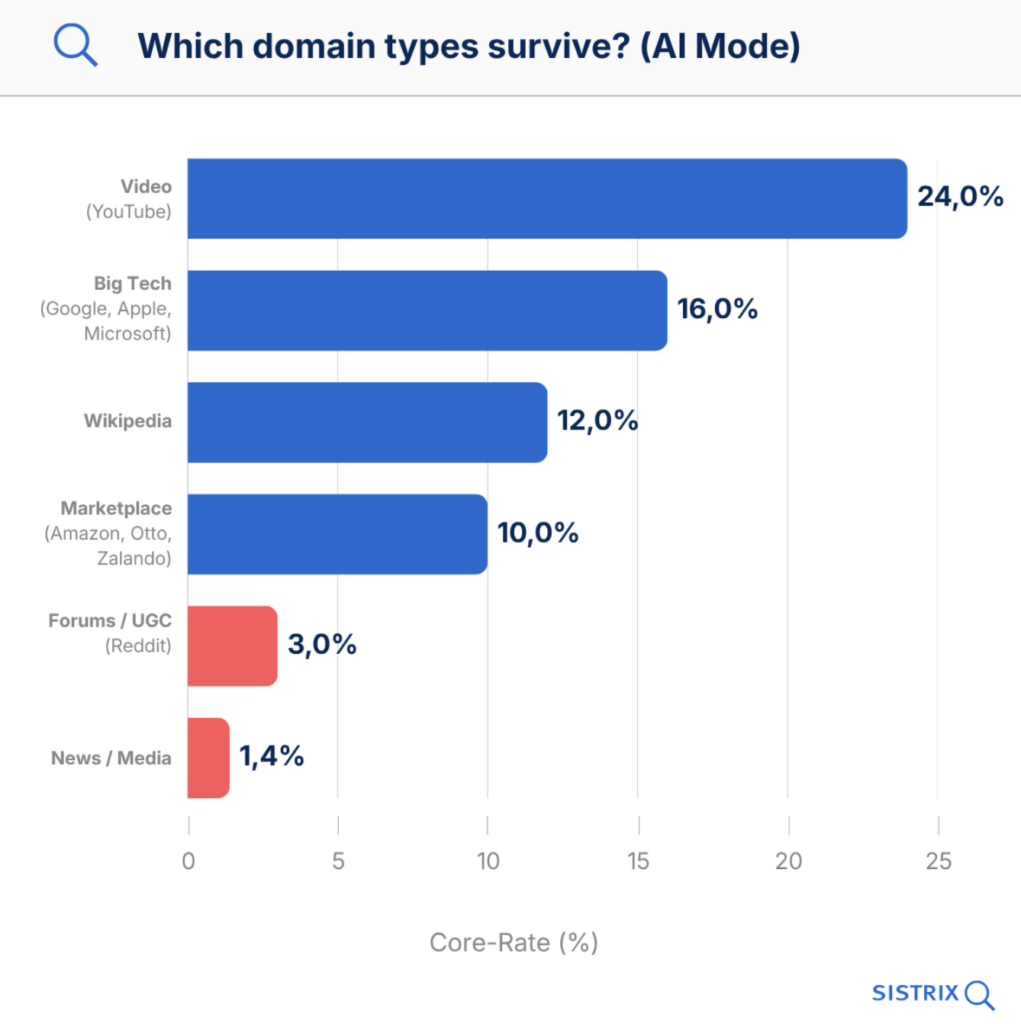
In Google AI Mode, YouTube/video has the strongest stable-core performance at 24%. Big Tech is at 16%, Wikipedia at 12%, and marketplaces at 10%. News/media is only 1.4%. The more stable citations also skew heavily toward evergreen URLs.
That should affect what content teams produce.
If the stable sources for your target prompts are product pages, don’t respond by publishing another opinion post. Improve the product or solution page.
If the stable sources are documentation pages, improve your docs and help center. Add clearer answers, better navigation, and stronger internal links from product pages.
If video appears repeatedly, create a video that answers the prompt. Don’t make a generic brand video. Create a clear, titled asset around the exact use case or question.
If marketplaces or review sites recur, work on your presence there. Update profiles. Improve product descriptions. Add screenshots. Encourage reviews from the right customer segments. Make sure category and use-case language matches how buyers search.
If news sources rotate in once and disappear, don’t build your strategy around news coverage. Treat PR as support, not the foundation of repeat AI visibility.
The action should follow the asset type that keeps recurring.
Use Competitor Recurrence to Find Content Gaps
Don’t only track your own citations. Track the domains that appear with you and instead of you.
For brand queries, the data shows that a brand’s own domain stayed present across all 17 weeks in only 43% of cases. The domains cited alongside the brand rotated at 70% per week.
That means even branded visibility isn’t guaranteed.
For each branded and non-branded prompt, log the recurring third-party domains. Then sort them by frequency.
You are looking for patterns like:
- Review sites that appear repeatedly
- Competitor comparison pages that appear repeatedly
- Marketplaces that appear repeatedly
- Forums or communities that appear repeatedly
- Documentation sources that appear repeatedly
- Media domains that appear once and disappear
Each pattern gives you a different action.
If review sites recur, improve your category presence there.
If competitor comparison pages recur, build stronger alternatives pages with clearer positioning, use cases, and proof.
If forums recur, look at the questions people are asking there. Use those questions to improve product pages, docs, and comparison content.
If marketplaces recur, update listings and category descriptions.
If your own domain is missing from branded prompts, fix brand basics first: homepage clarity, about page, product pages, docs, schema, social profiles, review profiles, and consistent naming across the web.
Competitor recurrence tells you what AI trusts when it doesn’t trust you enough. See more about getting brand mentions in AI.
Turn Citation Tracking Into a Monthly Content Workflow
Don’t leave all this work in a dashboard. Every month, review your prompt set and assign actions.
Use a simple decision table:
- Domain recurs, URL recurs: maintain and strengthen the page
- Domain recurs, URL changes: consolidate overlap and clarify the preferred page
- Domain appears once: monitor, but do not report as traction
- Competitor recurs, you do not: analyze their asset type and build the missing equivalent
- Third-party source recurs: improve your presence on that source or build content that answers the same need
- Only branded prompts recur: build non-branded topic and comparison coverage
- No prompts recur: rebuild the topic cluster before chasing citations
AI search is volatile. Use that volatility to make better decisions. Track recurrence. Separate platforms. Classify page types. Watch competitors. Then change the content plan based on what keeps showing up.
AI citations are worth tracking only when it matches the way citations behave.