
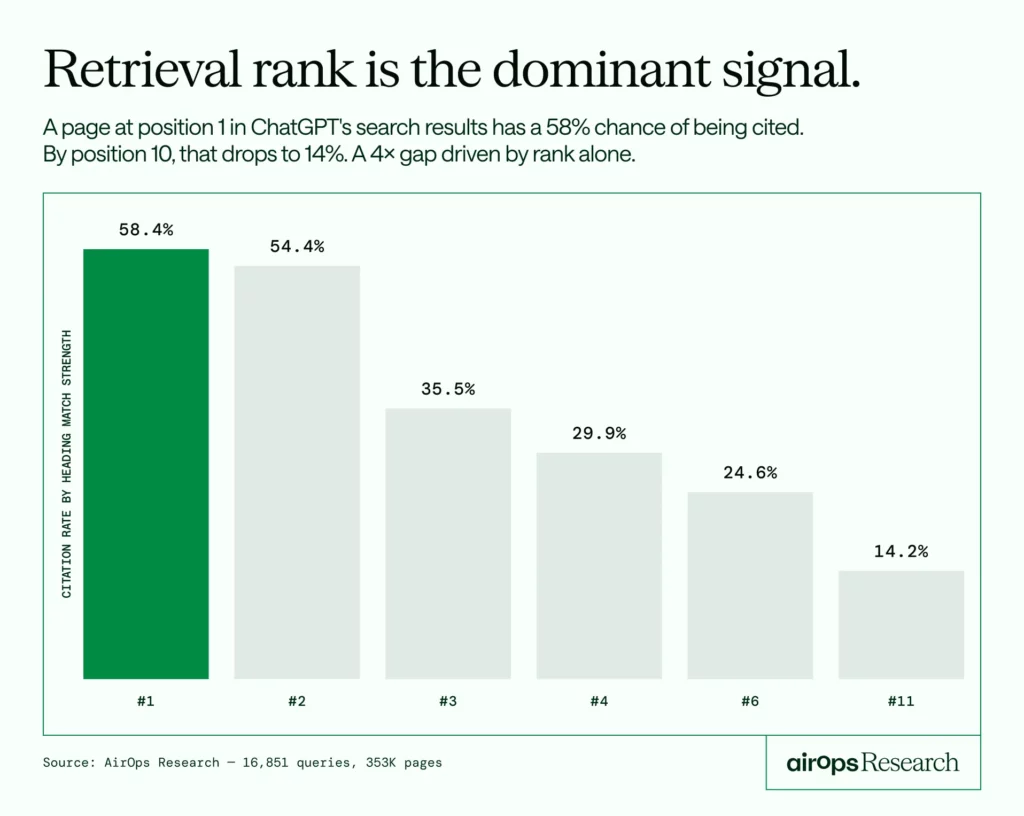
The lower a page appears in ChatGPT’s retrieval results, the less likely it is to be cited.
That is the main finding from AirOps’ analysis of 16,851 queries and 353,799 pages, which looked at what happens between retrieval and citation.
A page in the top position had a 58.4% citation rate. By position 10, that fell to 14.2% – AI citations are not rankings, and one citation does not prove durable AI visibility.
It leads to a different order of operations for AI search.
The problem is marketers still think the answer is bigger pages with more topics. This report suggests something more specific.
Your page needs to appear high in ChatGPT’s results, match the exact question, and stay focused on that question.
Trying to pack in every related topic can do more harm than good. Structure helps, but it comes after ranking and topical relevance.
Let’s break down the report:
Retrieval Comes First
AI citation is still tied closely to SEO basics. Crawlability. Indexation. internal linking. query targeting. page-level competitiveness. Those are still carrying weight.
AI search didn’t create an entirely separate system. It changed the interface, but the page still has to enter the candidate set.
That also explains why it’s easy to get misled by prompt tracking tools. Teams see a few appearances and assume they are building effective visibility.
In reality, they might just be showing inconsistently from weak retrieval positions. One ranking drop or one stronger competing page can wipe that out.
This is why most advice on writing for AI fails. It starts with formatting and ignores retrieval.
If rank is doing most of the filtering, no amount of formatting will rescue a page that doesn’t appear high enough in search.
Query Match Is Important
Heading similarity to the original query was the strongest on-page signal in the report.
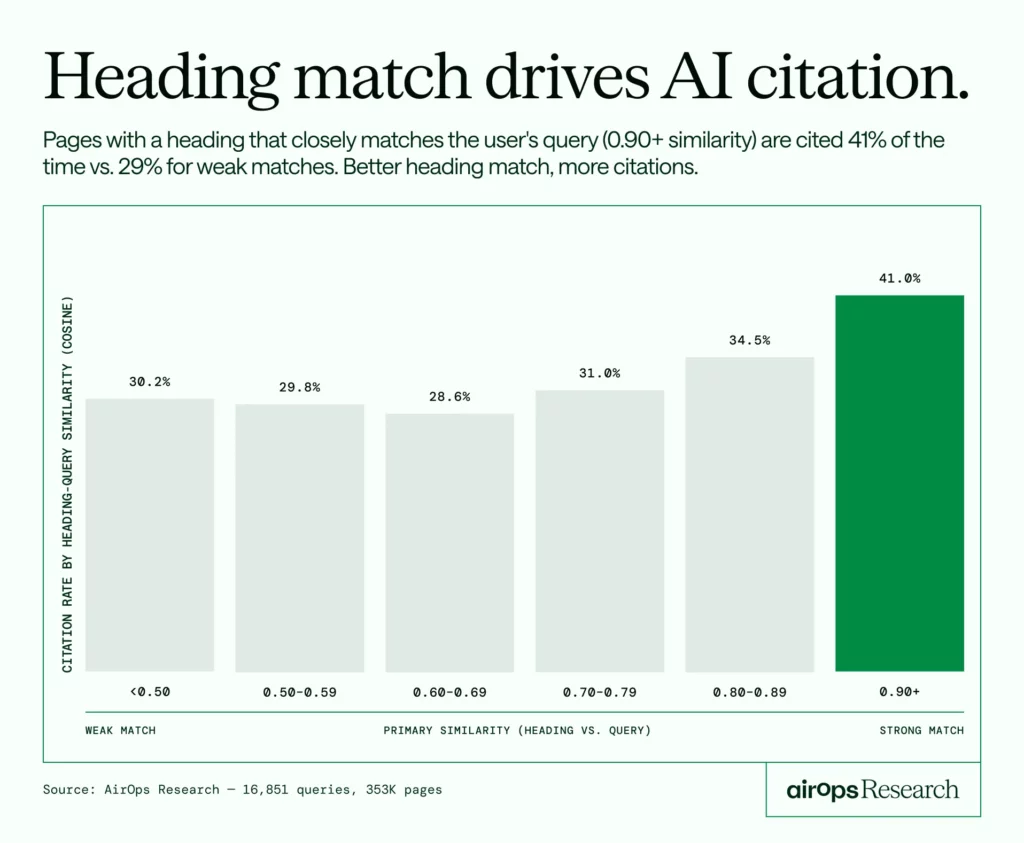
Pages with stronger heading matches were cited more often than weaker matches. Broad fan-out targeting performed poorly.
That should change how content is built.
Many teams start with a broad topic and keep adding related angles until the article becomes a mix of adjacent ideas. That can still pick up some search traffic, but it’s less reliable for citation.
A shorter page that is well structured and focused on the exact question can outperform a 5,000-word page trying to target every prompt in your industry.
It’s another reminder that AI citation still runs through SEO basics. The page has to rank, match the query, and stay focused.
Fan-Out Is Being Used the Wrong Way
One mistake being made with AI search is treating fan-out subqueries as a writing prompt.
The report found that pages covering 26% to 50% of fan-out subtopics outperformed pages covering 100% when the primary query match was already strong. Moderate coverage beats exhaustive coverage.
Pages that try to cover everything can end up in more retrieval sets, but they are less reliable as the cited answer to a specific query.
The problem is with research and planning.
Fan-out should guide supporting content for the page, not expand what the page tries to do.
Use those subtopics to decide which articles to build, to improve internal linking, and to improve topical coverage. Don’t cram every angle into one URL and expect to cheat the system.
Ultimate guide content is probably overbuilt for this. Some of it needs trimming. Some of it needs splitting. Some of it should be repositioned.
Structure Is Secondary
Structure can help once the page is already a good fit for the query, but it’s not the main factor.
Pages in the 500 to 2,000 word range did better than longer pages. Articles with a good heading pattern did better than pages with barely any structure or too much of it.
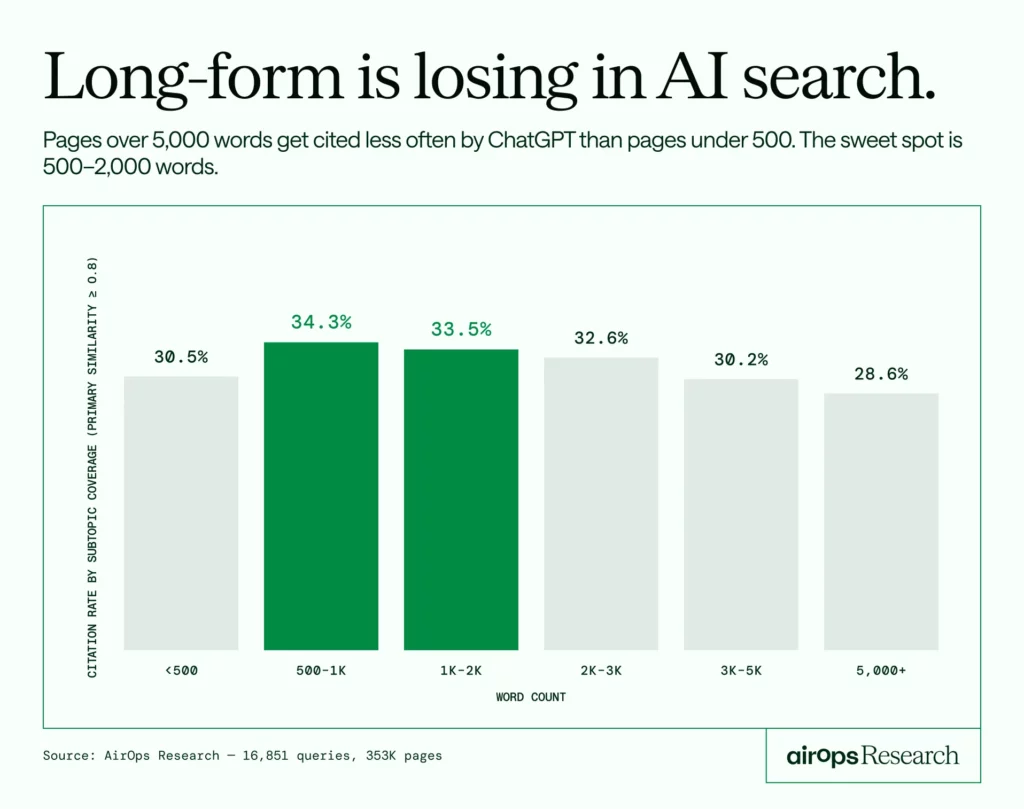
JSON-LD helped. Lists and tables helped in some page types. Updated info helped when the page already matched the query.
But that info is easy to misread.
It’s not a reason to stuff every page with FAQ schema, tables, or more subheads. Those are supporting edits. They don’t fix a page not matching intent or covers too many things at once.
The action from this is to set an update plan for pages that have a good opportunity to rank.
Improve the headings, stay on topic, and ensure there’s enough content to satisfy the intent but not too much where it harms performance (a common tendency of AI producing 10000 words when it could be 100).
Authority Is a Weaker Shortcut
The report also found no positive correlation between citation rate and domain authority or backlinks.
That doesn’t mean links should be ignored, as they are one of the top ranking factors in SEO.
But authority is a poor shortcut for predicting citation once a page is already in the retrieval set.
Big sites are assumed to have a built-in edge. Sometimes they do. Sometimes they’re just retrieved more often.
Once the model reads the page directly, authority carries less weight. This creates room for smaller publishers.
A site doesn’t need the strongest backlink profile to get more citations in AI search.
What Marketers Should Do Now
There are three things to focus on here.
First, audit pages by retrievability, not just rankings.
Find the URLs that already show for target topics and improve those before creating more assets.
Second, improve page intent.
One page should answer one primary question. Supporting subtopics belong around that page, not stuffed into every section of it.
Third, refresh with discipline.
The report’s freshness data suggests that content performs best once it has had a little time to settle, but older pages do fade. So updates are more important than churn.