
AI search optimization has already given marketers a lot to think about (and question). Add a TL;DR. Turn every heading into a question. Break everything into tiny chunks. Add FAQ schema. Publish an llms.txt file.
Some of this has evidence behind it. A lot of it doesn't. And plenty of what gets called "GEO" is normal SEO practices anyway.
It's making optimizing an article harder than it needs to be. You end up with long checklists of things to change without knowing which ones could improve retrieval and citations, which are good SEO, and which are probably a waste of time.
So I built this guide and template on how to optimize an article for AI search, backed by what the latest data points to and where it overlaps with SEO.
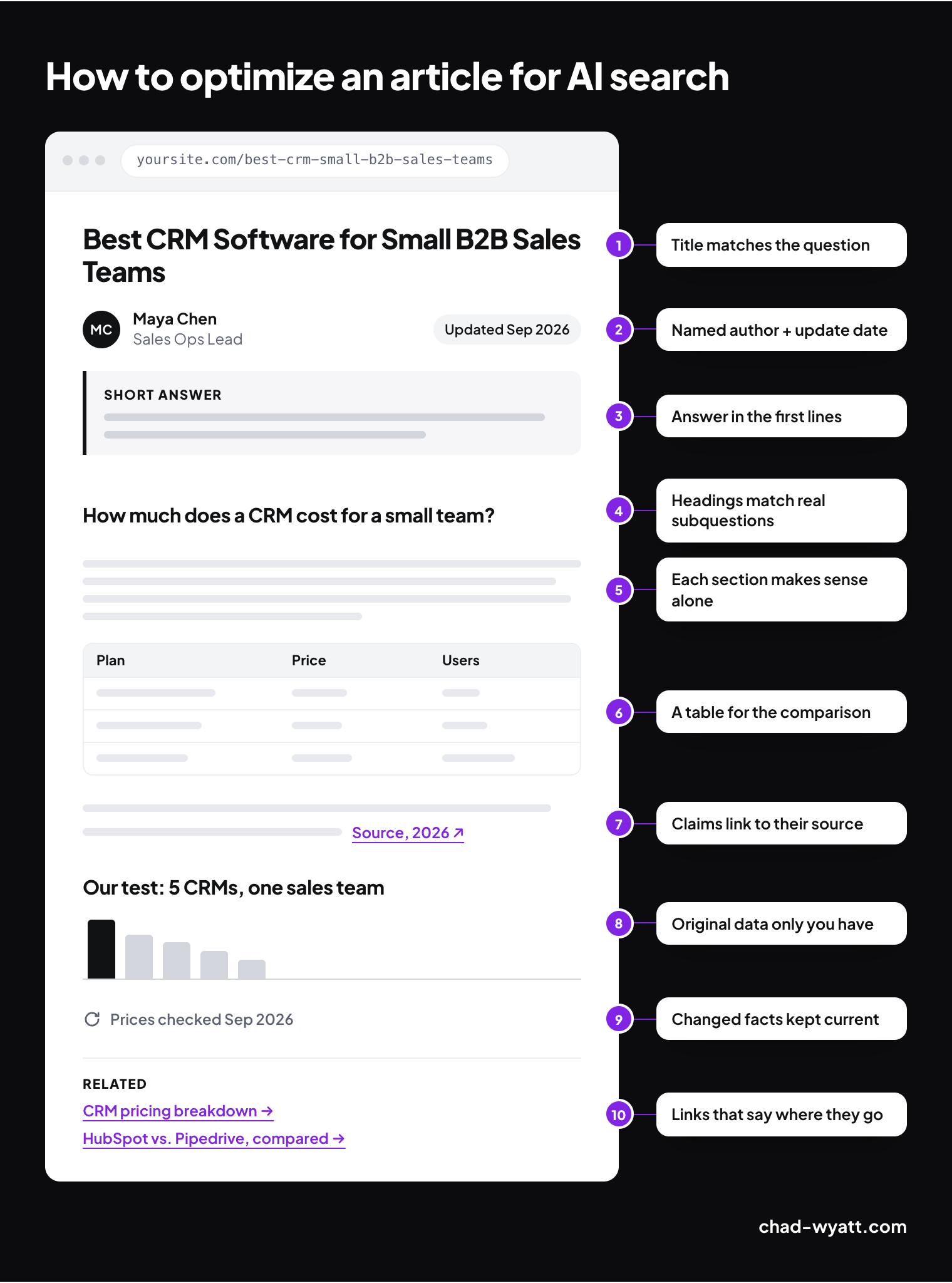
Optimizing an article for AI search doesn't require rebuilding how you write content. The main things I would focus on are:
- Match the title and article intent clearly so the page aligns with the question and related searches an AI engine may generate.
- Answer the main question early, rather than burying the useful information halfway down the page.
- Structure sections so they still make sense when retrieved on their own, without breaking the article into tiny artificial "chunks."
- Use evidence, original data and your own point of view so the page gives an AI system something specific worth citing.
- Show who wrote the article and when it was updated, especially when expertise or freshness affects how the information should be interpreted.
- Keep changing facts current and link to the original sources behind statistics and claims.
10 Steps to Optimize Articles for AI Search
1. Write a Title That Clearly Matches the Information Need
The title should tell both the reader and search system exactly what the page covers or what question it answers.
Ahrefs analyzed 1.4 million ChatGPT prompts and compared URLs that ChatGPT cited with URLs it retrieved but didn't cite. Cited pages had titles that were substantially more semantically aligned with the original prompt and, even more strongly, with ChatGPT's generated fan-out queries.
Ahrefs measured:
- Prompt vs. cited title: 0.602
- Prompt vs. non-cited title: 0.484
- Best fan-out query vs. cited title: 0.656
The relationship here is that pages cited tended to have titles more closely aligned with the information ChatGPT was trying to find.
This doesn't mean stuffing every variation of a prompt into the title. It means being specific.
For example:
- Weak: AI Search Optimization Guide
- Better: How to Optimize Blog Posts for AI Search
- Weak: Best CRM Software
- Better: Best CRM Software for Small B2B Sales Teams
- Weak: Email Deliverability Tips
- Better: How to Improve Email Deliverability and Fix Common Problems
The same applies to the URL. Ahrefs found natural-language URL slugs had an 89.78% citation rate within its search retrieval sample compared with 81.11% for URLs without them. Again, that's an association rather than proof that changing your slug creates citations.
SEO overlap: This is almost entirely normal on-page SEO. Titles should already reflect search intent and clearly describe the page. The AI addition is that the title may also need to align with the related subquestions an AI engine generates when it expands the original prompt.
2. Show Who Wrote the Article and When It Was Updated
A generic byline wastes an easy opportunity to show who wrote this and why they are qualified to talk about this topic. If the article has advice, research, testing, or a point of view, I would make the author and their relevant experience obvious.
There is now more direct AI citation data behind this than just Google's E-E-A-T guidance.
Semrush's 2026 content study compared AI-cited pages with similar pages ranking in Google and found E-E-A-T signals were 30.64% more associated with AI-cited content. Semrush's recommendations from the study specifically include adding an author bio with relevant experience and making expertise clear on the page.
A separate Presence AI study tracked 1,200 pages from more than 400 domains over 90 days in ChatGPT, Claude, Perplexity and Google AI Overviews. The difference between anonymous and attributed content was substantial:
- Expert author + bio: 72% citation rate
- Professional author + credentials + bio: 58%
- Named author + basic bio: 47%
- Company/organizational author: 34%
- No author attribution: 25%
In that dataset, pages with clear author attribution had roughly 2.4x higher citation rates than pages without it.
So I would give the author enough context for both the reader and retrieval system to understand why the article carries weight.
Near the top of the article, I would show:
- The author's full name
- Their relevant role, experience, or credentials
- A link to a dedicated author page
- Relevant first-hand experience where it applies
- The original publication date
- A visible Last updated date when the article has materially changed
- A methodology note when the article contains original testing or research
For example:
- Weak: Written by Marketing Team
- Better: By [Name], [relevant role] · [specific experience in the topic] · Last updated September 2026
For the 'date updated' on an article, Ahrefs analyzed 16.975 million cited URLs and found content cited by AI assistants was 25.7% newer by publication date than organic Google results. Looking specifically at the last update date, AI-cited content had been updated 13.1% more recently on average. ChatGPT showed the strongest freshness bias in the study.
So if the pricing, screenshots, product features, statistics, or recommendations have changed, update the page and show that date. Changing a timestamp without changing the article doesn't achieve anything.
SEO overlap: Author attribution, expertise, and freshness are already part of good SEO and trust building. They have long been a part of E-E-A-T guidelines and a proven search ranking factor.
3. Give the Answer Early
I wouldn't spend five paragraphs introducing a problem before giving the reader what they came for. Instead, tell them what they want to know straight away and give them a reason to continue.
There is now reasonable evidence that AI citations are concentrated nearer the beginning of pages too.
Kevin Indig's analysis of 1.2 million AI answers and 18,012 verified ChatGPT citations found that 44.2% of citations came from the first 30% of page content.
That doesn't prove that moving a paragraph from 70% down the page to 10% will automatically get it cited. Important definitions, summaries, and core claims also naturally tend to appear near the top.
But I would still make sure the core question gets answered before moving into the details behind it.
For example, an article about schema and AI citations shouldn't open like this: Structured data has been an important component of SEO for many years and continues to evolve as search technology changes.
It could simply start with: Adding schema hasn't been shown to increase AI citations. Ahrefs tracked 1,885 pages that added JSON-LD and found no meaningful citation increase in ChatGPT or Google AI Mode.
The reader gets the answer immediately. The evidence and explanation can follow.
The same applies to simpler informational content:
Question: What is content chunking?
Direct answer: Content chunking means dividing a page into distinct sections so each section covers one clear topic while retaining enough context to make sense independently. Then explain how and why it can affect retrieval.
SEO overlap: Giving readers the information they came for without unnecessary buildup has always been good content and UX. However, it was never essential for SEO. This also doesn't mean every article needs a TL;DR.
Similarweb looked specifically at this in September 2026 and found that a TL;DR should be used when a summary improves the page rather than being added automatically as a GEO tactic.
4. Build the Article Around the Real Subquestions Behind the Topic
LLMs turn one user prompt into several different searches before generating an answer (also known as query fan-out). So optimizing only for the wording of the original prompt means you can miss the queries being used to retrieve sources.
Peec analyzed 5 million query fan-outs from ChatGPT, Perplexity and Grok. It found the engines generated different numbers of searches from each prompt:
- ChatGPT: 2.1 fan-out queries per prompt
- Perplexity: 1.4
- Grok: 6.8
ChatGPT also changed what it searched for rather than simply rewriting the original question. In advice-style prompts, it added the word "best" to 24.3% of fan-out queries, even when the user had not asked for the "best" option. It also added the current year to searches generated from 5.44% of prompts.
Profound found an even bigger difference between what someone types and what ChatGPT searches.
Its study tracked 10,000 prompts over 14 days and captured the search queries generated by ChatGPT, Perplexity and Copilot. For ChatGPT:
- 91% of generated search queries were unique, meaning the same prompt rarely produced the same search string on a later run.
- The most divergent ChatGPT fan-out had only 13% word overlap with the original prompt on average.
- Perplexity, by comparison, retained 88% word overlap with the original prompt.
That's why I would build an article around the information needed to answer the topic, rather than just one target keyword.
So a page targeting: Best CRM for small B2B sales teams
May also need to cover:
- CRM pricing for small teams
- User limits
- Sales automation
- HubSpot vs. Pipedrive
- CRM integrations
- Implementation difficulty
- Reviews and customer experience
- Which CRM suits a five-person sales team
The user might never type some of those questions. The AI engine can generate them itself while researching the answer.
I wouldn't create a separate article for every fan-out query either. Profound found 91% of ChatGPT's generated queries were unique, so chasing individual query strings would be almost impossible. The better approach is to identify the recurring topics, comparisons, criteria, and questions behind those searches and cover them properly in one relevant article.
SEO overlap: Good SEO already covers related questions, secondary keywords, and the wider search intent rather than repeating one keyword. But targeting for AI search is more specific and has a wider range of targeting options.
For a deeper look at what happens between the prompt and the final citation, I covered the retrieval step in AI Citation Starts With Retrieval.
5. Make Each Important Section Understandable on Its Own
AI-cited pages are more strongly associated with clear summaries and defined sections, so each part of your article that contains important information should make sense if it's retrieved by itself.
It charges per user.
Most CRMs for small teams charge per user.
Semrush compared AI-cited content with Google-ranking content and found cited pages showed stronger associations with:
- Clarity and summarization: +32.83%
- Q&A formatting: +25.45%
- Section structure: +22.91%
AI retrieval can operate at passage level, which means a system may pull one section from a long article rather than rely on the entire page. If that section depends too much on information several paragraphs earlier, the retrieved passage can lose its meaning.
For example:
Weak: It increased by 2.2%.
Better: In Ahrefs' 2026 matched-control study, ChatGPT citations increased by 2.2% after pages added JSON-LD, but the change was statistically indistinguishable from zero.
The second version carries the subject, study, metric, and interpretation with it. It still makes sense even when you remove it from the surrounding article.
I tested this myself with a controlled retrieval experiment using the same article content in different formats.
- Structured content: the correct passage appeared in the top five results 80% of the time
- Dense prose: 68%
- Short Q&A fragments: 12%
So simply breaking an article into more sections isn't enough. The strongest version in my test used clear sections while keeping enough context inside each one. When I split the same information into very short Q&A fragments, retrieval performance dropped heavily because too much context had been removed.
I would apply that by making sure important sections:
- Clearly state what the section is about
- Answer the heading early
- Include the subject of important claims rather than relying on vague words such as "it" or "this"
- Keep supporting numbers, conditions, and context close to the claim they belong to
- Avoid splitting one idea into several tiny sections purely for AI retrieval
SEO overlap: Headings, logical sections, and readable paragraphs are already standard SEO and UX practice. But now you have to think about expanding on important points to optimize for AI.
6. Use the Format That Best Fits the Information
Tables and bullets can help AI systems extract information, but that doesn't mean an AI-optimized article should become one giant collection of boxes and lists.
Semrush's 2026 study found structured elements such as headings, lists, tables and charts were 21.6% more associated with cited content in its scoring model.
Use them where they make information easier to understand.
For example:
- Pricing comparison: table
- Step-by-step process: numbered list
- Product specifications: table or bullets
- Research finding: short explanation followed by the data
- Complex argument: normal prose
- Three genuinely common follow-up questions: Q&A can make sense
A paragraph explaining why a strategy failed doesn't become better because you turn every sentence into a bullet.
An FAQ isn't automatically more retrievable because it uses questions.
My retrieval experiment found the opposite when the information became too fragmented. The very short Q&A version performed considerably worse than normal structured prose.
SEO overlap: Again, this is largely good content design.
7. Back Important Claims With Data That Can Be Attributed
If you want an article to be cited in an AI answer, make the important information easy to verify and attribute. That means giving the source, number, sample, timeframe, or methodology wherever they're relevant, rather than making a statement and expecting the reader or AI system to figure it out.
Studies show AI tools prefer fresh content.; for example, Ahrefs analyzed 17 million citations and found URLs cited by AI assistants were 25.7% newer on average than URLs appearing in Google's organic results.
For example:
Weak: Studies show AI tools prefer fresh content.
Better: Studies show AI tools prefer fresh content; for example, Ahrefs analyzed 17 million citations and found URLs cited by AI assistants were 25.7% newer on average than URLs appearing in Google's organic results.
The second version contains everything needed to understand the claim: who found it, what they analyzed, what they measured and what the result was.
It's more important once a page has already been retrieved. In Ahrefs' study of 1.4 million ChatGPT prompts, ChatGPT retrieved large numbers of pages that never went on to become citations. Being relevant enough to enter the retrieval set therefore doesn't mean the page will be used as a source.
So I would make important info as self-contained and attributable as possible.
That can mean including:
- Statistics: the number, sample size, and source
- Research findings: who ran the study and what they measured
- Experiments: the methodology, sample and result
- Product claims: the specific feature, price or limitation and where it was verified
- Expert input: the person's name, role, and relevant expertise
- First-hand observations: what was tested or observed rather than a claim about "experience"
- Screenshots or documentation: evidence that directly supports what the article says
For example, instead of: Shorter content performed better in our test.
Write: In our test of 50 articles, pages under 1,500 words had a 14% higher retrieval rate than pages over 2,500 words.
The second example gives the reader and AI something concrete to interpret and potentially cite.
I would also keep the evidence grouped with the claim. Don't state a statistic in one section and put the source three paragraphs later. The claim, number, and attribution should be together.
SEO overlap: Strong sourcing has always supported credibility, links, and content quality. Now you need to be more specific and intentional in the use of data and evidence.
8. Add Original Information or a Point of View Competitors Don't Have
AI has made it much easier to publish similar content on the same topics. If your article says the same thing as every other result, it's easier to replace, so I would add original data, first-hand evidence, or a unique point of view that gives the article something competitors don't have.
Kevin Indig and Amanda Johnson audited 301 live pages carrying 1,075 AI citations in 2026. Only eight qualified as primary research, but those eight averaged 11.3 citations per page compared with 3.4 for the other pages. That made the primary-research pages 3.3x as citation-dense in that dataset.
That doesn't mean publishing any survey or benchmark will suddenly triple citations. Most of the primary-research citations were concentrated in one benchmark topic, so the finding is more limited than 'original research always wins.'
But it does support giving the page something another source can't simply reproduce. That could be:
- A test you ran yourself
- Proprietary customer or product data
- A benchmark between named products
- Screenshots from a real process
- An expert interview
- A result from your own experiment
- A primary document other articles haven't examined
- A clear point of view built from evidence
It doesn't have to be a huge research project.
My article on how Google AI Mode selects sources came from going through Google's patents rather than rewriting existing GEO advice. One of those patents describes a process where a less relevant passage can still be selected if it adds information that the passages already chosen don't contain.
That patent isn't proof of a live ranking factor. But it shows why a page that adds something different can be more effective than another version of the same answer.
SEO overlap: Original research, first-hand experience, and information gain have already been valuable for links, authority, and differentiation. But now with AI search, when crawlers are looking at the articles for a query and see that 9/10 say the exact same thing, differentiation and uniqueness will stand out.
9. Keep Time-Sensitive Information Up to Date
AI search prefers recently updated information for topics where the underlying facts can change.
Ahrefs analyzed almost 17 million citations and found AI assistants cited pages that were 25.7% newer on average than pages in Google's organic results.
ChatGPT showed the strongest difference. Its citations were, on average, 458 days newer than Google's organic results in that dataset.
But new doesn't automatically mean better.
Ahrefs' more recent 1.4-million-prompt study found the median cited search result was still around 500 days old, and many much older pages continued to be cited. Relevance was still important.
So update information that has genuinely changed:
- Software pricing
- Product features
- Screenshots
- Regulations
- Market statistics
- Benchmarks
- Available integrations
- Company information
Don't change the publish date every three months. Update the article when the information itself has changed, then show that clearly with a visible last-updated date.
SEO overlap: Search has always favored current information when the query depends on up-to-date facts. Now, several citation datasets show AI platforms, particularly ChatGPT, sourcing newer material more heavily than classic organic results.
10. Add Internal Links Where the Reader Needs More Depth
Use internal links to connect an article to deeper supporting information on your site because data shows that AI agents can follow those links while gathering evidence for an answer.
Peec analyzed ChatGPT Deep Research sessions using more than 10 separate accounts with about 20 research requests per account. In the session logs, Deep Research repeatedly followed links from one page to another when the first page didn't contain all the information it needed.
The agent could see both the anchor text and destination URL before deciding whether to open the linked page. Peec's logs showed it following internal links to pages containing things like pricing, specifications, and additional supporting information.
That gives internal linking a second job beyond normal SEO. A relevant internal link can give an AI agent a direct route from a high-level article to the deeper evidence it needs elsewhere on your site.
So instead of anchors such as:
- Read more
- Click here
- Learn more
Use anchor text that explains what the linked page contains:
- content chunking retrieval experiment
- how Google AI Mode selects sources
- tracking AI crawler activity with Cloudflare
For example, my content chunking experiment contains the full methodology and test data behind the retrieval results mentioned earlier. The main article can use the relevant findings, then link directly to the evidence for anyone, or any research agent, that needs more detail.
Peec also found that Deep Research doesn't crawl every link on a page. It selectively follows links it believes are relevant, which makes descriptive anchor text better than filling an article with unrelated internal links.
SEO overlap: Internal links already help search engines discover pages, understand relationships between content, and distribute authority through a site.
What Is Actually Different About Optimizing for AI Search?
Once you strip away the new terminology, much of the optimization process remains familiar.
Titles should match intent. Pages should answer the intent. Headings should structure information logically. Claims should be sourced. Internal links should help users navigate related content.
That's SEO.
The additions for AI search tweak how content is finished.
You need to think more about the subquestions an engine may generate, whether individual passages retain enough context when retrieved separately, whether your article contains evidence worth citing, and whether the AI systems you're targeting can access it.
If you want more of the tests and research behind these recommendations, I publish them in The AI Content Marketer newsletter.