
LinkedIn has spent the last 48 hours doing what LinkedIn does best: taking a company announcement and spreading false information without any evidence.
I found posts about this stating:
‘Your AEO strategy will fall apart’ if AI engines can identify machine-written pages.
Marketers should ‘assume this will be a ranking factor’ for SEO, GEO, and AEO in the future.
Others are already talking about hidden signals being ‘embedded for good,’ AI content becoming easier for Google to identify, or ways to remove the watermark. There are even posts invoking the ‘SEO is dead’ reaction.
It’s ok to speculate, but the problem is speculation is getting repeated as fact.
Not to mention the majority of these posts on LinkedIn are clickbait and AI-generated…
Here’s what we actually know.
TL;DR
A few of the claims doing the rounds:
- ‘Claude permanently watermarks every piece of text it produces.’ False. Anthropic says only supported models are covered right now, and heavy editing, paraphrasing, translation, or mixing can make the mark undetectable.
- ‘If Claude edits your writing, the watermark proves AI wrote it.’ False. Anthropic explicitly says detection may only show that Claude processed the text; for example, by proofreading, translating, or summarizing it.
- ‘We already know exactly how Claude’s watermark works.’ We don’t. Anthropic hasn’t published the technical mechanism yet, so claims about statistical token patterns, hidden characters, or specific removal methods are still speculation.
What Anthropic has actually confirmed:
- Models launched on or after August 2, 2026 support marking at launch. Earlier models are still being transitioned.
- On supported models, Claude embeds an imperceptible, machine-readable watermark into generated text.
- The watermark is applied at model level, including Claude, Claude Code, the API, and supported third-party deployments.
- Anthropic says the mark is designed to survive copy and paste and some editing.
- Heavy editing, paraphrasing, translation, mixing with other writing, or reducing the text to a short passage can make detection fail.
- A detected watermark doesn’t prove Claude originally authored the content.
- Anthropic has not yet disclosed exactly how the text watermark works or released full technical detection documentation.
First: What Has Anthropic Actually Announced?
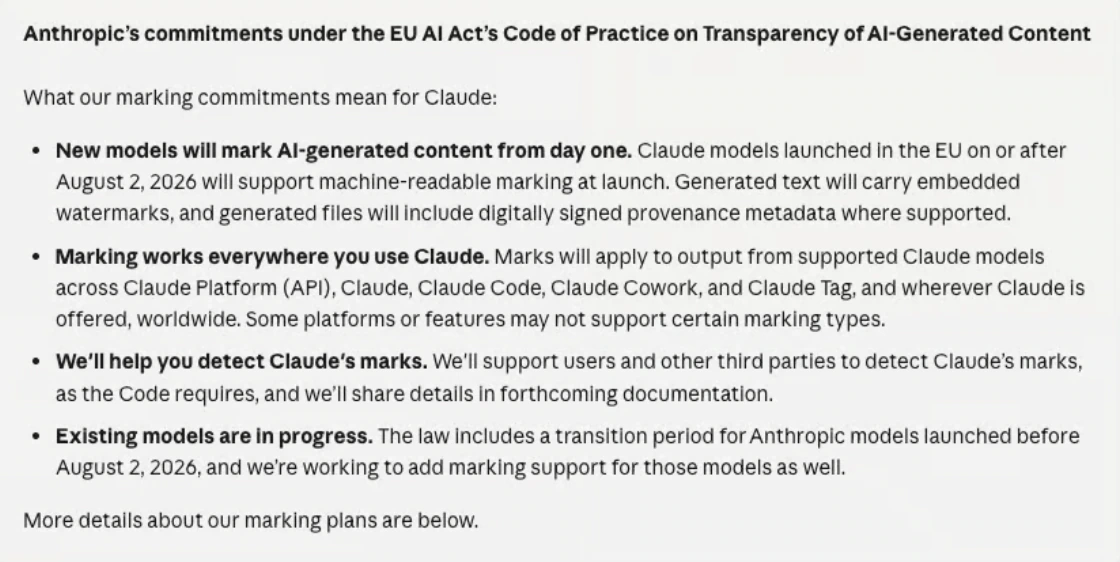
Anthropic is introducing machine-readable marks into content produced by supported Claude models.
Machine-readable simply means: You won’t necessarily see anything, but software designed to look for the watermark signs can potentially detect it.
There are actually two different systems, and people are already mixing them together.
For text, Claude will embed an imperceptible watermark directly into the generated text.
For supported files such as PNG, JPG, and SVG, Claude can attach signed provenance metadata using the C2PA standard. Think of the metadata as a digital label attached to the file saying something about where it came from and if it appears to have been edited.
Anthropic also says the text watermark is applied at model level. So for a supported model, it applies whether you use Claude, Claude Code, the Claude API, or Claude through AWS, Google Cloud, or Microsoft Foundry.
The rollout is worldwide, not limited to EU users.
But there are some caveats.
No, Every Piece of Claude Content You’ve Ever Created Isn’t Suddenly Watermarked
Anthropic says models launched on or after August 2, 2026 support marking at launch.
Models released before then are still being transitioned.
This also isn’t some retroactive scan of your website. The mark is introduced when the model produces the output. Anthropic’s rollout is only focused on content generated by models with marking support.
If you published a Claude-assisted article six months ago, Anthropic hasn’t somehow reached into WordPress this week and added a watermark to it.
No, We Do Not Know How Claude’s Text Watermark Technically Works
This is where some of the information on LinkedIn is just BS.
Anthropic says the model inserts an imperceptible watermark directly into the text.
It hasn’t yet published the detailed technical mechanism behind that.
That means we currently cannot state as fact that Claude uses:
- hidden Unicode characters,
- zero-width spaces,
- statistical word patterns,
- or any particular watermarking algorithm.
Those are possibilities. They are not confirmed.
So when someone tells you they know exactly how to remove Claude’s new watermark – remove what, exactly?
Anthropic hasn’t published the detector or the full technical spec yet.
Google Has Been Doing This for 2 Years…
Not many people realize that Google has already been doing this.
Google introduced SynthID-Text into Gemini in May 2024.
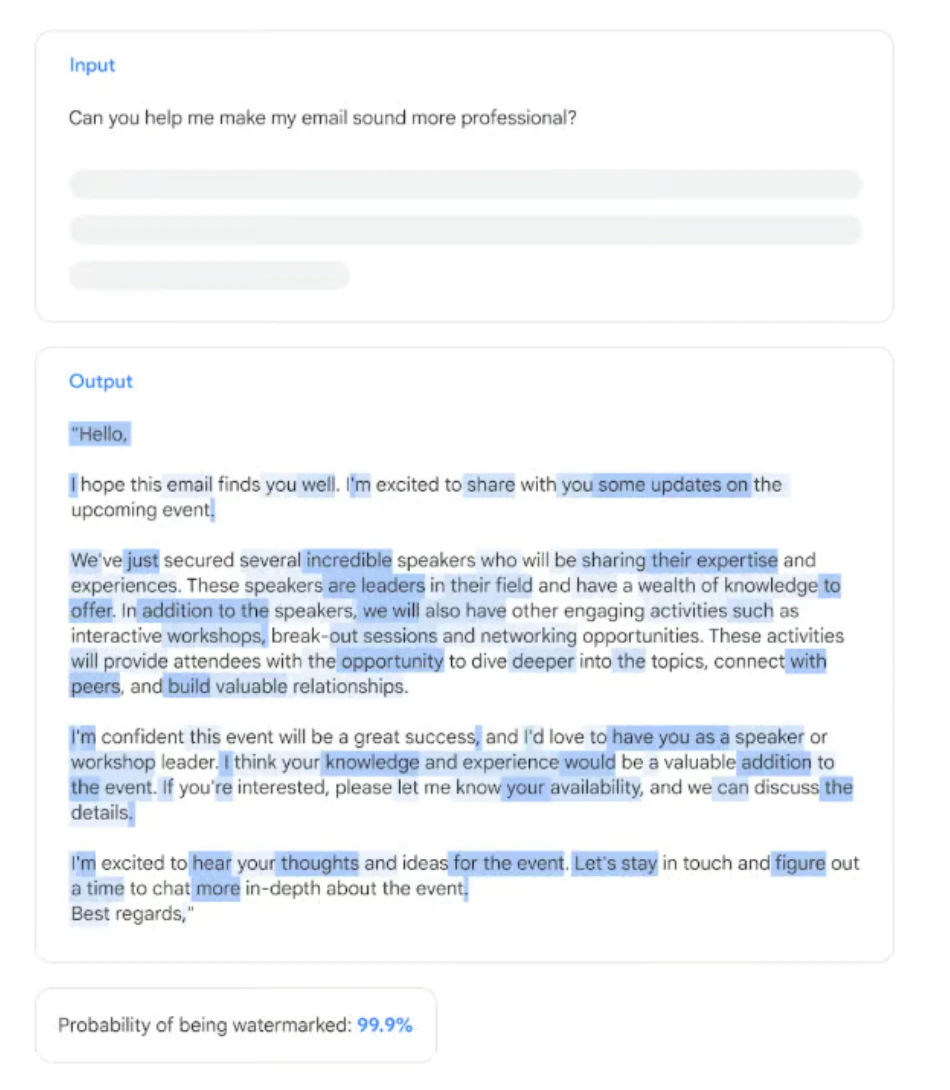
Unlike Claude’s system, Google has actually explained how its text watermark works.
It isn’t a hidden character. It changes the model’s token-selection process.
A token is just a small piece of text. It might be a whole word, part of a word, or punctuation.
When an AI writes a sentence, it doesn’t normally have one predetermined next word. It calculates a range of possible next tokens and their probabilities.
For example, if Gemini is writing: ‘this article provides useful…’ it might calculate several possible next words:
- information – very likely
- guidance – likely
- insights – possible
- advice – possible
SynthID subtly influences which option gets picked. One individual word looks completely normal.
But repeat that process across hundreds or thousands of token choices and a detector can look for the statistical pattern left behind.
Google tested watermarked and unwatermarked output across roughly 20 million live Gemini responses and found no statistically significant difference in user feedback on quality. SynthID-Text was then productionised in Gemini.
That doesn’t prove Claude uses the same technique. But it proves:
A text watermark doesn’t need to be an invisible character that somebody can delete with a Unicode cleaner.
So What Happens When You Copy and Paste Claude Text?
Anthropic says that because the watermark is embedded in the text, it travels when the text is copied and pasted elsewhere and may persist through some editing.
So this advice: ‘Just paste it into Notepad first.’ isn’t supported by Anthropic’s documentation, and if it does use the text watermark method, Notepad isn’t going to save you.
The same as moving the same text through Word or Google Docs and removing formatting, etc. It doesn’t solve anything.
But that doesn’t mean the mark lasts forever either.
Anthropic also says a Claude mark may not be detectable if the text is: heavily edited, paraphrased, translated, mixed into other writing, or reduced to a very short passage.
That word detectable already suggests we’re not talking about an indestructible tag permanently attached to a paragraph.
It’s more of a signal that a detector needs enough evidence to identify.
A Watermark Doesn’t Prove Claude Wrote Your Content
This is possibly the most important part of Anthropic’s entire announcement.
Anthropic says detecting its mark doesn’t conclusively establish the full provenance of the content.
Meaning: Where did this content actually come from, and what happened to it before you saw it?
Imagine I write an entire article myself.
I research it. I develop the argument. I write 2,000 words.
Then I give it to Claude and say: Improve this and fix spelling/grammar mistakes.
The output I get back might have Claude’s watermark.
Anthropic documents proofreading, translating, and summarizing as examples where marked output could contain ideas or text that came from elsewhere.
So Claude watermark detected doesn’t mean Claude wrote this article.
It might suggest that Claude ‘processed’ this article.
That’s a huge difference, and it makes some of the ‘finally we’ll know who is using AI to write’ commentary look pretty naive.
A Positive Result Isn’t Absolute Proof. A Negative Result Isn’t Proof Either.
Another important technical term to note is probabilistic detection.
It basically means a detector isn’t necessarily finding a secret label saying: CLAUDE WROTE THIS: YES.
It’s looking at evidence and deciding how strongly that matches the expected watermark.
For example, Google’s open SynthID implementation can return three states:
- Watermarked
- Not watermarked
- Uncertain.
Anthropic itself says that detecting its mark is not conclusive, and failure to find a watermark doesn’t prove AI wasn’t involved.
The text may have been generated before watermarking existed, edited, translated, mixed with human writing, or be too short for detection.
So the future thought process here isn’t: was AI used: YES/NO?
But what did AI actually do?
- Writing an article from scratch isn’t the same as proofreading one.
- Proofreading isn’t the same as research.
- Research isn’t the same as translation.
- Translation isn’t the same as formatting.
A watermark alone can’t reconstruct that entire process.
But Surely Google Will Use This to Kill AI Content?
There’s currently no evidence that Gemini SynthID watermark or AI-text watermark is a negative ranking signal.
Although Google likes to hide the truth, its guidance on generative AI content specifically states, ‘generative AI can be useful for research and adding structure to original content.’
Warning that using generative AI to create excessive pages without adding value can violate Google’s scaled-content-abuse policy.
It specifically encourages original viewpoints and first-hand experience rather than content that repeats what’s already available – which generative AI often does.
Could Google theoretically use provenance signals in some way in the future?
Of course. Google itself developed SynthID.
Actually, the leaked Google Content Warehouse documentation contains some interesting clues about how Google can assess content.
One field, contentEffort, is an LLM-based effort estimation for article pages. Another, OriginalContentScore, is for originality of content.
Caveat: the leak doesn’t prove these are used as ranking factors, how they’re weighted, or that AI content is a negative.
But it does reinforce the point: Google already has systems capable of assessing characteristics such as effort and originality without needing a Claude watermark.
A provenance watermark can indicate AI involvement; it doesn’t tell Google whether the article is original, useful, or low-effort.
There’s Another EU Detail Marketers Should Know
The EU rules don’t say ‘AI touched your blog post, therefore slap an AI-generated warning on it.’
For certain AI-generated text informing the public on matters of public interest, the Commission says the disclosure obligation doesn’t apply where the text has undergone human review or editorial control, and somebody assumes editorial responsibility for publication.
The Commission explains what it means by human review.
It means someone with relevant knowledge actually examining the substance of the content.
Editorial control includes having authority to approve, change, or reject the substance, including fact-checking information and checking the trustworthiness of sources.
This points to a much more sensible distinction than:
Human vs AI.
The important distinction increasingly becomes:
AI-generated and blindly published vs AI-assisted and reviewed by humans.
That’s more of a content workflow problem. If you’re automating content production without input, then yeah, you’re likely going to run into some trouble.
What I Think Will Happen for Marketers
Right now, marketers should do nothing.
There’s no evidence this changes rankings, AI citations, platform reach, or content performance.
So don’t rewrite old content, don’t change your workflow, and don’t start running everything through watermark removers.
What I expect to happen next:
- Anthropic will release more technical detail and detection tools.
- Some platforms may eventually use provenance signals.
- The distinction between AI-written and AI-assisted content will matter more.
- Mass-produced AI content is the area most likely to be impacted.
For most marketers, nothing needs to change yet. Especially if you are adding value to the content – which you should be doing anyway.
If you’re publishing with no human input, you might want to rethink that – but this is nothing new and should have been a process as soon as you adopted generative AI tools.
I will be covering this in the future when updates get released, so make sure you subscribe if you haven’t.