
Over the last 12-18 months, a lot of LinkedIn Company Pages have seen organic impressions and engagement drop, even when posting the same cadence and topics.
At the same time, personal profiles are pulling strong results, especially when the content reads like real expertise instead of a brand update.
The question isn’t ‘Is LinkedIn dead for brands?’ The question is why Pages are losing share of attention, what the algorithm is pushing instead, and how to rebuild performance without wasting time and effort.
So what’s going on with LinkedIn?
Company pages lost reach
LinkedIn still gives company posts a chance, but it is a smaller chance than it used to be.
The feed is more picky about what it shows and who it shows it from. For example, the algorithm ranking process on LinkedIn goes through different stages: a post gets classified, checked for red flags like heavy self-promotion, then scored for how relevant and credible it looks.
If it clears that, it gets shown to a small group first. It only expands if people spend time with it and interact. A lot of page posts now stay stuck in the “first test” group. Leading to your drop in performance.
That setup hurts pages in two specific ways.
1: The algorithm factors in the relationship between the viewer and the author. A person has connections. A page does not. So the “do I know this author” signal starts weaker for brand posts, before the content even gets judged.
2: A lot of brand posts read like marketing. Product updates, hiring pushes, press links, event promos. Those are exactly the kinds of posts that trip the “too promotional” filter, or fail the early test because people scroll past fast.
This is why the tone on LinkedIn has turned so blunt about pages. You will see creators and marketers say pages are ‘alive’ but close to useless for organic reach, with numbers like ~1.6% reach of followers getting thrown around.
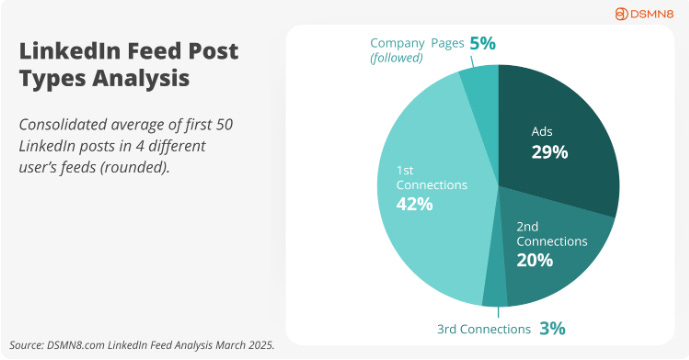
A LinkedIn feed analysis shows how serious the problem is.
It ran four tests from different accounts and categorised the first 50 posts in each feed into: 1st-degree posts, 2nd-degree posts, ads, and company pages. In that sample, company page posts made up about 5% of what appeared. The rest of the feed was dominated by people posts and ads.
Benchmarks look fine. Your page doesn’t.
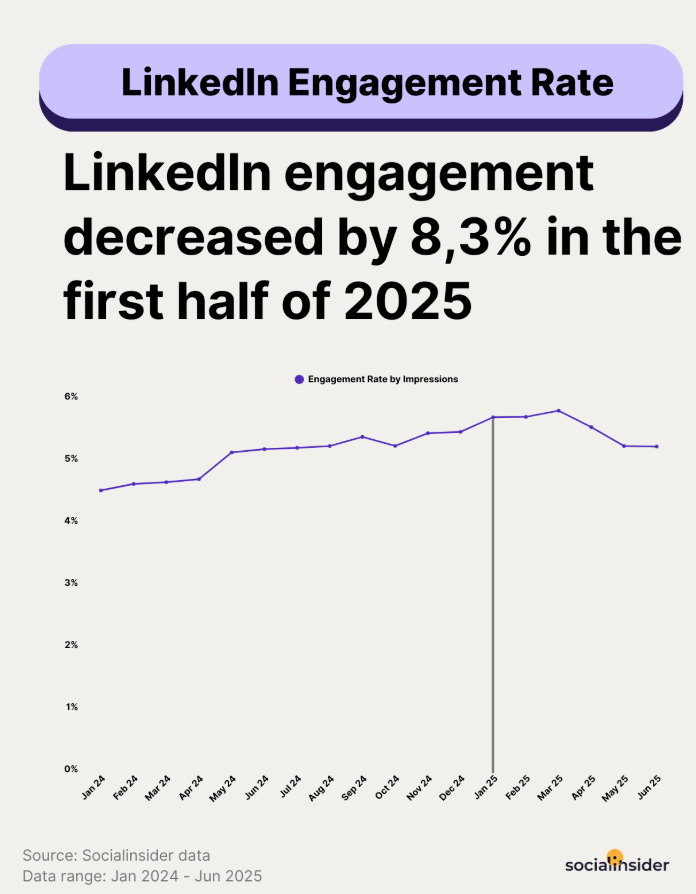
A benchmark across 1M+ posts puts the average LinkedIn engagement rate by impressions at about 5.0% in 2025, up roughly 30% year over year. That number is real.
It also doesn’t describe how most company pages are actually performing.
What it suggests is concentration. The feed is showing fewer posts more often, and the posts that make it through get strong engagement from a smaller, better-matched group. If your page posts are not getting picked up in that first wave, you only see the drop in impressions.
This is why benchmarks feel disconnected. Your page impressions fall, but ‘average engagement rate’ looks healthy because the winners are doing better and the losers are getting less distribution.
Company pages are also fighting over a smaller slice of the feed. Several reports put organic page posts at roughly 1–2% of what a typical user sees.
When the slot is that small, publishing more doesn’t increase reach. It usually does the opposite. More posts means each post gets a smaller first test, fewer early signals, and less chance to spread. You end up with more content, but most of it stalls after the first batch of impressions.
However, there’s still upside in doing the basics properly. Data shows that fully completed and regularly updated pages can get about 38% more organic visibility than minimally maintained pages, with strategic work pushing that up to 63%. Useful uplift, but it does not change the core problem: pages are not where LinkedIn is putting most organic distribution.
What works on LinkedIn now?
How the feed decides what gets shown
LinkedIn’s feed has a two-step process. First, it pulls a large pool of possible posts. Then it ranks that pool to decide what appears and in what order.
A key input is whether a post holds attention. LinkedIn itself states that it predicts short ‘dwell time’ and uses that as a negative signal. It also talks about optimizing for ‘time well spent’ and trying to reduce clickbait and ‘dwell bait.’
That creates a simple reality for brands: posts that get skimmed and skipped will get ignored. Posts that make people pause, read, and respond keep getting chances for better performance.
Post formats that perform
Socialinsider’s 2025 benchmark across 1M posts from 9,000 pages shows what formats are working across LinkedIn:
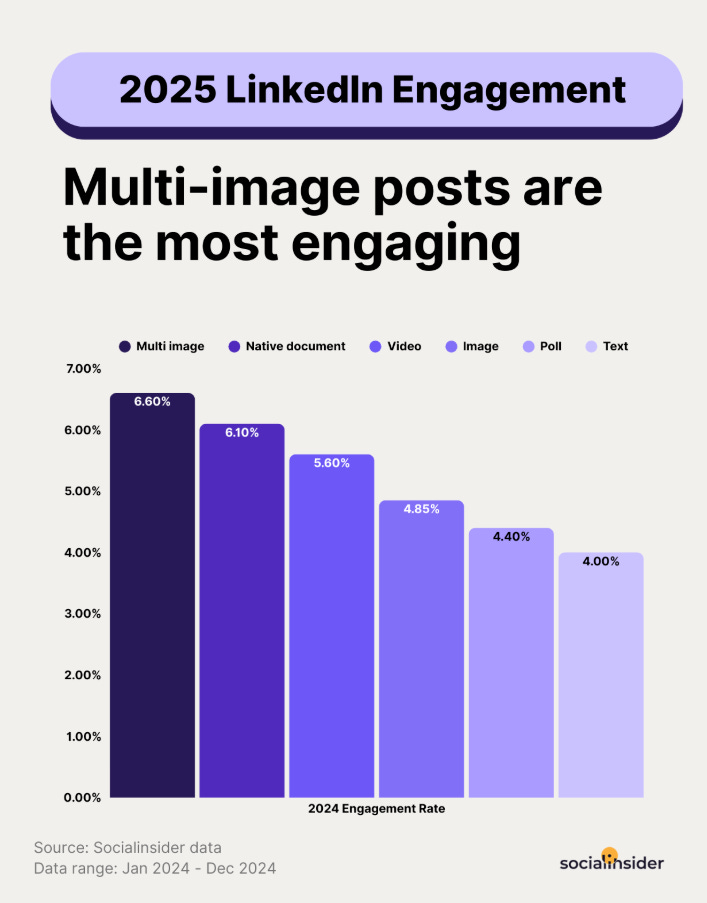
- Multi-image posts lead at 6.60% engagement rate by impressions.
- Native documents sit at 6.10%.
- Video comes in at 5.60%.
- Text-only is lowest at 4.00%.
If you think about it, it’s not about the creative. It is about friction.
Multi-image and carousels force a slower read. Video keeps people in place longer. Text-only is fast to consume, which makes it easier to skip and harder to earn another round of distribution.
LinkedIn’s own marketing data supports why video keeps showing up in playbooks, stating that video uploads are up 34% year over year, and video gets 1.4× more engagement than other formats.
That combination usually points to the same thing: more supply because it performs, and more performance because the feed can measure attention properly.
Thought leadership
Thought leadership is a named person explaining something specific that they know because they do the work. It is advice, perspective, and proof, without the boring corporate tone applied. And it’s one of the main drivers of LinkedIn post performance right now.
The reason it keeps growing is buyer behaviour. The 2025 Edelman–LinkedIn B2B Thought Leadership report says 95% of hidden decision-makers are more receptive to outreach when thought leadership is strong. It also says 71% find it more effective than standard marketing materials at showing value, and 64% trust it more than product sheets when assessing capability.
That’s why generic page updates keep losing ground. They don’t help a buyer decide. Strong thought leadership does, so it earns more attention and more follow-on conversation.
Employee advocacy
Employee advocacy is employees posting and sharing about the work in their own voice, plus engaging in comments in a way that feels human.
LinkedIn’s own employee advocacy guide says employee networks are 10× larger than a company’s follower base, people are 3× more likely to trust company information shared by an employee than by a CEO, and click-through rate is 2× higher when content is shared by an employee versus the company.
It also claims something that explains why small programs can matter: only 3% of employees share company content, but those shares can drive a 30% increase in total company engagement.
Even if that ratio varies by brand, it shows that the page is not the strongest distribution channel anymore. People are.
More recent program benchmarks show how this becomes a system, not a campaign. One report says 68% of employee advocates share three or more times per week, and sales teams account for 33% of advocacy activity in the programs surveyed.
The pattern across all of this is consistent. The feed is set up to push posts that hold attention and create discussion. Formats that slow people down help. Named experts help more. Employee voices turn that into scale.
What to do next
Treat the company page like a profile, not a channel. Keep it complete and current. Pin the few posts that explain what the company does and why it matters. Use it as the place people go to check you are real, not the place you expect to get reach.
Move publishing to a small set of named experts for the next 8–12 weeks. Pick people who can say something specific without sounding like marketing. Give them a narrow target each. One topic, one audience, one point of view. Track comments that add substance, not follower growth.
Change the format mix. Multi-image, documents, and video are leading benchmarks for engagement rate by impressions. Text-only is the weakest. Use text when the writing is strong enough to carry the post on its own. Otherwise, package the idea into a format that makes people stop.
Start advocacy small and measure it properly. The LinkedIn guidance is that a small group can drive a big share of engagement. Set an initial target around a few percent of employees posting.
Give them one strong idea a week, plus a simple way to join conversations in comments. Review after four weeks: share of engagement coming from employee posts, and how often those posts pull useful replies.
Use paid as support, don’t rely on it. Put budget behind posts that already earn comments and time spent. Avoid boosting page announcements that don’t move on their own.
Company page performance is not ‘random.’ The feed is set up to move posts that hold attention and create real discussion, and that tends to happen through people. The page still matters, but mostly as proof and context.
Need more guidance? Check out my LinkedIn Marketing Guide.