
Over the last couple of years, AI search became the thing everyone felt they had to act on. Teams started talking about GEO the way they talked about mobile-first a decade ago. Urgent. Slightly panicked. Vague on process and outcomes.
When you look at the early benchmarks, they don’t say ‘drop everything.’
They say two important things:
1: AI search optimization (AEO/GEO) should be a small part of your strategy.
2: Stop worrying about clicks and start focusing on brand recall.
This is my overview of Conductors AEO/GEO Benchmarks Report which has been broken down further here.
AI Referral Traffic is a Minor Percentage Overall
Across 10 industries, AI referral traffic accounts for about 1.08% of total website traffic. Roughly one visit out of every hundred.
Even the leading industries are still small. IT is around 2.8%. Consumer Staples sits near 1.9%. Others are far lower, like Communication Services at 0.25% and Utilities at 0.35%.
It is growing over time, but the pace matters. AI referral traffic is increasing at roughly 1% month over month on average. That’s steady, not explosive.
If you were expecting AI search to behave like early organic search or early social, this data is a warning sign. As a traffic source, it’s still marginal. But it’s not a primary acquisition channel.
When you compare it to organic Google search, and even other traffic (direct, paid, social), you can see the difference:
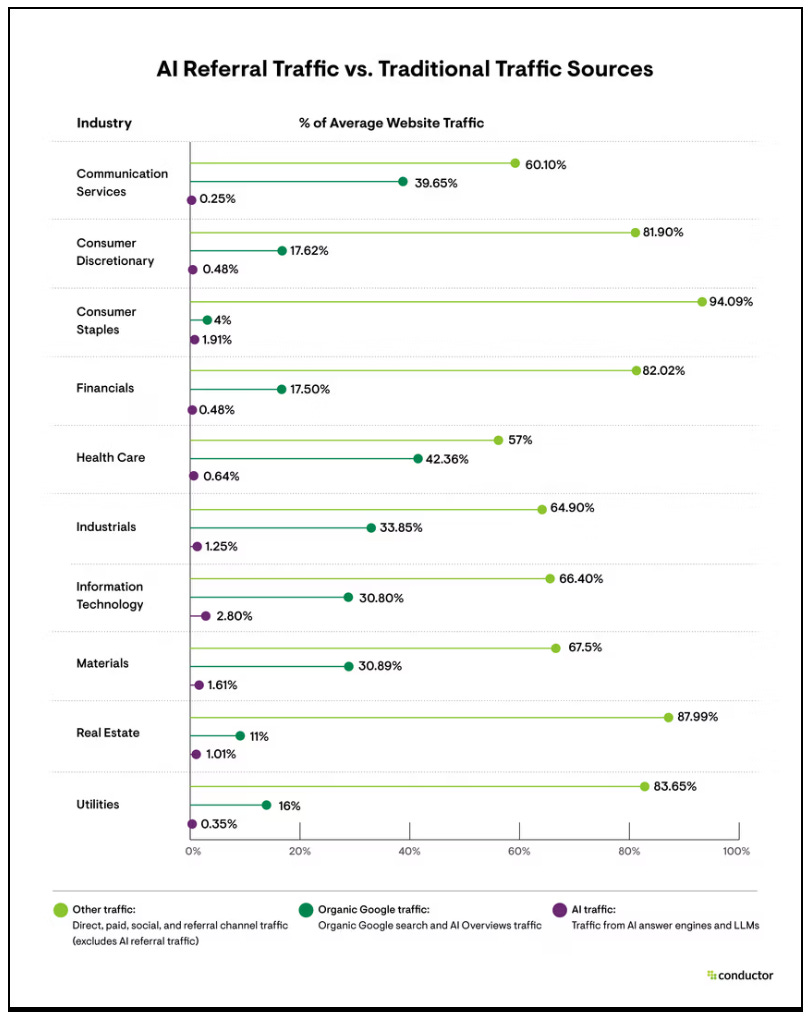
That’s not to say ignore AI search and don’t bother with the AEO/GEO hype, but don’t throw everything you have thinking it’s a core traffic channel.
AI Referrals Are High-Intent, Low-Volume
Another number in the data that explains why AI search is important.
Visitors coming from LLMs convert at roughly 2x the rate of other traffic sources, and they do it in about one-third of the sessions.
That changes how you should think about the channel. For example, it’s not regular browsing traffic. These are people asking specific questions because they are trying to decide.
When AI traffic looks small in dashboards, that doesn’t mean it’s irrelevant. It means it’s concentrated. One visit might equate to a decision that used to take five or six pageviews elsewhere.
This is where a lot of GEO thinking breaks down. People optimize for volume when the real value is influence.
Instead of optimizing with the goal of ‘increasing lost clicks,’ you should be focused on optimizing for brand awareness and recall. Being the authority mentioned in AI answers, so users are more inclined to find your brand for what they need.
AI Overviews Are Stealing Clicks
A quarter of Google searches now return an AI Overview.
Out of 21.9 million searches analyzed, 5.5 million showed an AI summary before the results. That’s 25.11% of queries where Google answers first and links second.
The distribution is uneven. Healthcare is close to 49%. Financials and Utilities sit around 25%. Real Estate drops to 4.48%. Consumer Staples is 6.82%.
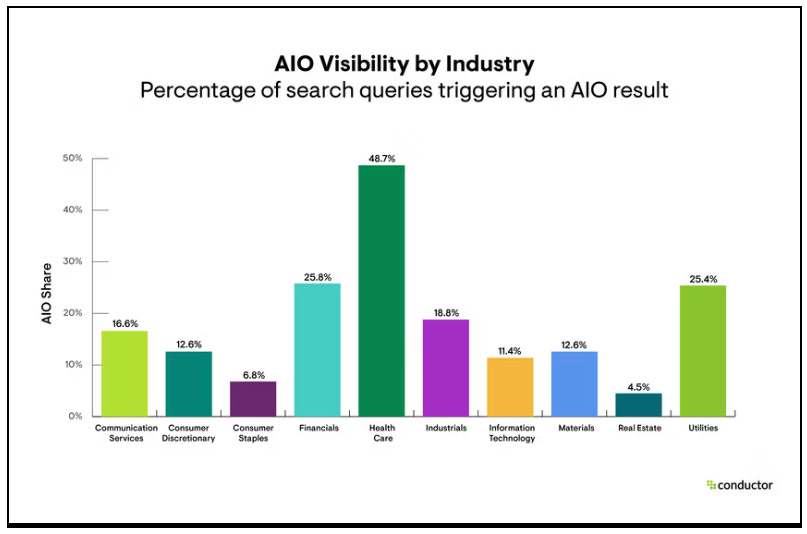
This explains a pattern content teams are already seeing but struggling to diagnose. Pages still rank. Positions don’t collapse. But traffic softens, especially on informational queries. The page isn’t failing, but it’s being used differently.
Google isn’t sending users to read your content. It’s reading it for them. Paragraphs, lists, and definitions are pulled into a summary that can satisfy search intent immediately. If your content isn’t one of the sources feeding that summary, then you might lose out completely.
The industry spread shows why this feels disruptive for some teams and irrelevant for others. In categories where summaries appear on nearly half of queries, content has to function as reference material first. In categories where summaries are rare, the old ‘rank and win the click’ model still mostly works.
The mistake is assuming the same content strategy works everywhere. In high-summary categories, writing only for clicks won’t work.
Content needs to be written so AI can retrieve and cite it. But the important part being missed is that content needs to be more impactful to have a lasting impression on the user. So your brand is remembered.
Brand Mentions and Cited Domains Are Different
The most useful insight is what kinds of sources keep showing up in AI answers.
Across AI search, the most cited page types are blogs, articles, video, news content, and product pages. Showing that AI has a preference for content types.
But brand mentions and domain citations are different. For example, in the Communications Services industry, these are the top 3 domain citations:
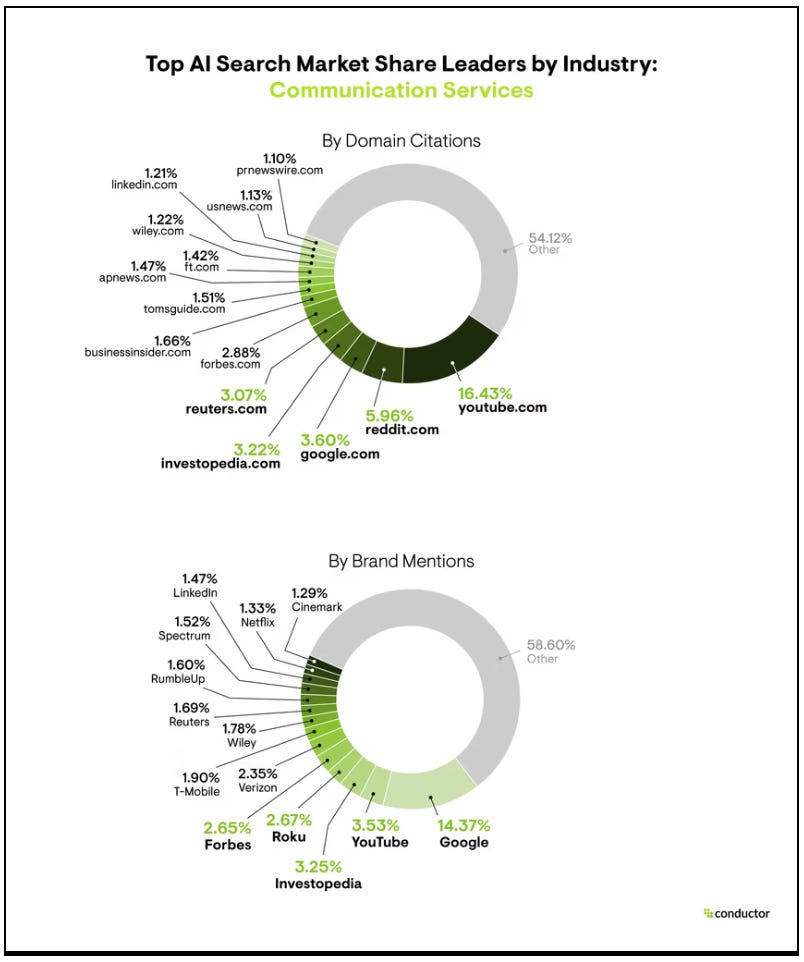
- YouTube
Compared to the top 3 brand mentions in the same industry:
- YouTube
- Investopedia
This is the same for all industries in the report.
The key point to this is: being mentioned compared to being used as a source. Mentions build familiarity. Sources inform the answer itself. If you only track traffic, you miss both.
ChatGPT Dominates – But Not Everywhere
About 87.4% of AI referral traffic currently comes from ChatGPT. That makes it tempting to treat this as a single-platform target.
Industry-level data already shows cracks in that logic. In Utilities, Gemini drives about 21% of AI traffic. In Financials, Copilot accounts for around 5%, second only to ChatGPT.
The mix will keep changing. What doesn’t change is the kind of content that gets pulled in. Clear explanations. Specific answers. Pages that don’t require interpretation.
That’s why rushing to optimize for model updates is risky. Optimizing content for user experience, SEO, and then elements of GEO/AEO with slight tweaks is better.
What To Do Next
Stop rushing to implement AEO/GEO tactics on your entire site.
Don’t treat AI search as a primary growth channel.
Research and monitor, test small batches, then implement, iterate, and repeat.
Start with a narrow scope. Pick 20–30 queries that are important to your content strategy. Comparisons. ‘Best for.’ Pricing questions. Track two things weekly: whether your brand appears at all, and whether your pages are cited.
Run some basic GEO tactics on those pages. Put the answer in the first few paragraphs. Use headings that match how people ask questions. Remove fluff that adds nothing to understanding. If a human can skim it and get value fast, an AI system can too.
Use video to support explanations. YouTube appears as a top-cited domain in at least one major category. The domain may get the credit, but your brand still gets exposure. One solid explainer video embedded on the right page can extend reach without chasing traffic.
Keep traditional SEO doing its job. Organic search still drives the majority of traffic everywhere measured. The smart teams are adding AI search optimization on top, not swapping one for the other.
Back to the question, is AEO/GEO a big deal?
Yes. But it shouldn’t be the primary focus for brands.
Organic search still dominates and should be the priority.