

ToFu, MoFu, and BoFu are the three stages of the sales funnel. Top of Funnel (awareness), Middle of Funnel (consideration), and Bottom of Funnel (conversion) guide a potential customer from first discovering a brand to making a final purchase.
When applied to content, at ToFu, the reader is trying to understand the problem and the basics. At MoFu, they’re comparing options and trying to pick an approach. At BoFu, they’re close to a decision, and they want proof and specifics.
This article breaks down ToFu, MoFu, and BoFu in content marketing and what each stage needs to answer, plus the content types that fit each one. You’ll see examples of content and what to include so each piece works how it should.
What Is ToFu, MoFu BoFu, and Why Are They Important?
ToFu means top of funnel. MoFu means middle of funnel. BoFu means bottom of funnel.
The acronyms come from the marketing funnel and sales funnel model. It’s a way to understand how people move from first awareness to a purchase or other conversion, and it’s often explained as a shortened version of AIDA style thinking.
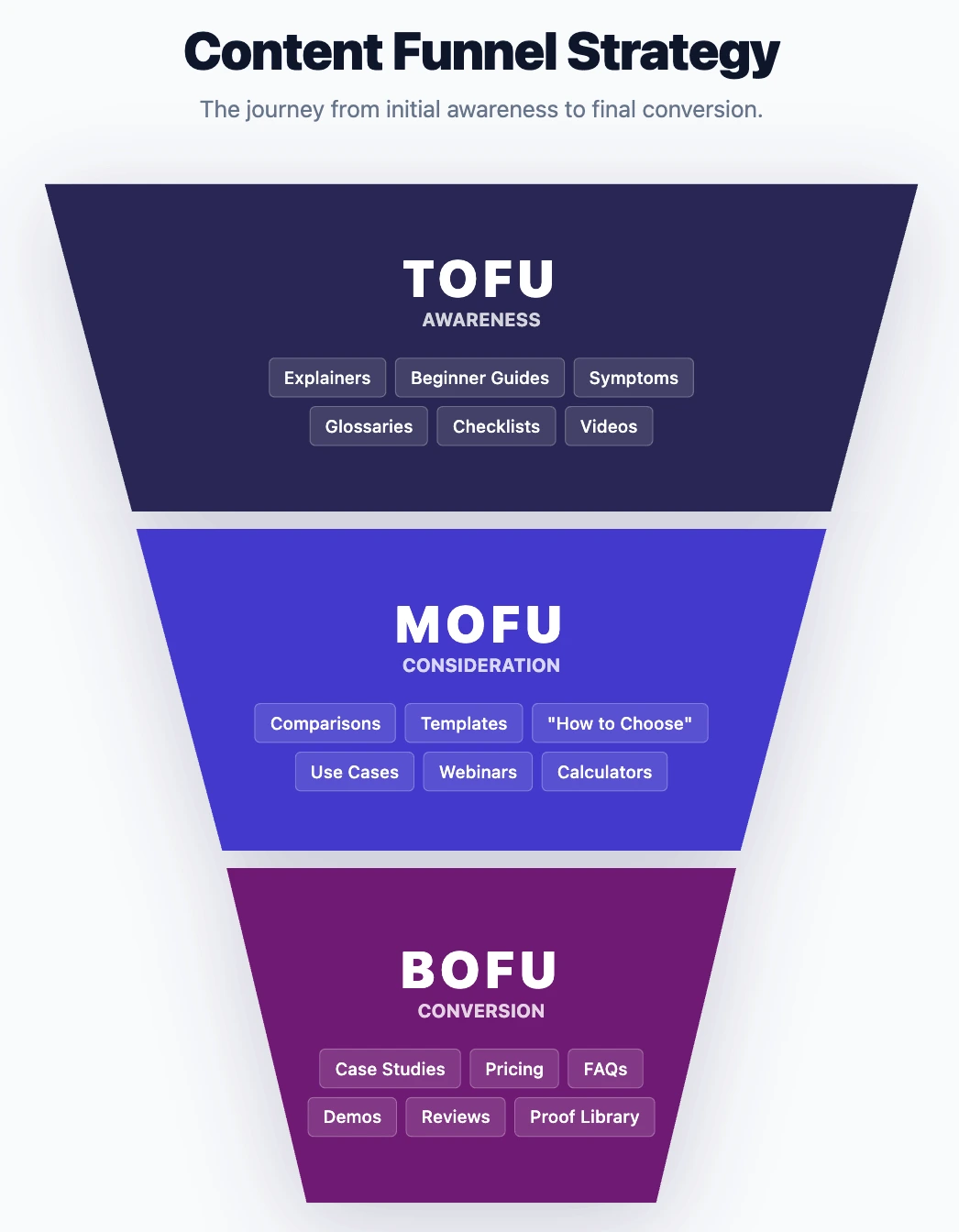
When you apply it to content, it becomes more like intent. TOFU content helps someone understand the problem. MOFU content helps them compare options. BOFU content helps them verify fit and reduce risk so they can decide.
- TOFU (learning): They’re trying to name the problem and understand the basics. Like explainers, beginner guides, definitions, and simple checklists.
- MOFU (evaluating): They’re comparing approaches and building a shortlist. Like ‘how to choose,’ comparisons, use case walkthroughs, templates, and deeper product guides.
- BOFU (deciding): They want proof and specifics. Like case studies, reviews and testimonials, setup details, and FAQs that answer buyer questions.
This framework shows up most in marketing programs where content is expected to drive a business result. Think B2B lead gen, B2B SaaS, ecommerce, apps, and services with a clear next step like a demo request, trial, checkout, or booking.
| Stage | Reader Intent | Content Angle | Types of Content |
|---|---|---|---|
| ToFu | Help me understand this. | Define the problem and teach the basics | explainers, beginner guides, definitions, simple checklists |
| MoFu | Help me choose an approach. | Compare options and give decision criteria | ‘how to choose’ comparisons, use case walkthroughs, templates, webinars that teach |
| BoFu | Help me feel certain. | Prove fit and remove uncertainty | case studies, product demos, explainers, implementation pages, buying FAQs |
ToFu Content
ToFu content is for people who are still trying to understand a topic. They’re not comparing tools or vendors yet. They’re trying to get clear on what the problem is, why it happens, and whether it applies to them.
ToFu content should do three things.
- Explain the concept without assuming prior knowledge.
- Show the common causes and signs so the reader can relate to their own situation.
- Give them a simple first step they can take right away, even if they never take action.
This content should stay neutral and specific. Don’t assume they’ve picked a solution category. Don’t jump into product features. If you mention solutions at all, keep it high-level.
Types of ToFu content that usually work:
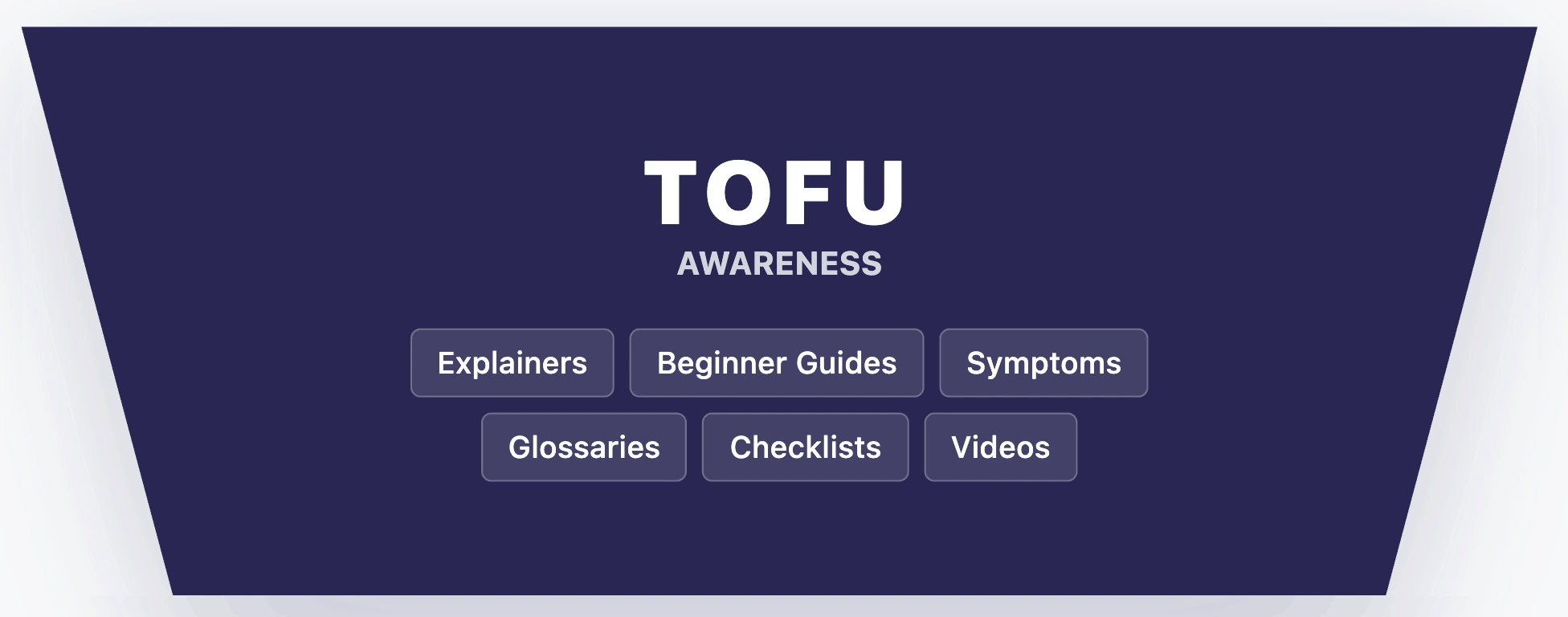
- ‘What is X’ explainer. Define the term. Give an example. Explain where it occurs.
- Beginner guide. A short overview of the topic with 3-5 steps and an example.
- Symptoms/causes post. Common signs. Common root causes. What people confuse it with.
- Simple checklist. A quick self-check or setup list that helps them avoid obvious mistakes.
- Definitions/glossary. The terms they keep seeing, with definitions and short examples.
- Short video explainer. One concept, one example, one takeaway.
- ‘Examples of X’ post. Several examples with a sentence on why each one is important.
End ToFu content with one ‘next read’ link. Point to MoFu content like a ‘how to choose’ guide, a comparison, or a template. That keeps the reader moving without turning the page into a pitch.
MoFu Content
MoFu content is for people who understand the problem and are now trying to pick an approach. They’ve got options in front of them. They’re asking, ‘What should I choose?’ and ‘How do I know it’ll work for my situation?’
MoFu content should make the options easy to compare on the points people actually decide on. What it takes to get started. What has to be true for it to work. How much effort it needs over time. What breaks it. Who it fits.
MoFu content shouldn’t just promise outcomes. It should spell out what each option requires and where it tends to fall apart. If an approach only works with a certain team setup, budget, timeline, or data quality, say that.
MoFu content does this by getting specific. It lists what each option needs upfront, walks through the basic process, and shows an example of what the result looks like. Then it tells the reader when to choose each option based on their situation.
MoFu formats that work across most topics:
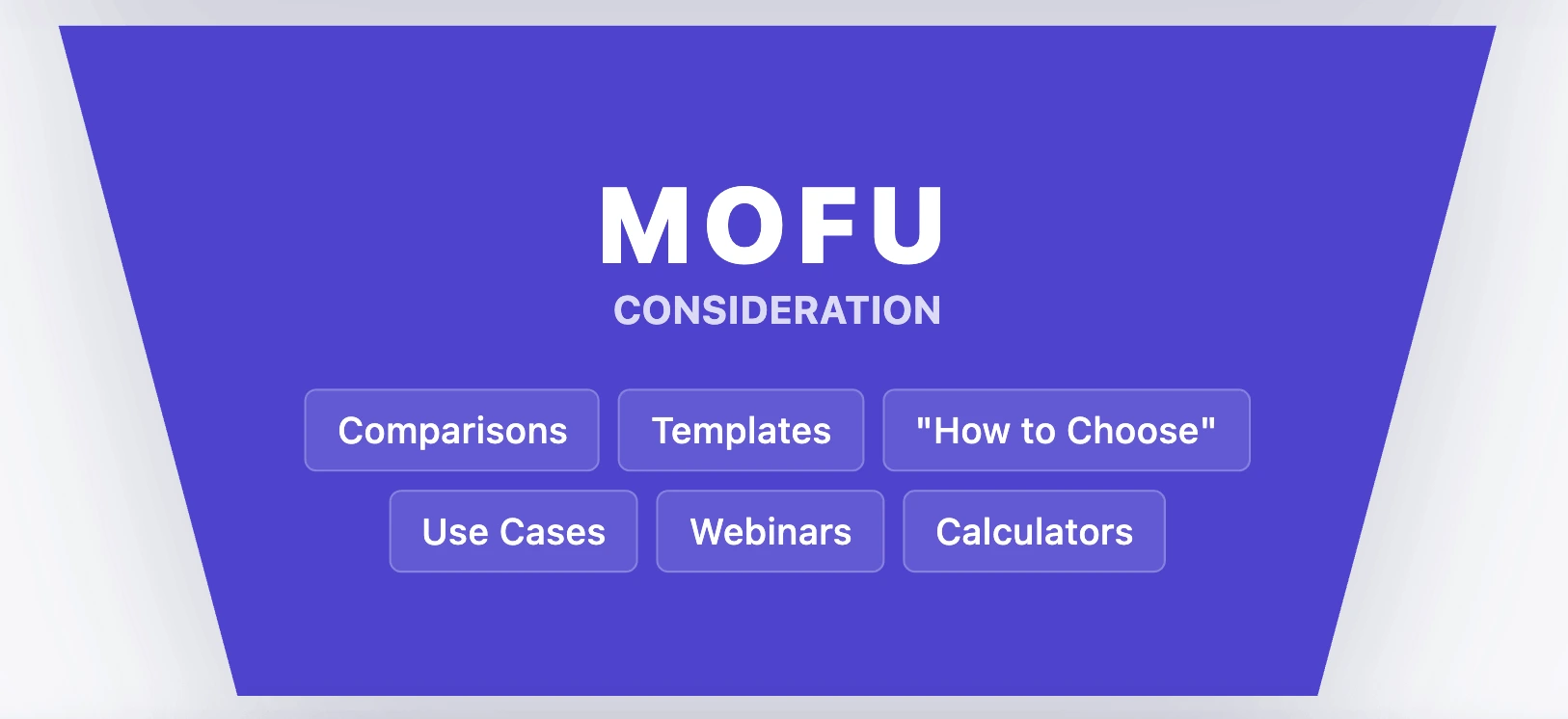
- How to choose guides with clear criteria
- A vs B comparisons that use the same criteria on both sides
- Option breakdowns (3 ways to do X) with when each one fits
- Scorecards/checklists people can use to evaluate choices
- Templates (briefs, plans, scripts, policies) tied to each approach
- Worked examples that show the process and the end result
End MoFu with one link to BoFu content that proves the option works and answers the last questions that could be causing friction.
BoFu content
BoFu content is for people who are close to a decision. They’re not trying to learn the basics. They’re trying to remove doubt. They want proof, specifics, and a clear picture of what happens after they say yes.
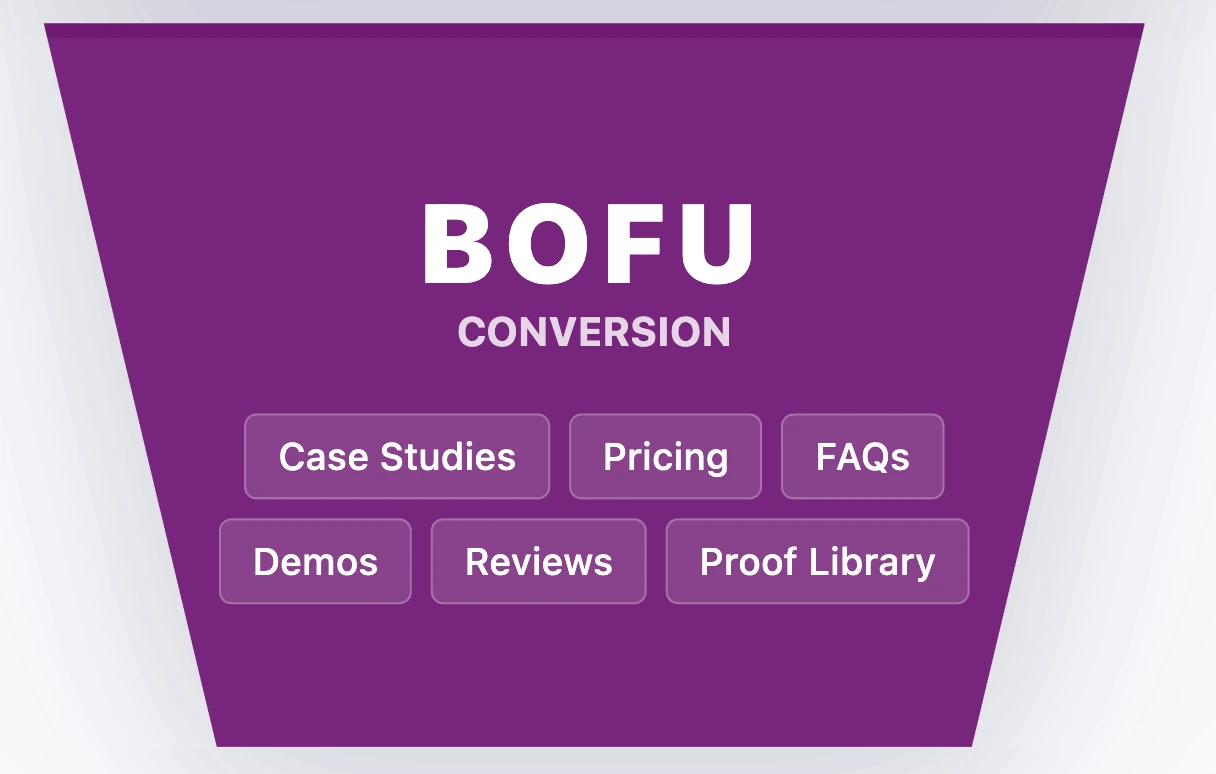
BoFu content needs to answer the last set of questions that stop a decision. It should make the fit obvious, so the reader can tell if it’s for them or not. It should deal with risk, so they know what could go wrong and what happens if it does. It should show proof and demonstrate trust.
What BoFu content should cover:
- Fit: who it’s for, who it’s not for, and the conditions required for it to work
- Risk and friction: implementation, time, support, switching effort, edge cases, limits
- Proof: examples, specifics, outcomes, and the context around them
Types of BoFu content that usually work:
- Case studies. Starting point, what was done, what changed, and what it took to get there.
- Product walkthroughs. What the experience looks like, step by step, for a specific use case.
- Implementation/onboarding page. Steps, owners, timelines, inputs needed, and common blockers.
- Pricing explained. What’s included, what changes by tier, and how to choose without guessing.
- FAQ for buyers. The questions people ask before committing, including limits and edge cases.
- Proof library. Testimonials with specifics, examples, reviews, screenshots, before/after.
End BoFu with the simplest next step available. Start a trial, request a demo, book a call, or contact support. Keep it one primary action, not a menu.
How to Connect Each Funnel Stage
Connect ToFu, MoFu, and BoFu by giving each page an obvious next read.
On a ToFu page, send the reader to one MoFu piece that helps them choose an approach. Put that link at the end, and make the anchor text specific. ‘How to choose X’ or ‘X vs Y’ is clear. ‘Learn more’ is not.
On a MoFu page, send the reader to one BoFu piece that reduces risk. That’s usually a case study, an implementation page, pricing explained, or a product walkthrough. Keep it to one primary link so the page has direction.
On a BoFu page, add two short context links for people who aren’t ready. One back to a ToFu explainer for basics. One back to a MoFu comparison for decision criteria. These are secondary links. They’re there to stop drop-offs.
Example 1 – B2B SaaS, onboarding software
A reader starts on a ToFu post like ‘Employee onboarding basics plus a checklist.’
The last section points to a MoFu page like ‘Onboarding software vs manual onboarding. How to choose.’
That MoFu page ends by pointing to a BoFu page like ‘Implementation timeline and a real setup example.’
On the BoFu page, you include two small links near the bottom. One says ‘Start with onboarding basics’ and the other says ‘How to choose an approach.’
Example 2 – ecommerce, coffee grinders
A reader starts on a ToFu post like ‘Why coffee tastes bitter.’ The last section points to a MoFu piece like ‘Blade vs burr grinder. Which one to buy.’
That MoFu piece points to a BoFu buying guide like ‘Choose a grinder by brew method and budget,’ plus the proof you have available on-page, like reviews, returns info, and common questions.
On the buying guide, add two small links back. One to ‘Why coffee tastes bitter’ for shoppers who realize the issue isn’t the grinder. One to ‘Blade vs burr’ for shoppers still deciding.
FAQ: TOFU MOFU BOFU Content
ToFu means top of funnel, MoFu means middle of funnel, and BoFu means bottom of funnel. In content terms, ToFu content helps people learn the basics, MoFu content helps them compare options, and BoFu content helps them decide with proof and specifics.
ToFu (top of funnel) content is early-stage content for people who are new to the topic. It explains what something is, why it happens, and basic first steps. Common ToFu formats include “what is” posts, beginner guides, definitions, and simple checklists.
MoFu (middle of funnel) content is for people who understand the problem and are comparing approaches. It helps them choose by giving options, tradeoffs, and decision criteria. Common MoFu formats include “how to choose” guides, comparisons, templates, use case walkthroughs, and process breakdowns.
BoFu (bottom of funnel) content is for people close to a decision who need confidence and details. It reduces risk with proof, constraints, and “what happens next” information. Common BoFu formats include case studies, product walkthroughs, implementation pages, pricing explained, and buyer FAQs.
Look at the main question the page answers. If it explains basics and defines the problem, it’s ToFu. If it compares options and helps selection, it’s MOFU. If it proves fit and answers decision blockers, it’s BOFU. One page should usually have one primary intent.
It can, but it usually gets weaker. A mixed page often feels unfocused because it tries to teach basics and compare options at the same time. If you must combine, keep one primary intent and link to the next stage instead of stuffing everything into one page.
ToFu works best with explainers, beginner guides, glossaries, and quick checklists. MoFu works best with comparisons, “how to choose” guides, templates, and use case walkthroughs. BOFU works best with case studies, walkthroughs, implementation details, pricing explained, and buyer-focused FAQs.
Connect pages by intent. A ToFu page should point to one MOFU page that helps evaluation. A MOFU page should point to one BOFU page that provides proof or specifics. BOFU pages should link back to one ToFu basics page and one MoFu comparison page for readers who still need context.
A ToFu article should link to one deeper “next read” that helps the reader choose an approach. That’s usually a MoFu piece like a comparison, a “how to choose” guide, or a template. Keep the link framed as the next step in learning, not a push to buy.
There’s no perfect ratio, but most sites over-publish ToFu and under-publish MOFU and BOFU. A practical target is to make sure every major ToFu topic has at least one MoFu comparison or selection guide, and every MoFu guide has at least one BOFU proof page tied to it.