
The top-ranking organic page gets an estimated 58% lower CTR when an AI Overview appears.
That’s more than half the clicks gone before anyone gets to your result, based on data from Ahrefs’ 2026 study. But that’s not even the worst part: their earlier 2025 data put the same figure at 34.5%. So it’s getting worse.
In the SERPs, it’s always been about the higher the position, the higher the percentage of clicks. But with AI Overviews (AIO) now stealing most of those clicks and position 1 taking the leftovers, what happens to the rest?
Yes, SEO is still important, but organic strategies are changing, and you can’t rely on search engines or AI citations either. Read more on AI search vs traditional search.
Here’s the background on that data, and the fixes I suggest to help.
Google Is Satisfying User Intent Without Sending A Click
Ahrefs reran its study on 300,000 keywords, comparing informational keywords with and without AIO using aggregated Google Search Console desktop CTR data from December 2023 and December 2025.
When an AIO appeared, the average position-one CTR dropped from 0.073 to 0.016. Showing that the AIO brings a 58% lower CTR for top-ranking pages where it appeared.

It’s not just Ahrefs, all data studies point to the same decline.
Similarweb found in May 2025 that nearly 80% of searches that trigger AI Overviews end without a click.
Pew Research found that Google users clicked a traditional search result in just 8% of visits when an AIO appeared, compared to 15% when no AI summary appeared.
In 2025, Seer Interactive found that organic CTR was down 65.2% year over year for queries where an AIO appeared and the brand was not cited, based on 3,119 informational and educational queries across 42 sites.

So yes, AI Overviews are making zero-click worse. But they aren’t the only explanation for traffic drop. Weak content that doesn’t actually match search intent, outdated pages, and generic AI slop articles that repeat what’s already there – are always going to lose ground, with or without an AIO.
Informational Search Has Been Hit Hardest
AI Overviews hit informational keywords first because those are the easiest queries for Google to answer. The Ahrefs data showed that the average CTR for the page in position one fell from 0.076 (Dec 2023) to 0.039 (Dec 2025) when an AIO appeared.

This is also supported by BrightEdge, which, after tracking AI Overview rollout across 9 industries for 16 months, said Google prioritized informational queries and protected commercial intent. Its data showed overall AIO coverage rising from 26.6% to 44.4%, while eCommerce fell to 18.5%.
However, Semrush found in a 2025 study of 10M+ keywords 91.3% of queries triggering an AIO had informational intent. By October 2025, that had fallen to 57.1%, which shows AIOs are spreading, but informational is still the biggest bucket.
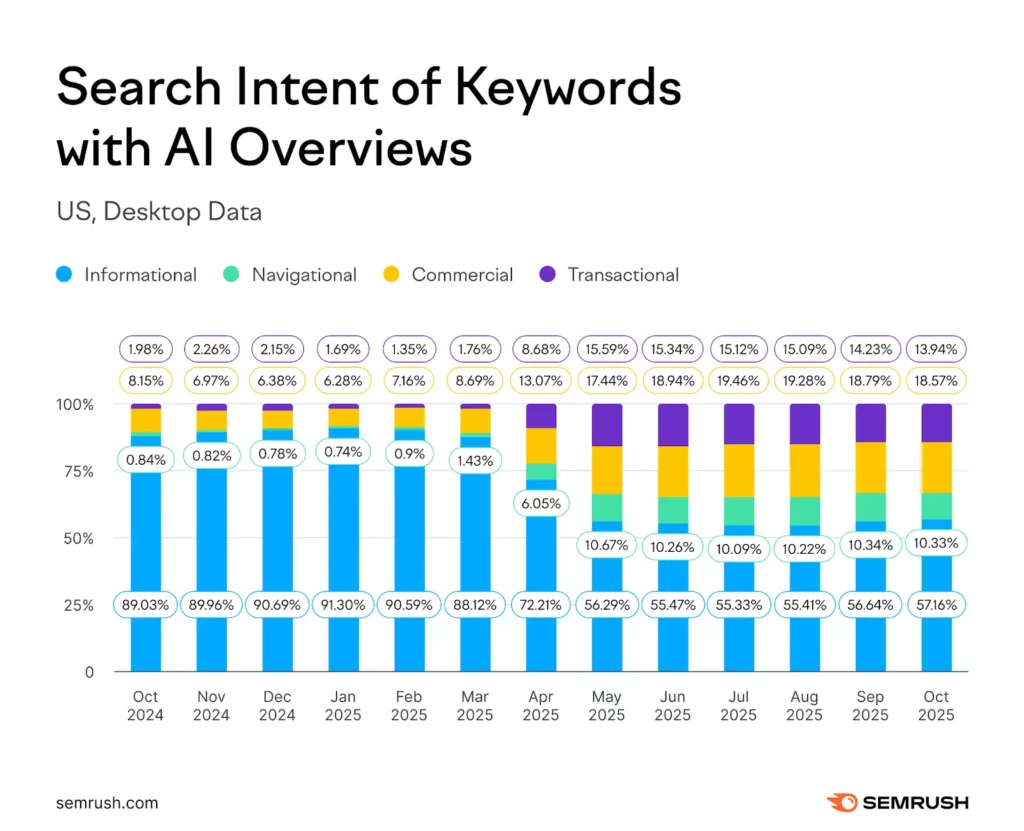
This is important because informational content is the standard for TOFU content. You publish, rank, get the click, and then try to turn that visit into a subscriber, lead, or customer. The page doesn’t need to convert on the spot. It just needs to bring the person in. AIOs weaken that model. You can keep the ranking and still lose the visit.
How To Adjust Your Strategy For Less Clicks In Organic Search
Knowing that AIOs cut CTR by 58% on average doesn’t tell you which of your pages are exposed, which are still working, or where revenue is actually at risk. These steps are about turning that general finding into something you can act on for your site.
1. Set up AI Overview tracking
It starts by understanding performance through reporting. Right now, most teams can’t see whether a drop came from lower rankings, click-through rates, or lower-value traffic. AIOs make that harder because clicks change, and rankings might not.
If you want to know what’s happening, you need a search view that separates AIO queries from the rest.
Start by splitting your tracked keywords into two groups:
1: Queries where an AIO appears
2: Queries where an AIO doesn’t.
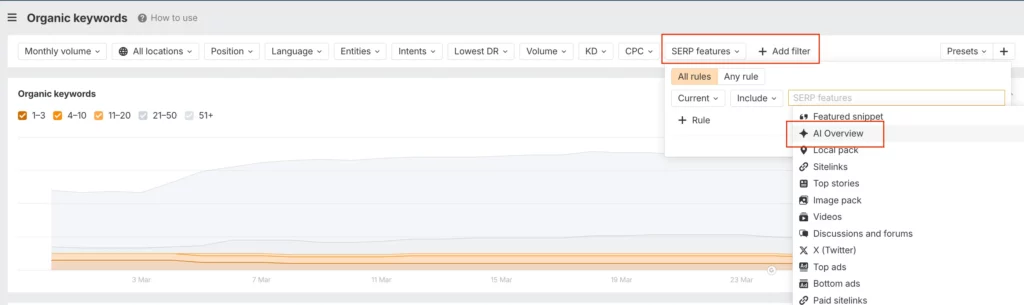
In Ahrefs, you can do that in Site Explorer > Organic keywords by filtering for the AI Overview SERP feature. Export that list and tag it in your reporting. You can do this manually, but it’s very time-consuming. I recommend using a tool.
From there, split the same keywords by intent: informational, comparison, commercial, and branded.
Informational terms are where AIO exposure is highest, and CTR is usually worst. Comparison and commercial terms still tend to send more clicks because the searcher needs further info. Branded terms are a different case again.
By separating these queries, you get a better idea of what’s losing out to AIO.
Then track rank, impressions, CTR, conversions, and assisted conversions for each segment. You are looking for one pattern in particular: rankings and impressions are steady, but CTR drops.
That usually points to a SERP change rather than a ranking loss. On queries where an AIO now appears, that often means Google is answering more of the query before a click is made.
Keep a separate list of pages that still drive leads or pipeline. Those are the pages where a click loss directly impacts revenue. Don’t mix them in with pages that only ever drove top-of-funnel traffic.
The point of this setup is to spot where CTR loss lines up with AIO exposure, separate that from ranking drops, and see which losses impact pipeline.
2. Make your high-intent pages harder to skip
You won’t win back every lost click, so don’t waste time trying. The best thing to do is to improve the pages where users do still click, to provide more value and a better experience.
Start with pages targeting comparison, alternatives, reviews, pricing, and strong use-case terms. These are the searches where people still need details before they act.
Pull the pages that already rank in the top five for those terms. Then work through them one by one. Rewrite the title tag and meta description to stand out more. Add elements like a comparison table, pricing details, screenshots, proof points, and recommendations near the top.
Don’t make the reader scroll through a long intro to find what they’re looking for. If someone lands on a buyer page, they should see the decision-making criteria straight away.
Next, build clear paths from informational pages to these pages. If you have a top-of-funnel article about the problem, link it to the comparison page, the alternatives page, or the use-case page.
Then tighten the conversion path. Add a better CTA, next step, and remove friction and dead ends.
A simple test helps here. Look for pages where rankings are holding, impressions are steady, but CTR is down. Those pages may not need a full rewrite. They may need a better reason to click.
That’s a better response to AIO click loss than chasing more volume.
3. Optimize for AI citations (GEO)
I’ll start by saying don’t replace your SEO strategy and focus only on AI search. It is still search. The fundamentals of SEO must be in place before even being considered for AI citations – but that doesn’t mean you shouldn’t optimize content for being cited.
A citation is also not a ranking you can hold. It can appear, disappear, and get replaced daily. Data from Ahrefs found that after an AIO refreshed, as many as 45.5% of citations changed. Authoritas found that 70% of AI Overview rankings changed within two to three months.
So yes, this is worth working on. No, it’s not something you control.
Start with the pages that are already important to the business. Comparison pages. Strong category pages. Product-led guides. Core educational content that feeds pipeline.
Put the answer or key information higher on the page. Like the example below, the post includes the definition and explanation before a scroll is needed.
Write headings that add more context. Use original data, research, or findings. Add tables and don’t create content that’s 5,000 words long with key information at the bottom.
Then clean up the elements of trust that AI looks for. Add a real byline. Show who wrote the content and their experience. Link related pages together so the important ones are easy to find. Keep your strongest pages updated regularly.
Just be honest about what this gets you. A citation will not always provide a click. But it still puts your brand in front of the user, and that has value.
4. Add information only you can provide
Stop publishing content that says the same thing as every other page. Search engines don’t rank that anymore, and AI won’t rely on it either.
The fix is to add information that only exists because you or your company has it.
- Product examples.
- Data analysis.
- Customer patterns.
- Internal benchmarks.
- Support-team questions.
- Sales objections.
- Implementation details.
- Experiment results.
It gives the reader more reason to click and read, whether it’s in the SERP or AIO. It gives AI more of a reason to pick it up, because no one else has it. It also opens up backlink opportunities for being the original source of data.
Google’s own guidance even says to focus on unique, non-commodity content for AI search. It also still mentions whether your content shows first-hand expertise and depth from actually using a product, service, or process.
In Seer’s 2026 study of 247 blog posts, original research earned more AI referrals than listicles and guides. That’s not saying Google always cites original data, but it does support the idea that pages with something new on them perform better AIO.
Keep one rule in mind when you do this: Don’t hide the data in a PDF, image, or lead magnet. The data needs to be on the page, near the top, and be clear.
5. Get more value from the traffic you still win
If AIOs only give you a few clicks, the obvious response is to get more value from the clicks you still win. Visits from AI search results tend to be higher quality too. If you’re currently doing nothing to capitalize on that, you’re losing out.
Capture emails from the traffic you do win
Email has always been a high-performing channel, but owned audiences are even more valuable now that organic traffic is unpredictable.
Email capture works best when you give something back to the reader. A weak ‘join our newsletter’ gives people no reason to act. A strong lead magnet gives them a reason to hand over their email.
GetResponse’s lead magnet study found that marketers most often saw the best conversion rates from video and written lead magnets, and that short-form versions tended to outperform longer ones.
The best lead magnets are specific, immediate, and useful. Things like generic ebooks underperform. They’re broad and slow to consume. Short, tightly matched offers convert better because the value is obvious fast.
Where you ask is important too. Don’t hit people with the form the second they land. Omnisend’s pop-up benchmark, based on 1.24 billion displays, found that pop-ups shown after a short delay performed better than immediate ones, with the best average conversion rate at 6 to 10 seconds.
It also found that forms with one to three fields performed about the same, while four or more fields caused a sharp drop.
Put the capture point where intent is already there: after the reader has had time to engage with the page, inside the content, or on exit when they are about to leave. Keep the ask tight. Keep the form short. If you use popups, make them earn the interruption.
Build retargeting audiences based on what people read
If you already run paid social or display, retargeting is one of the simplest ways to get more from search traffic. But it’s not for everyone. If traffic is low or you don’t run paid campaigns, skip it. But if you already have the setup, it’s a good way to stay in front of warm visitors instead of starting from zero.
Don’t put every visitor into one audience. Someone who read an educational post isn’t in the same place as someone who visited pricing or a comparison page.
Split those groups. Show educational readers more proof or give them the next step. Show pricing and comparison visitors a better product offer. Keep the message close to the page they read.
There is a reason marketers still put money here. AdRoll’s 2026 report found that display retargeting CPMs were up 18% year over year, while display prospecting CPMs were down 11%. That is a good sign that advertisers still see more value in getting back in front of people who already showed intent.
Match the next step to the page intent
This is where a lot of teams waste the traffic they do get. A visitor lands on a comparison page and gets asked to ‘subscribe for updates.’ A visitor reads a how-to post and gets pushed straight to a demo. Both are wrong.
The next step should fit the page:
- Informational content should feed email capture and nurture.
- Comparison and use-case content should push people toward a case study, product tour, or commercial page.
- Pricing and alternatives pages should move straight to demo, trial, or sales.
The same logic shows up in email performance. Campaign Monitor says marketers have seen a 760% increase in email revenue from segmented campaigns. The channel is different, but the lesson is the same: relevance increases value.
6. Build demand in channels Google doesn’t control
Organic search isn’t the only way to acquire new audiences, and it shouldn’t be relied upon either. That’s where a lot of teams are exposed. If Google controls discovery, traffic, and ultimately clicks now, one product change can hit all three at once.
There’s a reason budgets are moving elsewhere. CMI’s research found that marketers expect higher investment in video (61%), thought leadership content (52%), in-person events (35%), webinars (32%), and online communities (27%).
If you’ve been hit by a drop in clicks – and content quality isn’t the cause – start building demand in other channels:
Build an audience you own
Email is the most obvious place to start because you own the list. Litmus’ data shows 35% of marketing leaders report $10 to $36 back for every $1 spent, and 30% report $36 to $50 back. More importantly, email gives you a way to keep reaching people after the first visit instead of waiting for Google to send them back.
Put your thinking where buyers already spend time
For B2B teams, that means LinkedIn marketing, founder channels, and expert-led distribution. The value is reach and familiarity before the search. Edelman and LinkedIn’s B2B Thought Leadership report found that 71% of hidden decision-makers trust thought leadership more than conventional marketing when they assess a vendor’s capabilities.
Invest in formats that build a direct audience
Video, webinars, events, and community bring people to you directly through subscriptions, registrations, feeds, follow-ups, and repeat engagement. Video is a great option. LinkedIn says 78% of B2B marketers now use video, and the formats with the strongest reported ROI include short-form social, testimonials, demos, and brand storytelling.
Video content also gives people a reason to follow, come back, and click from places other than search.
Webinars and events do the same with higher intent. ON24 says the average webinar now drives more than 300 interactions, including 91 resource downloads, 19 survey responses, and 14 attendee questions. Goldcast says webinars on its platform were up 225%. That’s opted-in attention and first-party data you can use again.
Community works for the same reason email and social work: it gives people a reason to come back. That could be a newsletter community, a Slack group, a Discord, a private forum, a comments-led publication, or regular live sessions.
It’s slower than publishing a blog post, but you’re not chasing one click. You are building a place where people hear from you regularly, ask questions, share problems, and start to know your brand without the need for organic discovery.
Build audiences on social
Social gives you another place to build an audience without depending on Google. In B2B, that usually means LinkedIn for expert distribution and Reddit or other communities for authoritative discussion.
Edelman and LinkedIn found that 71% of hidden decision-makers are more likely to advocate for proposals from companies that produce high-quality thought leadership.
Reddit and SurveyMonkey found that at the decision stage, 63% of B2B buyers would ask an industry peer or a community discussion site. That’s an opportunity to build familiarity and trust with other audiences.
The mistake is using social with the mindset to drive clicks to landing pages. Social performs better when it gives value first, supporting links second. Publish original thoughts, guides, and insights. Give people a reason to follow, remember, and come back.
AI is also pulling content from social channels. BrightEdge says nearly 10% of AI citations come from social platforms like LinkedIn and Reddit, and Semrush found Reddit and LinkedIn among the most-cited domains across AI search experiences. So you also increase the chances of citations and improving E-E-A-T.
FAQ – AI Overviews
AI Overviews are Google-generated answers that appear above or alongside the standard search results for some queries. Google says they use AI to summarize information and surface supporting links, and that they are reported inside normal Search Console Performance data rather than in a separate report.
Yes. Ahrefs’ February 2026 update estimated that when an AI Overview appears, the page in position one gets about 58% fewer clicks than expected. That doesn’t explain every traffic drop, but it does show that AI Overviews are now a measurable cause of click loss.
Informational keywords are hit hardest. Ahrefs found the biggest CTR losses on informational queries, and its data showed position-one CTR on AI Overview keywords falling from 0.073 in December 2023 to 0.016 in December 2025.
Yes, but not with a separate technical playbook. Google says there are no additional requirements to appear in AI Overviews or AI Mode, so the work is still standard SEO: clear pages, crawlable content, strong internal linking, and genuinely useful information.
Track it in Search Console, then layer your own segmentation on top. Google says AI Overview clicks and impressions are counted in the normal Performance report, so the practical move is to split queries by AI Overview presence, intent, and brand vs. non-brand, then compare changes in impressions, CTR, rankings, and conversions.
No. You should stop valuing them the same way you did before. Informational content still helps with brand visibility, citations, email capture, and moving readers toward higher-intent pages, but it is a less reliable traffic source than it used to be.
Yes. A citation still puts your brand inside the answer, which can build awareness and support later branded searches or return visits. But citations are unstable, so they should be treated as a visibility win with upside, not as a traffic source you can count on the same way you count on a ranking.