
Both tools help marketers understand and improve visibility in AI search, but they do it in different ways. Semrush One is stronger if you want AI visibility tied into a bigger search workflow, with benchmark data, competitor research, and reporting built around a large prompt dataset. Peec AI is more focused on daily prompt tracking, source and citation analysis.
The hard part with AI search is knowing whether your brand shows up consistently, which prompts trigger that, which LLMs cite your content, and whether competitors are taking the spots you want.
Manual checks can show you some instances, but they don’t give you a reliable view of performance across ChatGPT, Gemini, Perplexity, Copilot, and Google’s AI search features.
That’s where these tools are useful. Semrush helps marketers size the market, compare brands, and report on AI visibility. Peec helps marketers monitor a chosen prompt set daily, review the chats, and connect changes in visibility back to sources and citations.
After comparing them, my view is: choose Semrush when you need stronger market context and reporting, and choose Peec when you need daily prompt monitoring and context planning.
I purposely left out SEO features from Semrush, as that wouldn’t be a fair comparison. I did a full Semrush One review here.
Quick verdict:
- Choose Semrush One if your team wants AI visibility inside the same workflow it already uses for search. It makes more sense for marketers who need market context, competitor benchmarks, and reporting.
- Choose Peec AI if your team is trying to improve AI visibility. It makes more sense for marketers who need to track specific prompts, see which sources AI relies on, and work out what to update, create, or promote next.
What Does Each Tool Do & Who Are They For?
Semrush One and Peec AI help marketers track AI visibility, but they have different purposes.
Semrush is aimed more at teams that need a view of the market, competitor movement, and overall brand presence in AI search.
Peec is more for teams that are trying to improve performance on a set of prompts and need better visibility into what LLMs are using, mentioning, and citing.
Semrush One vs Peec Comparison
| Attribute | Semrush One | Peec AI |
|---|---|---|
| Primary approach | Benchmarking + reporting + prompt tracking | Daily custom prompt monitoring + source analysis |
| Dataset model | Large prompt database (239M+ prompts/responses) | Your tracked prompts and stored chats |
| AI platform coverage | Stronger on broad research coverage | Stronger on custom multi-model tracking |
| Prompt tracking | Daily, but not the whole product | Core product workflow |
| Source/citation analysis | Good source and citation reporting | Deeper source, URL, and gap analysis |
| Sentiment/perception | Stronger brand perception reporting | Simpler prompt-level sentiment tracking |
| Segmentation/filtering | Good, but more report-led | Stronger for tags, topics, models, geos |
| Reporting / BI | Exports inside Semrush workflows | Looker Studio connector + API options |
| Pricing model | Fixed subscription tiers | Credit-based pricing |
| Best fit | Teams that want AI visibility inside a broader search workflow | Teams that want a specialist AI visibility workflow |
Semrush One overview
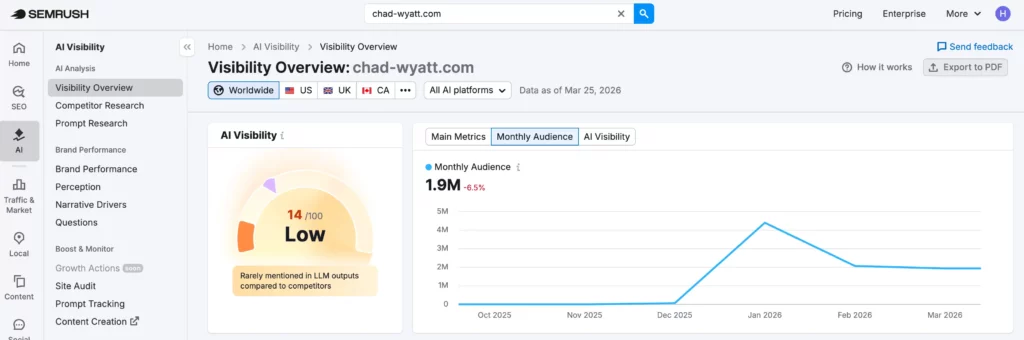
Semrush One is split across three areas:
- AI Analysis gives you market-level research from Semrush’s prompt database.
- Brand Performance tracks how LLMs describe your brand and competitors.
- Prompt Tracking monitors a custom set of prompts daily.
That setup gives you both market context and hands-on tracking. The downside is it’s less unified than it first appears. You are working across different datasets and updates rather than one single source of truth.
Semrush is a better fit for marketing teams that need to understand AI search topics, where competitors are being cited for gaps, and overall brand positioning within AI search. It’s not useful if you need deep, multi-model prompt monitoring across a wider set of AI systems every day.
Semrush gives you stronger market and competitor research than it gives you custom prompt tracking. Its daily tracking is useful, but it covers fewer AI models than the rest of the AI Visibility product suggests.
Semrush One key features
- 239M+ prompt database for market and competitor benchmarking
- Visibility Overview, Competitor Research, Prompt Research to find gaps and priorities
- Brand Performance for sentiment, share of voice, and brand perception
- Daily Prompt Tracking for custom prompts in ChatGPT Search and Google AI Mode
- AI Visibility score, mentions, audience, cited sources, cited pages for reporting
- AI Search Site Audit to catch crawl and access issues for AI search
Peec AI overview

Peec AI is more direct. You set up prompts, Peec runs them on a fixed cadence, stores the resulting chats, then turns those chats into visibility, sentiment, position, source, and citation data.
That structure keeps the product close to what a team can analyze and act on. You can see what the models said, what sources were used, and where your brand or domain is missing.
Peec is a better fit for teams that already know the prompts and journeys they care about and want to improve performance.
It’s stronger than Semrush on source intelligence and workflow clarity. It’s weaker on broad market benchmarking because it doesn’t have the same scale of prompt database or research coverage.
Peec is more operational. Semrush One is better for wider market research.
Peec AI key features
- Daily prompt runs across selected models
- Visibility, sentiment, and position tracking
- Brand visibility vs source visibility to separate mentions from content usage
- Domain and URL source analysis for retrieval and citation insights
- Tags, topics, and country/IP filtering for prompt segmentation
- Actions to group source opportunities into next steps
- Looker Studio connector and exports for reporting
| Feature | Semrush One | Peec AI |
|---|---|---|
| AI Search Coverage | Large AI search dataset & daily tracking in ChatGPT Search and Google AI Mode | Daily tracking across selected models and platforms |
| Visibility & Insights | Better for benchmarking and reporting | Better for prompt-level monitoring |
| Sources & Citations | Good source and citation reporting | Stronger source, URL, and gap analysis |
| Segmentation | Solid reporting filters | Stronger prompt, model, and geo segmentation |
| Reporting | Better inside a broader Semrush workflow | Better for AI visibility-focused reporting |
| Pricing | Fixed monthly plans | Credit-based pricing |
| Best Fit | Teams that want AI visibility inside a search workflow | Teams that want a specialist AI visibility tool |
Which Tool Gives You Better AI Search Coverage?
Semrush and Peec are a little different in coverage. Semrush covers the main AI search platforms, including ChatGPT, Gemini, Perplexity, SearchGPT, Google AI Mode, and AI Overviews. Peec’s coverage is slightly ahead, with Microsoft Copilot, Perplexity, and Grok, with Claude Sonnet 4 and GPT-5 Search on Enterprise.
So Semrush covers the core platforms well, while Peec gives you more to look into if cross-platform AI visibility is a priority.
Semrush One’s AI search coverage
Semrush includes the main AI search channels that marketers need. This includes ChatGPT, Gemini, Perplexity, SearchGPT, Google AI Mode, and Google AI Overviews.

The key thing to note is that coverage is not identical in every report. Semrush One Prompt Tracking covers Google AI Mode, AI Overviews, Gemini, and ChatGPT Search, while Brand Performance covers Google AI Mode, ChatGPT, SearchGPT, Perplexity, and Gemini.
I think that is fine for most teams, but it does mean you need to know which report you are in before assuming a channel is included there.
I found that strong enough for most marketing teams, but not as in-depth as a tool that gives you the same coverage everywhere in the product.
Semrush One AI coverage features
- Overall product coverage: ChatGPT, Gemini, Perplexity, SearchGPT, Google AI Mode, and AI Overviews
- Prompt Tracking coverage: Google AI Mode, AI Overviews, Gemini, and ChatGPT Search
- Brand Performance coverage: Google AI Mode, ChatGPT, SearchGPT, Perplexity, and Gemini
- Regional coverage: country and regional databases across multiple markets
Peec’s AI search coverage
Peec appears to cover more AI search channels overall. It includes ChatGPT, AI Mode, AI Overviews, Microsoft Copilot, Perplexity, Gemini, and Grok on standard plans, with Claude Sonnet 4 and GPT-5 Search listed on Enterprise.
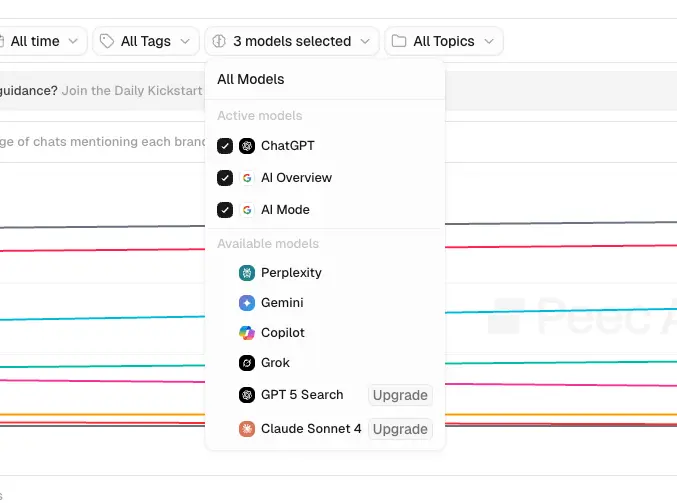
The extra channels are useful if your team wants to monitor AI visibility across more of the market, not just the biggest two or three platforms.
Peec also supports daily runs, country/IP-based setup, and channel-level filtering, so you can compare how visibility changes by platform and geography. I found that more useful for a deeper understanding of where a brand is showing up.
Peec AI coverage features
- Standard plan coverage: ChatGPT, AI Mode, AI Overviews, Copilot, Perplexity, Gemini, and Grok
- Enterprise adds: Claude Sonnet 4 and GPT-5 Search
- Geo coverage: country and IP-based runs
- Channel-level monitoring: compare visibility across selected platforms and models
Which Tool Gives You Stronger AI Analytics & Data?
I think the quality of data each tool gives you is important. But I also think it should be taken with a pinch of salt, as data is based on generated prompts, but it’s not a 100% accurate reflection of what a user sees, as prompts can return different results for different people.
Semrush gives you more planning data and market-level estimates. Peec gives you more direct evidence from the prompts and chats it runs.
Semrush One’s AI dataset and research data
Semrush is better for planning and prioritization. The data helps see AI visibility by topic, where competitors are positioned, and which areas are worth targeting before investing time in new campaigns.

That comes from Semrush’s AI Analysis system, which uses a database of more than 239 million prompts and responses and reports metrics such as AI Visibility, Mentions, Monthly Audience, Topic Opportunities, and Prompt Research data.
What I find most useful here is the topic and audience data, because it helps you decide where effort is likely to get results. What’s less useful is accuracy. Semrush states that several of these metrics are modeled or estimated, so they are best used as directional data for planning rather than hard proof of performance.
Semrush One analytics & data features
- 239M+ prompt and response database for large-scale analysis
- AI Visibility, Mentions, Monthly Audience for benchmarking and reporting
- Topic Opportunities and Prompt Research for finding demand and content gaps
- Best for planning what to target next, not for inspecting one prompt in detail
Peec AI’s prompt and chat-level data
Peec is better when you want to inspect the evidence behind the numbers. Its analytics are built from the chats it generates by running your prompts daily, and those chats feed the rest of the product: visibility trends, position, sentiment, source analysis, and competitor comparisons.
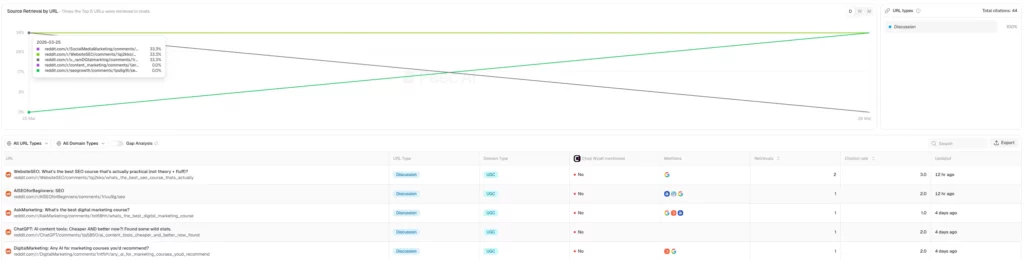
That makes the data easier to trust because you can go back to the underlying response instead of relying on summary metrics.
What I find more useful in Peec is the way it keeps the data close to the prompt, the model, and the source. You can look at brand visibility versus source visibility, review recent chats, and filter performance by tags, topics, competitors, and date range.
That gives content teams a clearer read on what changed and why. What’s missing is the bigger market-sizing view that Semrush gives you.
Peec analytics & data features
- Analytics built from stored chats run on your prompt set
- Visibility, sentiment, and position tied closely to tracked responses
- Brand visibility vs source visibility to separate mentions from content usage
- Best for diagnosis when you need to see what changed on specific prompts and sources
Which Tool Gives Better AI Visibility Metrics and Prompt Insights?
The useful difference here is not the data each tool shows, but how easy it is to use. Semrush gives you a larger set of metrics for reporting, trend spotting, and topic discovery, while Peec keeps its metrics more to the actual prompts, responses, and sources behind them.
So Semrush is better when you need a larger reporting view, and Peec is better when you need metrics that are easier to link to what changed.
Semrush One’s AI visibility and prompt insights
In Visibility Overview, Semrush reports AI Visibility, Mentions, Monthly Audience, Performing Topics, Topic Opportunities, Cited Sources, Source Opportunities, and Cited Pages.
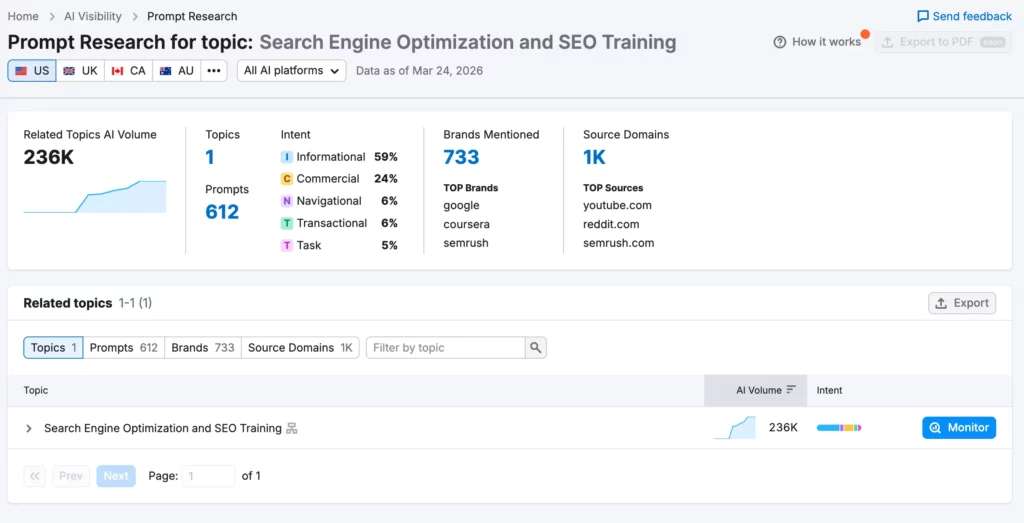
In Prompt Research, it adds AI Topic Volume, Topic Difficulty, intent, and the brands already showing up for those prompts.
I found this most useful when deciding where to focus, as it helps turn AI visibility into a list of topics, gaps, and competitors.
Semrush also gives you more executive-friendly prompt insights through Brand Performance, where you can track share of voice, sentiment, narrative drivers, and the questions informing brand coverage.
The weak point is the headline numbers are estimates or benchmark scores, and Prompt Tracking doesn’t include everything a marketer might expect for AI search.
Semrush says Estimated Traffic, Search Volume, and Share of Voice are not available there, so I would treat the reporting metrics as guidance, not a source of truth.
Semrush One visibility & prompt features
- AI Visibility, Mentions, Monthly Audience for top-line reporting
- Topic Opportunities and Prompt Research for finding missed themes and competitor gaps
- Brand Performance for share of voice, sentiment, and narrative analysis
- Prompt Tracking adds prompt-level metrics, but some AI search fields are missing
Peec AI’s visibility, sentiment, position, and prompt insights
Peec gives you a smaller metric set, but it’s easier to read and act on. Its primary metrics are Visibility, Share of Voice, Sentiment, and Position, which are calculated from chats Peec runs and stores.

I found Position especially useful because it helps understand brand position when AI cites you. Which is easier to work with than abstract benchmark scores.
The other thing Peec does well is separate brand visibility from source visibility. Giving a cleaner diagnosis. You can tell whether the problem is with AI not naming your brand, not using your content, or doing one without the other.
Peec also lets you filter performance by competitor, date range, tags, models, country, and topics, which makes the prompt insights more beneficial for teams reviewing changes by segment rather than looking only at one aggregate number.
Peec visibility & prompt features
- Filters by tags, topics, models, country, and date range for cleaner prompt insights
- Visibility, Share of Voice, Sentiment, Position as the core metrics
- Brand visibility vs source visibility to separate mentions from content usage
- Recent chats and competitor views to inspect what actually changed
Which Tool Gives Better Source, Citation, and Action Workflows?
Both tools show which sites and pages influence AI answers, but they handle that workflow differently. Semrush is better at showing where competitors are getting cited and where you are missing. Peec is better at turning that gap into a more usable content or distribution workflow.
Semrush One’s source and citation workflow
Semrush gives you a good view of which domains and pages are impacting AI visibility. Its AI visibility reports include Cited Sources, Cited Pages, and Source Opportunities, so you can see which external sites AI uses most, which of your own pages get picked up, and where competitors are appearing instead of you.
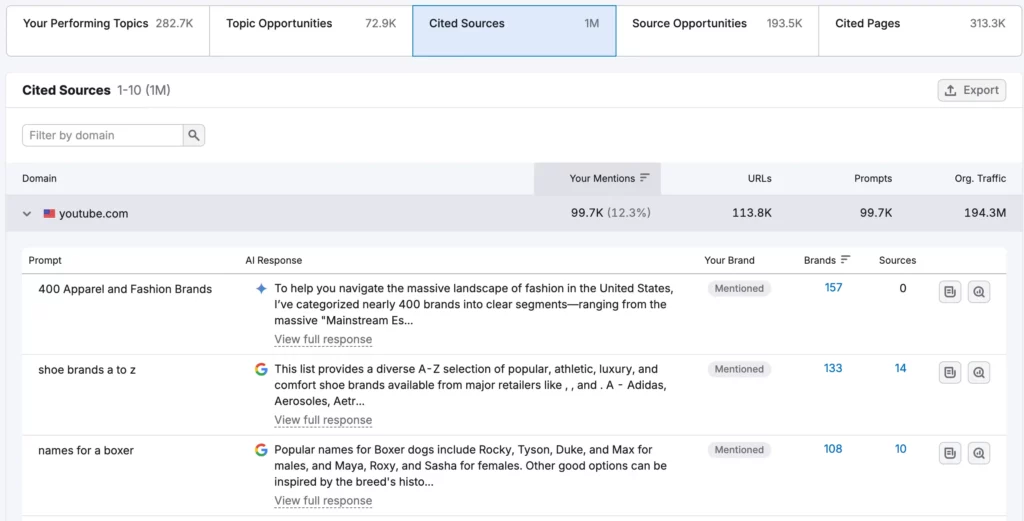
I found this most useful when quickly reviewing a topic, as it shows which sites influence visibility without needing a complex setup.
Where Semrush is weaker is the process from insight to action. It shows the gap, but you still have to decide whether the right move is new content, better formatting, PR, or outreach.
That makes it good for spotting patterns and prioritizing sources, but less useful when you are not as experienced and need the tool to guide the next step.
Semrush One source and citation workflow features
- Cited Sources to show which external domains AI tools reference most.
- Cited Pages to show which pages from your site are already being used.
- Source Opportunities to find sites citing competitors but not you.
- Best for spotting source gaps and competitor citation patterns.
Peec AI’s sources, citations, gap analysis, and Actions
Peec gives you more detail on the source. You can review sources at the domain and URL level, and its docs separate sources from citations, useful because AI can use a page without citing it.

I found that distinction more helpful than citation count, because it tells you whether the issue is visibility, source usage, or both.
Peec also helps with the next step. Its Actions workflow groups similar source opportunities together and suggests what to do, such as creating a page type AI already trusts or improving your presence on external sites that keep appearing in answers.
That makes the workflow more practical for marketers who need to decide where to put effort.
Peec AI source and action workflow features
- Actions to turn source gaps into clearer next steps.
- Domain and URL views for source-level analysis.
- Sources vs citations to separate used pages from explicitly cited ones.
- Gap analysis to find where competitors appear and you don’t.
Which Pricing Model Delivers Better Value?
Each tool gives you value in different ways. Semrush gives you more included research, reporting, and planning features at the base level. Peec gives you more prompt tracking, model coverage, and monitoring capacity for the money.
So the better value depends on whether your team needs general insights or more hands-on AI visibility workflows.
Semrush One pricing and value
At the base level, the Semrush $99 AI Visibility Toolkit includes benchmarking, Prompt Research, Brand Performance, AI Search checks in Site Audit, and exports, so the value is strongest for teams that need reporting and planning as much as monitoring.
I found that easier to justify for in-house teams and agencies that need to justify AI visibility.
| Semrush plan | Price | What you get |
|---|---|---|
| AI Visibility Toolkit | $99/mo | 25 tracked prompts, 1 Brand Performance domain, 300 daily AI Analysis queries, 1,000 daily Prompt Research queries, AI Search Checks for 100 pages, 10 CSV exports |
| Semrush One Starter | $199/mo | AI Visibility Toolkit + SEO Pro plan, 50 tracked prompts |
| Semrush One Pro+ | $299/mo | AI Visibility Toolkit + SEO Guru plan, 100 tracked prompts |
| Semrush One Advanced | $549/mo | AI Visibility Toolkit + SEO Business plan, 200 tracked prompts |
As you move up to Semrush One, there’s more prompt capacity plus the full SEO stack around it. That makes Semrush One Starter the better value if you already need Semrush for SEO, while the standalone AI Visibility Toolkit is the better value if you only want the AI visibility product.
Against Peec’s base plan, Semrush gives you more research and reporting value, but less raw tracking capacity at the entry point.
Peec AI pricing and value
Peec gives you more tracking capacity at the entry level. The €85 Starter plan includes 50 prompts, 3 models, daily tracking, and unlimited users, which is a stronger base offer. I think that makes Peec easier to justify for teams, because you are paying for actual tracking volume and collaboration, not just reporting access.
It also scales: Pro adds more prompts and projects, while Advanced is where it starts to make more sense for multi-market teams because you get 3 countries per project, Looker, and GSC/GA integrations.
| Peec plan | Price (USD) | What you get |
|---|---|---|
| Starter | $95/mo | 50 prompts, 3 models, unlimited users, daily tracking, 1 project |
| Pro | $245/mo | 150 prompts, 3 models, unlimited users, daily tracking, 2 projects |
| Advanced | $495/mo | 350 prompts, 3 models, unlimited users, daily tracking, 5 projects, 3 countries per project, Looker + GSC/GA integrations |
| Enterprise | Custom | Unlimited models, unlimited projects, daily or weekly tracking, API access, SSO |
Compared with Semrush’s base AI Visibility plan, Peec gives you more monitoring value, while Semrush gives you more built-in research and reporting value.
If your team needs to track prompts across several models every day and work from that data, Peec’s base plan is the better value.
If your team cares more about benchmark reports, topic research, and management reporting, Semrush still makes the easier business case.
One useful extra with Peec is that you can add another model without changing plan, with add-on pricing at €30/mo on Starter, €70/mo on Pro, and €140/mo on Advanced.
Which Tool Is Better For Different Team Sizes & Workflows?
The biggest difference here is who will use the tool each week. Some teams need AI visibility data to brief leadership, compare brands, and plan. Other teams need it for content updates, PR targets, and GEO reviews.
Semrush is positioned towards SMBs, agencies, and mid-market teams, while Peec fits teams where someone is expected to dive deeper into the platform data and turn what they find into content, PR, or GEO actions.
Semrush One fit by team type
Semrush is a better fit for a marketing lead, SEO lead, or account lead who needs to turn the data into decisions for other people. I think it works best in teams who need to spot weaknesses, compare against competitors, and give the business direction where to invest next.
That suits in-house teams with regular monthly reporting and agencies that want a more standard client workflow.
It’s a weaker fit for teams that need to spend time diving into data inside the tool, making lots of small decisions.
If the workflow depends on checking prompts every day, reviewing source-level changes, and adjusting work by market or audience segment, Semrush can do part of that, but it’s not a strong point.
Semrush One is a strong fit for:
- A marketing or SEO lead who needs to explain AI visibility clearly to leadership
- An agency account team that wants a consistent review format across clients
- A brand team that needs competitor context before committing budget or content effort
- A small or mid-sized team that wants AI visibility without building a separate operating process
Peec AI fit by team type
Peec is a better fit when AI visibility has dedicated ownership. In teams where someone is expected to review changes, look at sources, and turn that into work for content, PR, or GEO each week.
That makes it a better match for GEO specialists, content operations teams, and agencies offering AI visibility as an active service rather than a monthly add-on.
It also fits teams that need more than one person in the product. Peec includes unlimited users on standard plans, and its docs put tags, topics, and prompt organization at the center of the workflow.
That’s useful when strategy, content, and client teams all need access to the same dataset without adding seat costs or building manual handoffs.
Peec AI is a strong fit for:
- A cross-functional team that needs shared access without paying for extra seats
- A GEO or AEO specialist running AI visibility as a weekly channel
- A content team using citations and source gaps to plan updates and new pages
- An agency delivery team managing prompt sets across multiple clients or brands
Additional Features Worth Noting
There are the smaller features that are easy to miss, but they can make a difference once a team starts using the product week to week.
Semrush One

Semrush’s less obvious features are mostly about making AI visibility easier to inspect and present. I found these more useful in reviews, stakeholder meetings, and side-by-side checks.
- SERP snapshots in Prompt Tracking let you open the actual ChatGPT Search or Google AI Mode result for a tracked prompt.
- Multitargeting lets you compare AI search visibility next to traditional Google, Bing, or Baidu results in the same tracking setup.
- AI-specific SERP feature filters help you isolate response areas, citations, and shopping ads inside AI search results.
- Questions Panel in Brand Performance shows the full unedited AI response behind the report, which is useful when you want to check exactly how a platform described the brand.
Peec AI
Peec’s additional features are helpful for explaining why a result happened and keeping a growing prompt library manageable. I find these more useful for teams that plan to use the tool regularly rather than just pull a monthly report.

- Query fanouts for ChatGPT show the extra searches the model ran while building an answer, plus the common terms across those fanouts.
- Auto-detected competitors speed up setup by suggesting brands found in your prompt responses.
- Inactive prompts keep history so you can stop tracking a prompt without losing the chats and source data it already generated.
- Regex-based brand detection rules help when competitor or brand names are messy, ambiguous, or easy to misclassify.
Final Verdict: Semrush One vs Peec AI. Which Should You Choose?
Most teams do not need both. Semrush One is the better choice when AI visibility needs to support planning, competitor context, and stakeholder reporting in one place. Peec AI is the better choice when AI visibility has a clear owner and the team needs answers on what changed, where it changed, and what to work on next.
| Use Case | Best Choice | Why It Fits |
|---|---|---|
| Leadership reporting on AI visibility | Semrush One | Clearer trend and competitor reporting for leadership. |
| Brand and comms teams tracking perception | Semrush One | Stronger for understanding how AI describes the brand. |
| Agencies that need a clean client review process | Semrush One | Better for standardized client reporting and reviews. |
| Teams deciding where to invest next | Semrush One | Better for spotting where to focus next. |
| GEO or AEO specialists doing weekly optimization | Peec AI | Better for regular hands-on optimization work. |
| Content teams deciding what to update or create | Peec AI | Stronger source and citation detail for content decisions. |
| Teams monitoring prompts across several models and markets | Peec AI | Better for multi-model and multi-market tracking. |
| Cross-functional teams sharing one AI visibility workflow | Peec AI | Unlimited users make shared access easier. |
| Teams focused only on AI visibility, not broader search reporting | Peec AI | More value goes into day-to-day AI visibility work. |
| Teams that want the safer all-round choice | Semrush One | Easier to buy, explain, and roll out. |
My view after comparing them: Semrush is the safer management buy, while Peec is the stronger specialist buy.
Choose Semrush One when:
- AI visibility needs to fit into an existing marketing reporting process
- Leadership wants a clearer view of competitors and market movement
- Your team wants one platform that is easier to roll out and explain internally
Choose Peec AI when:
- AI visibility is something the team actively works on every week
- Content, PR, or GEO decisions depend on source and citation changes
- Multiple people need shared access to the same prompt and source data without extra seat friction
Those use cases line up with how Semrush positions AI Visibility for marketers and agencies, and how Peec centers its product on daily prompt runs, source analysis, and Actions.
Take action
If your team is still figuring out AI visibility and wants one tool that covers research, reporting, and prompt tracking, start with Semrush One.
If your team already sees AI visibility as an active channel and needs better prompt, source, and action workflows, Peec AI is the better pick.
How I tested these tools
I tested Semrush One and Peec AI by working through the core AI visibility workflows in each platform. I looked at how each one handles prompt tracking, visibility reporting, source and citation analysis, segmentation, exports, and day-to-day usability. I also compared how easy it was to move from the data itself to an actual decision about what to publish, update, or improve next.
FAQ: Semrush One vs Peec AI
Neither is better for every team. Semrush One is the better pick if you want AI visibility tied to market research, competitor benchmarking, brand reporting, and prompt tracking in one product. Peec AI is the better pick if you want a tool built around daily prompt monitoring, source analysis, and turning citation gaps into clear next steps.
Semrush starts with a large research database and wraps reporting around it. Peec starts with the prompts you choose, runs them daily, stores the chats, and builds the analysis from those responses. That means Semrush is better for market context, while Peec is usually better for hands-on monitoring and follow-up work.
Semrush analyzes far more prompts overall because its AI Visibility product uses a database of 239M+ prompts and responses. But for your own custom tracked prompts, the answer depends on plan limits in Semrush and credit allocation in Peec, so Peec can be the better fit when you want flexible tracking across your own prompt set.
Usually, yes. Semrush shows Cited Sources, Cited Pages, and Source Opportunities, which is useful for spotting where competitors are getting picked up. Peec goes further with domain and URL views, source classifications, gap analysis, and Actions tied to those source gaps, so it gives marketers a clearer workflow after they find the problem.
Peec AI is usually the stronger choice for daily prompt tracking because that is the center of the product. Semrush does offer daily Prompt Tracking, but it sits alongside its research and brand-reporting products rather than driving the whole workflow.
It depends on how you plan to use it. Semrush is easier to budget because the AI Visibility Toolkit starts at $99/month and Semrush One starts at $199/month, with set prompt limits by tier. Peec is easier to justify when AI visibility is active weekly work, because its credit model scales with how many prompts, models, and daily runs you actually want.
Yes. Semrush’s Brand Performance reports track share of voice, sentiment, and narrative drivers, while Peec tracks Visibility, Share of Voice, Sentiment, and Position across tracked prompts. The difference is that Semrush does more on brand-level reporting, while Peec keeps those metrics closer to prompt-level monitoring.
Both can work for agencies, but they suit different agency models. Semrush is stronger for agencies that want standardized reporting and competitor research inside one broader search platform, while Peec is better for agencies running AI visibility as a service and needing flexible prompt allocation across clients.
For many teams, Semrush One is enough. It already includes AI visibility benchmarking, Brand Performance, Prompt Tracking, and AI-readiness checks. Peec is still worth buying when AI visibility is important enough to need a more focused workflow for daily prompts, source gaps, and action planning.