
The latest LinkedIn statistics show why it’s an important marketing channel. It’s a serious platform for B2B visibility, content distribution, paid targeting, and lead generation, which puts it firmly in the top tier of platforms marketers need to be using in some form.
The audience is professional, the targeting is built around business attributes, and the content is still heavily shaped by industry relevance, credibility, and intent.
For brands trying to reach decision-makers, build authority, or turn content into pipeline, LinkedIn is one of the few places where organic reach, audience quality, and paid performance still overlap.
These LinkedIn stats will give you an idea of what opportunities exist when marketing on the platform.
Key LinkedIn Statistics
| Key LinkedIn Statistics |
|---|
| LinkedIn has more than 1.3 billion members. |
| LinkedIn ads reached 1.20 billion members in January 2025. |
| LinkedIn’s ad-reachable audience grew by 176 million year over year, or 17.1%, between January 2024 and January 2025. |
| 4 out of 5 members use LinkedIn to inform business decisions. |
| 71% of B2B buyer groups are now Millennials or Gen Z. |
| Approximately 40% of LinkedIn visitors engage with a Page organically every week. |
| LinkedIn had the highest average engagement rate across major platforms at 6.50%. |
| LinkedIn’s median engagement rate rose from 6.00% in January 2024 to 8.01% in January 2025. |
| Carousels earn 278% more engagement than video, 303% more than images, and 596% more than text-only posts. |
| Advertisers see 2x higher conversion rates with LinkedIn Ads. |
LinkedIn User and Audience Statistics
The latest LinkedIn user statistics show that LinkedIn is a global platform with a huge professional audience, regional coverage, and reach for both organic visibility and paid distribution.
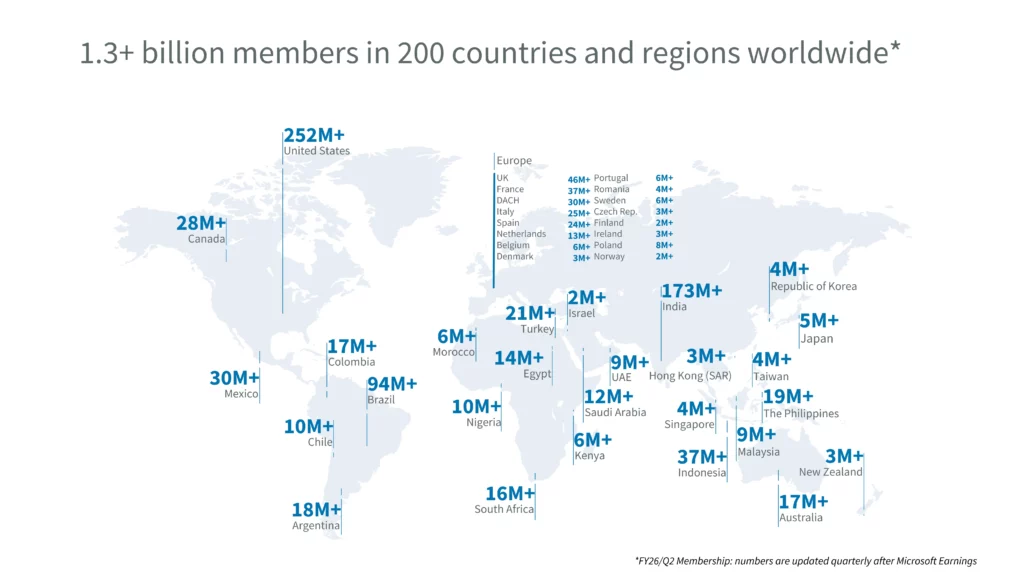
For marketers, it’s an opportunity for brand awareness, thought leadership, lead generation, and paid campaigns targeted at business decision-makers. These are are latest user and audience stats:
- LinkedIn has more than 1.3 billion members. (source)
- LinkedIn operates in more than 200 countries and territories worldwide. (source)
- LinkedIn has 70 million-plus companies listed on the platform. (source)
- LinkedIn also lists more than 144,000 schools and 42,000 skills. (source)
- 385 million-plus members are in Asia Pacific. (source)
- 407 million-plus members are in Europe, the Middle East, and Africa. (source)
- 280 million-plus members are in North America. (source)
- 212 million-plus members are in South and Central America. (source)
The more important point for marketers is that LinkedIn’s audience is large in both absolute and usable terms. There’s a difference between total registered members and active users, but even with that caveat, the audience is still huge. This gives LinkedIn enough scale to bring results as a content channel.
- LinkedIn ads reached 1.20 billion members in January 2025. (source)
- That means 20.7% of the world’s adults had a LinkedIn account at the time of reporting. (source)
- LinkedIn reached 21.6% of global internet users at the start of 2025. (source)
North America accounts for 277 million members, or 23.1% of LinkedIn’s global total.
- LinkedIn’s ad-reachable audience grew by 17.1% year over year going into 2025. (source)
- That was equal to 176 million more reachable members than a year earlier. (source)
- Approximately 61.3 million companies have a Page on LinkedIn. (source)
- Roughly 40% of visitors engage with a Page organically every week. (source)
LinkedIn is strongest in a handful of major markets, but the spread is wide enough that it has real international value. For marketers, it means global reach is not limited to the US and a few English-speaking countries.
- The United States has the largest LinkedIn audience, with 250 million registered members. (source)
- India is LinkedIn’s second-largest market, with 150 million registered members. (source)
- Brazil follows with 81 million registered members. (source)
- China has 57 million registered members on LinkedIn’s ad tools. (source)
- The United Kingdom has 45 million registered members. (source)
- France has 34 million registered members. (source)
- North America accounts for 277 million members, or 23.1% of LinkedIn’s global total. (source)
- Southern America accounts for 148 million members, or 12.3% of the global total. (source)
- Western Europe accounts for 81.9 million members, or 6.8% of the global total. (source)
- Northern Europe accounts for 65.4 million members, or 5.4% of the global total. (source)
LinkedIn Demographic Statistics
These LinkedIn demographic stats show that the platform still stands out from other social networks. The audience skews professional, the age profile sits in the core working years, and the seniority mix – why it’s a stronger B2B marketing channel than other socials.
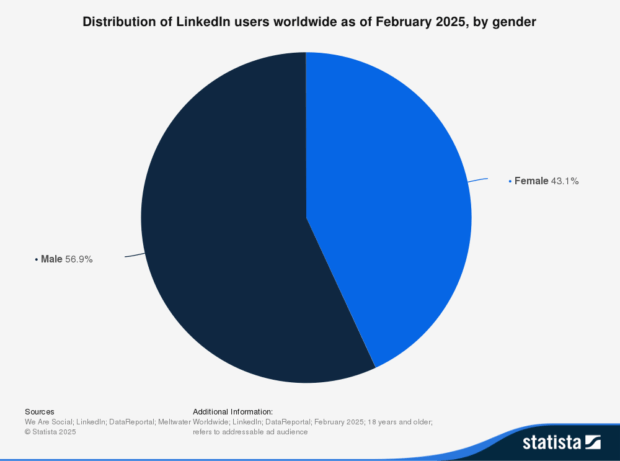
One caveat: some of the numbers below come from LinkedIn’s ad-planning tools, so they reflect LinkedIn’s ad audience rather than its full active user base.
- LinkedIn’s global ad audience was 43.1% female in January 2025. (source)
- LinkedIn’s global ad audience was 56.9% male in January 2025. (source)
- Females accounted for 50.9% of LinkedIn’s ad audience in the Caribbean. (source)
- Females accounted for 49.6% of LinkedIn’s ad audience in North America. (source)
- Females accounted for 31.5% of LinkedIn’s ad audience in Western Asia. (source)
- Females accounted for 29.7% of LinkedIn’s ad audience in Southern Asia. (source)
The gender split is interesting, but the more useful data for marketers is that LinkedIn is heavily concentrated in working-age cohorts. It’s not a youth-first entertainment platform, and it’s not dominated by retirees either. It sits in the middle, which is exactly where most business buying, career growth, and professional influence happen.
- LinkedIn’s average audience age sits in the 25 to 34 range. (source)
- In the US, 40% of adults aged 30 to 49 use LinkedIn. (source)
- In the US, LinkedIn use sits at roughly three in ten among adults aged 18 to 29 and 50 to 64. (source)
- In the US, 12% of adults aged 65 and older use LinkedIn. (source)
53% of U.S. LinkedIn users are in the high-income bracket.
For LinkedIn’s global ad audience (source):
- 26.8% are men aged 25 to 34.
- 20.5% are women aged 25 to 34.
- 16.2% are men aged 18 to 24.
- 12.5% are women aged 18 to 24.
- 11.7% are men aged 35 to 54.
- 9% are women aged 35 to 54.
- 2.2% are men aged 55 and over.
- 1.1% are women aged 55 and over.
This is where LinkedIn stands out. It’s full of the kinds of people marketers want to reach: decision-makers, senior operators, and educated professional audiences. That doesn’t mean every LinkedIn campaign will work, but it does explain why the platform is a key part of B2B budgets and thought-leadership strategies.
- LinkedIn says it has 180 million senior-level influencers on the platform. (source)
- LinkedIn says it has 63 million decision-makers on the platform. (source)
- LinkedIn says it has 10 million C-level executives on the platform. (source)
In terms of education (source):
- In the US, 53% of adults with at least a bachelor’s degree use LinkedIn.
- In the US, 28% of adults with some college education use LinkedIn.
- In the US, 10% of adults with a high school education or less use LinkedIn.
- 54% of U.S. college graduates use LinkedIn.
- 31% of U.S. adults with some college education use LinkedIn.
- 12% of U.S. adults with a high school education or less use LinkedIn.
- One-third of LinkedIn members had a bachelor’s degree or equivalent in February 2025.
- 18% of LinkedIn members held a master’s degree or equivalent in February 2025.
LinkedIn’s average audience age sits in the 25 to 34 range.
When looking at income (source):
- 53% of U.S. LinkedIn users are in the high-income bracket.
- 29% of U.S. LinkedIn users are in the middle-income bracket.
- 18% of U.S. LinkedIn users are in the low-income bracket.
LinkedIn Usage and Engagement Statistics
These LinkedIn statistics give insights into the day-to-day activity behind the membership numbers. For marketers, it’s important to know whether people are actually using LinkedIn, engaging with content, and interacting with Pages to assess the potential ROI of marketing efforts.
You might also want to read whether links impact LinkedIn post performance.
- LinkedIn members view more than 1.8 million feed updates every minute. (source)
- LinkedIn members make more than 17,000 connections every minute. (source)
- LinkedIn members consume roughly 147 hours of learning content every minute. (source)
- From 1 January – 30 June 2025, LinkedIn reported 213.1 million logged-out site visits from EU-based users. (source)
LinkedIn’s member count tells you how large the platform is, but what makes LinkedIn useful is that people still use it actively. They post, comment, reshare, click, and come back. For marketers, that’s the difference between a large user base on paper and a channel that can still distribute content.
- Approximately 40% of LinkedIn visitors engage with a Page organically every week. (source)
- Pages with complete information get 30% more weekly views than incomplete Pages. (source)
- Companies that post weekly see 2x higher engagement on LinkedIn. (source)
- Pages that post weekly have 5.6x more followers than Pages that post monthly. (source)
- Pages become much easier to grow once they reach 150 followers. (source)
- Posting up to one important employee notification per week to boost organic reach and engagement. (source)
In one study – carousels earned 196% more engagement than video posts.
The LinkedIn algorithm prefers consistent Page activity. A complete page performs better, a regularly updated page gets more engagement, and a page with some followers already becomes easier to grow. Basic activity and consistency still move the needle.
- Video drives 5x more engagement than other post formats on Pages. (source)
- Live video gets 24x more engagement than regular video. (source)
- Live videos get 7x more reactions than native video from the same broadcasters. (source)
- Live videos also get 24x more comments than native video from the same broadcasters. (source)
- LinkedIn’s total video viewership was up 36% year over year in FY25 Q1. (source)
- Weekly immersive video views on LinkedIn increased 6x quarter over quarter in FY25 Q1. (source)
- Gen Z logs 82% more video views than the average LinkedIn member. (source)
LinkedIn is still a text-heavy platform in a lot of marketers’ minds, but the numbers show that video and live formats are driving a growing share of interaction. That doesn’t mean every brand needs to become video-first, but it does mean usage patterns on LinkedIn are not just feed posts and static updates.
- LinkedIn Pages see more than 2 billion interactions per month. (source)
- Images on LinkedIn Pages typically generate a 2x higher comment rate. (source)
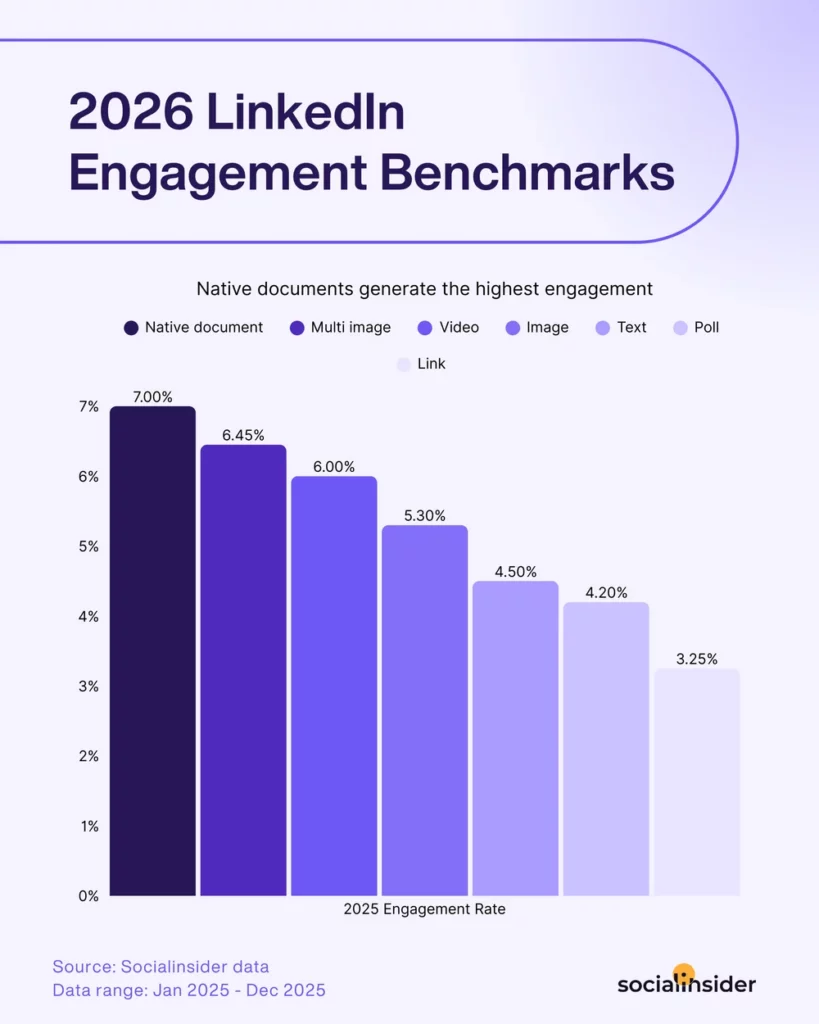
In an analysis of 1.3 million LinkedIn business posts, average engagement rates were (source):
- 5.20% for LinkedIn in general, in 2026, up 8% year over year.
- 7% for native document posts, the highest average, up 14% year over year.
- 6.45% for multi-image posts.
- 6% for video posts.
- 5.3% for image posts.
- 4.5% for text-only posts.
- 4.2% for poll posts.
- 3.25% for link posts.
Content engagement among SMBs has increased 25x over the past two years.
- Polls generated the highest impression rate on LinkedIn in 2025. (source)
- Multi-image posts drive more likes across all Page sizes. (source)
In a 45M+ post content-format study, median engagement rates were (source):
- 21.77% for carousel/document posts.
- 7.35% for video posts.
- 6.52% for image posts.
- 3.81% for link posts.
- 3.18% for text-only posts.
It also found that:
- Carousels earned 196% more engagement than video posts.
- Carousels earned 234% more engagement than image posts.
- Carousels earned 585% more engagement than text-only posts.
Additionally:
- Video creation is growing at twice the rate of other post formats on the platform. (source)
- Approximately 69 million companies and organizations actively manage a LinkedIn Page. (source)
- Nearly 11 million LinkedIn Pages post weekly. (source)
- Content engagement among SMBs has increased 25x over the past two years. (source)
- 150 million SMBs are active on the platform worldwide. (source)
- 56% of B2B audiences prefer to read thought leadership content, while 44% prefer to listen to it or watch it as a podcast or video. (source)
LinkedIn Advertising Statistics
These statistics show why marketers keep spending on the platform even when costs are some of the most expensive out there.
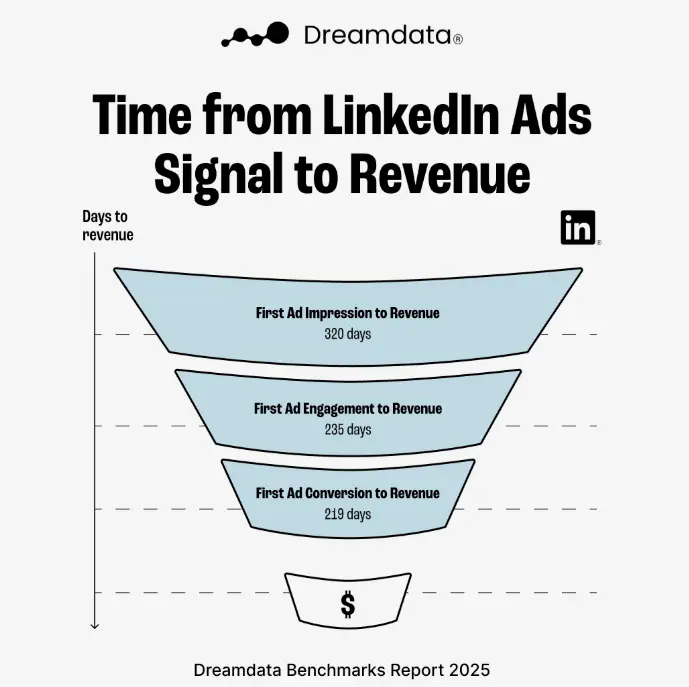
LinkedIn Ads are usually judged on CPC or CPM, but it’s better to look at efficiency at the account, pipeline, and revenue level. That’s where the platform’s value shows.
- LinkedIn Ads’ share of total B2B ad budgets grew from 31% in H1 2024 to 39% by year-end 2024. (source)
- LinkedIn delivered 113% ROAS, compared with 78% for Google Search and 29% for Meta Ads. (source)
- Cost per company influenced was 25% higher on Google Search Ads and 70% higher on Meta than on LinkedIn Ads. (source)
- LinkedIn Ads influenced 29% of MQLs, 36% of SQLs, and 35% of new business deals. (source)
- The minimum daily budget to start advertising is $10. (source)
- The minimum lifetime budget for a new inactive campaign is $100. (source)
Understanding budgets is important because LinkedIn isn’t competing on cheap traffic. It’s competing on deal influence, pipeline quality, and the ability to reach the right accounts. That’s also why quarter-by-quarter return patterns are more important than surface-level CPC comparisons.
A 2025 ads benchmark report across B2B companies found that (source):
- Q3 delivered the strongest pipeline ROI at 6.01x.
- Q4 delivered 2.46x spend-to-revenue ROI.
- Q2 generated 2.53x spend-to-pipeline ROI.
- Q1 delivered 2.44x pipeline ROI.
- Q4 accounted for 31% of total annual LinkedIn ad budget in its B2B SaaS sample.
- Q1 CTR at 0.82% and Q3 CTR at 0.96%.
- Q1 CPC at $10.48 and Q3 CPC at $15.72.
Adding hyperlinks to Message Ads can lift CTR by 21%.
The other side of LinkedIn Ads performance is format. The data shows large gaps between ad types, creative decisions, and lead-capture setup. Not every format performs equally, and not every optimization move is marginal.
- 90% of pilot customers beat their CPL goals with Lead Gen Forms versus standard Sponsored Content campaigns. (source)
- Lead Gen Forms can drive up to 5x higher conversions than external landing pages. (source)
- Gating a document with a Lead Gen Form can drive up to 4x more leads. (source)
- Document Ads saw 2x higher lead gen form completion rates and 4.5x engagement rates than other formats in 2025. (source)
- Thought Leader Ads had up to 2.4x higher CTR than other single-image ads within the same objective in 2025.
- Video Ads have, on average, 3x higher engagement rates than non-video ads. (source)
- Content with larger visuals can drive up to 38% higher CTR in Sponsored Content. (source)
- Message Ads with body text under 500 characters drive a 46% higher CTR on average. (source)
- Adding hyperlinks to Message Ads can lift CTR by 21%. (source)
LinkedIn’s own data leans heavily on tracking, testing, and cross-channel influence. Useful because it actually focuses on what improves efficiency and revenue attribution.
Content with larger visuals can drive up to 38% higher CTR in Sponsored Content.
- Advertisers using conversion tracking saw up to 20% higher conversion rates. (source)
- When A/B testing found a conclusive winner, customers saw a 20% to 40% improvement in ROI. (source)
- Conversions API can deliver up to 31% more attributed conversions and a 20% decrease in cost per action. (source)
- Running Sponsored Messaging alongside Sponsored Content produced a 19% uplift in open rate and a 72% increase in CTR in one case study. (source)
- Sending Conversation Ads from a member instead of a company produced a 16% increase in open rate, a 10% increase in CTR, and a 10% increase in conversion rate in one Sponsored Messaging campaign. (source)
- BambooHR improved cost-per-lead efficiency by 40% with Conversation Ads. (source)
- Cognism used Website Actions to drive a 3x increase in conversions and a 135% boost in CTR. (source)
- Accounts exposed to LinkedIn ads saw 46% higher paid search conversion rates, a 112% lift in content marketing conversion, and a 43% boost in SDR meeting-to-deal conversions. (source)
- Companies that pair strong organic activity with paid campaigns see 1.5x to 2x higher pipeline efficiency on LinkedIn. (source)
LinkedIn B2B Marketing and Lead Generation Statistics
LinkedIn tends to justify itself in B2B because the platform is close to professional identity, buyer context, and trust in a way other social platforms don’t.
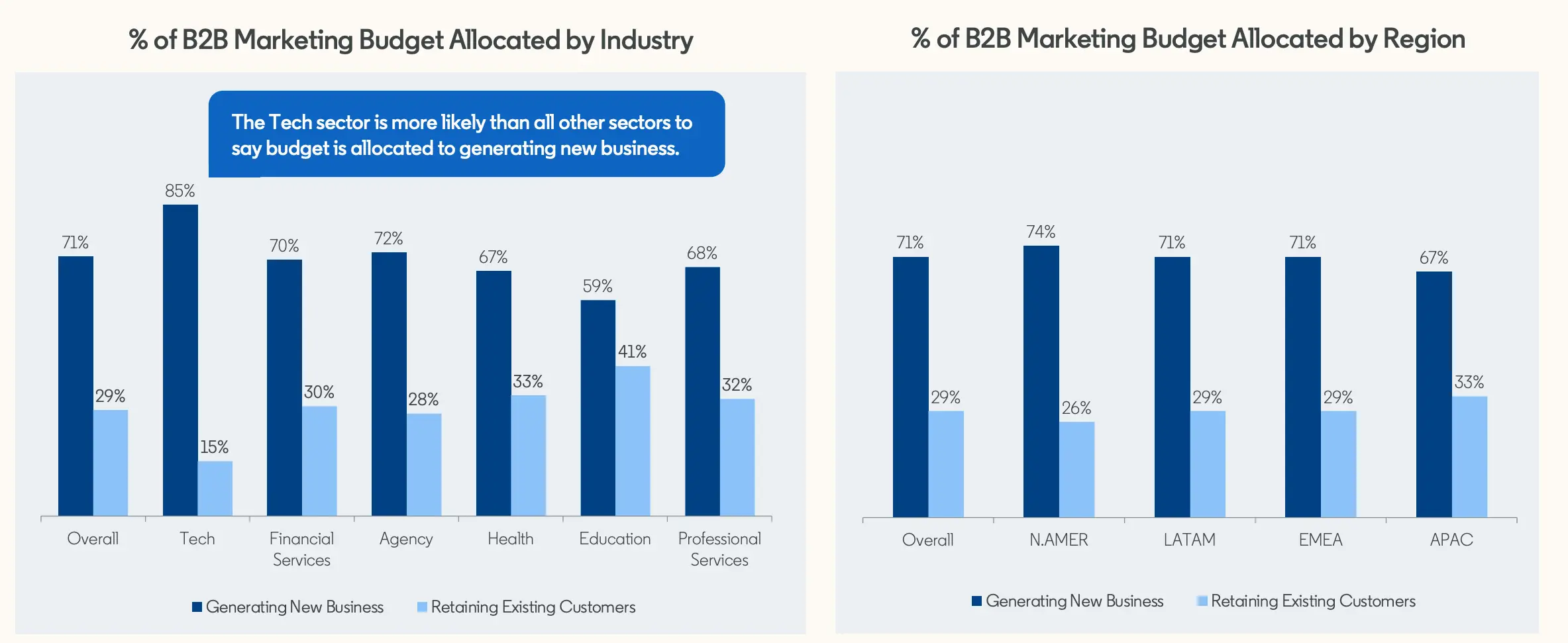
That doesn’t mean every campaign will work, but it does explain why LinkedIn is used in B2B demand generation, lead quality, and thought leadership strategies.
- 80% of B2B marketing leaders used LinkedIn for B2B marketing in the past year. (source)
- 65% of B2B marketing leaders said their use of LinkedIn increased in the past year. (source)
- 65% of B2B marketing leaders said they expect their use of LinkedIn to increase in the next year. (source)
- 71% of B2B marketers say the leads they generate on LinkedIn align more closely with their ideal customer profile than leads from other channels. (source)
- 74% of buyers choose the company that was first to add value during the purchase journey. (source)
LinkedIn stays in B2B budgets because it gives marketers access to buyers in a context where business relevance, credibility, and targeting can work together. The stronger lead-gen case is fit and downstream quality.
ICP accounts converted 46% better in paid search after seeing LinkedIn ads.
- 75% of would-be buyers say thought leadership helps them determine which vendor to put on their shortlist. (source)
- 79% of would-be buyers say thought leadership is critical for deciding which providers they want to learn more about. (source)
- 9 out of 10 B2B decision-makers find thought leadership important. (source)
- 73% of decision-makers say an organization’s thought leadership is a more trustworthy basis for assessing its capabilities than its marketing materials and product sheets. (source)
- Only 20% of content creators believe thought leadership helps them close and win deals, but 45% of business decision-makers and 49% of C-suite executives say it has directly led them to do business with a company. (source)
This is where LinkedIn’s B2B value is shown. A lot of lead generation there is about trust and consideration before it becomes a form-fill or demo request. That’s why thought leadership is high-performing. It helps with shortlist creation, vendor research, and credibility before buyers ever convert.
- 50% of thought leadership producers say the main barrier to creating more effective thought leadership is that it is under-resourced. (source)
- More than 75% of decision-makers and C-suite executives say a piece of thought leadership has led them to research a product or service they were not previously considering. (source)
- 86% of decision-makers say they are moderately or very likely to invite organizations that consistently produce high-quality thought leadership to participate in an RFP. (source)
- Only 38% of thought leadership producers expect their content to help get them invited into an RFP process. (source)
- 42% of thought leadership producers say they have no process in place for measuring effectiveness. (source)
- 29% of thought leadership producers can link sales leads back to specific pieces of thought leadership content. (source)
- 30% of thought leadership producers say their organization does not really know how to use thought leadership as a sales or marketing tool. (source)
- 64% of hidden decision-makers spend more than one hour per week consuming thought leadership content. (source)
64% of hidden decision-makers say they trust thought leadership more than marketing materials and product sheets when assessing capabilities.
Buyers are spending time with thought leadership long before most teams know how to measure what it is doing.
- 63% of target decision-makers also spend more than one hour per week consuming thought leadership content. (source)
- 55% of hidden decision-makers use thought leadership as part of their vendor-vetting process. (source)
- 56% of target decision-makers use thought leadership as part of vendor vetting. (source)
- 71% of hidden decision-makers say they have relatively little or no interaction with sales. (source)
- 95% of hidden decision-makers say strong thought leadership makes them more receptive to sales and marketing outreach. (source)
- 71% of hidden decision-makers say thought leadership is more effective than conventional marketing or sales materials at demonstrating vendor value. (source)
- 64% of hidden decision-makers say they trust thought leadership more than marketing materials and product sheets when assessing capabilities. (source)
- 53% of buyers say that if thought leadership is high quality, brand recognition matters less when vetting vendors. (source)
- 51% of hidden decision-influencers say high-quality thought leadership helps them convince the rest of the buyer group. (source)
This is where LinkedIn starts shaping conversion paths across search, site visits, and downstream sales outcomes.
- 2026 benchmarks show paid search leads were 14.3% influenced by LinkedIn first. (source)
- ICP accounts converted 46% better in paid search after seeing LinkedIn ads. (source)
- SDR meeting-to-deal conversion increased 43% when accounts had seen LinkedIn ads. (source)
- ICP accounts converted 112% better on website content pages after seeing LinkedIn ads. (source)
LinkedIn Revenue and Business Statistics
These stats show the business behind the platform. LinkedIn isn’t only a side product inside Microsoft, but a large commercial platform with multiple revenue streams, steady growth, and a business model built around subscriptions, advertising, and recruitment solutions.
Revenue data shows (source):
- LinkedIn gets roughly $19 billion in annual revenue.
- Revenue increased 11% year over year in FY26 Q2.
- Revenue increased 10% year over year in FY26 Q1.
- Revenue increased 9% year over year in FY25 Q4.
- Revenue increased 7% year over year in FY25 Q3.
- Revenue increased 9% year over year in FY25 Q2.
- Revenue increased 10% year over year in FY25 Q1.
That quarter-by-quarter pattern shows that LinkedIn is still growing. It’s operating as a mature large-scale business with steady high-single-digit to low-double-digit revenue growth, which is still strong at this size.
LinkedIn revenue surpassed $17 billion in FY25.
- LinkedIn has more than four years of double-digit member growth. (source)
- Paid video ads have grown by roughly 30% year over year. (source)
- Revenue surpassed $17 billion in FY25. (source)
- FY26 Q1 growth was driven by Marketing Solutions. (source)
- FY26 Q2 growth was also driven by Marketing Solutions. (source)
- FY25 Q4 growth came from all lines of business, not just one area. (source)
LinkedIn is not only an ad platform. Its revenue comes from several commercial lines, which helps explain why the company can keep investing in content, sales tools, subscriptions, and platform growth at the same time.
- LinkedIn says its business is diversified across membership subscriptions, advertising sales, and recruitment solutions. (source)
- LinkedIn says it has more than 17,500 full-time employees. (source)
- LinkedIn says it has offices in more than 38 cities around the world. (source)
- LinkedIn says the platform is available in 36 languages. (source)
- Microsoft’s acquisition of LinkedIn in 2016 was valued at $26.2 billion. (source)
FAQs
LinkedIn says it has more than 1.3 billion members worldwide. That makes it the largest professional network, but it is a registered-member figure, not a simple global monthly active user number.
LinkedIn’s ad tools reached 1.20 billion members in January 2025. DataReportal says that equals 20.7% of adults aged 18+ and 21.6% of internet users globally.
Not as a clean global number. The clearest recent public disclosure is LinkedIn’s EU Digital Services Act reporting, which showed an estimated monthly average of 54.7 million logged-in active users in the EU for January to June 2025.
Yes. LinkedIn’s About page says the platform has delivered more than four years of double-digit member growth, and its reported ad-reachable audience grew by 176 million year over year, or 17.1%, going into 2025.
Yes. LinkedIn’s own marketing materials say 4 out of 5 members drive business decisions, and its small-business ad guide says 71% of B2B marketers believe LinkedIn leads align more closely with their ideal customer profile than leads from other channels.
A useful current benchmark is around 5.20% average engagement rate for LinkedIn business content, based on Socialinsider’s 2026 benchmark study. That is a benchmark, not a target every Page will hit, but it gives a realistic reference point.
Document and carousel-style posts are the strongest performers in most recent benchmark studies. Socialinsider found native document posts had a 7.00% average engagement rate, while Buffer found LinkedIn carousel posts reached a 21.77% median engagement rate in its large content-format study.
Yes. LinkedIn says total video views were up 36% year over year, paid video ads grew by about 30% year over year, and Gen Z members log 82% more video views than the average member.
They can. LinkedIn says Lead Gen Forms can drive up to 5x higher conversions than sending traffic to an external landing page, and its materials position them as a way to collect higher-quality lead data with pre-filled forms.
Usually, yes, at the click level. But LinkedIn is often judged on pipeline and lead quality rather than cheap traffic, which is why many B2B marketers still use it despite higher media costs. LinkedIn’s own setup guidance also shows the platform is accessible at small budgets, with a $10 minimum daily budget and a $100 minimum lifetime budget for a new inactive campaign.
LinkedIn says there are more than 70 million companies listed on the platform. Its broader About page also says the network spans more than 200 countries and territories.
Because the audience is tied to real professional identity, company context, job role, and business intent. LinkedIn’s own materials emphasize that business-decision influence and ideal-customer fit are core reasons B2B marketers keep using the platform.