
Generative engines are now a key discovery channel across search, chat, shopping, and assistants. People have conversations, compare options, and build shortlists inside ChatGPT, Perplexity, Gemini, Claude, and AI Overviews before they ever see your site. A growing share of research and vendor selection now happens inside AI answers, and it’s now an important part of performance tracking.
SEO is still important, but it only shows how you perform in traditional search. Generative Engine Optimization (GEO) treats AI models or LLMs themselves as channels you can track and improve. Without GEO, you can’t see when a model prefers a competitor, what it cites about your product, or if it doesn’t include your brand in purchase conversations.
These are the best Generative Engine Optimization (GEO) tools you can use to improve understanding of brand performance in AI search.
What Is Generative Engine Optimization (GEO)?
Generative Engine Optimization is the practice of structuring your content, data, and brand signals so generative engines use you as the reference in their answers. Think defined prompt sets instead of rough keyword lists, clear answer chunks that LLMs can quote, clean entities and schema, and product data that aligns to real queries.
Instead of targeting rankings and click-through rate, you are targeting presence in AI answers, share of voice, and positive sentiment across models. Key concepts include prompt mapping, AI visibility metrics, citation and source analysis, and a feedback loop where you detect current answers, adjust content and entities, then re-measure.
How GEO Differs from Traditional SEO
Traditional SEO is about ranking pages for search terms through content, backlinks, and technical optimization. GEO is about influencing the answers, summaries, and recommendations that generative engines produce across chat, search, shopping, and assistants.
You optimize for prompt sets, machine-readable answers, entities, and trusted sources that models pull from, not just title tags and SERP snippets. The goal moves from only driving organic clicks to shaping the narrative, shortlists, and product picks users see inside AI responses, then turning that visibility into visits and revenue.
| Tool | Best for |
|---|---|
| Semrush One (AI Visibility) | SEO & content teams that want one stack |
| Conductor | Enterprise SEO and digital teams |
| Goodie | Teams that need full AI visibility |
| Scrunch AI | Brands that want monitoring plus an AI ‘shadow site’ |
| Profound | Enterprise GEO with deep citation and prompt analytics |
| AthenaHQ | Large teams needing premium GEO monitoring and automation |
| Peec AI | Lean teams and mid-market marketing orgs. |
| Otterly AI | SMB / mid-market teams needing GEO tracking + audits |
| Ahrefs Brand Radar | SEO teams already using Ahrefs |
| Prompt Monitor | Small teams and agencies needing lightweight AI monitoring |
1. Semrush One
Best for: SEO and content teams that want SEO and GEO data in one place.
Pricing: Tiered plans with AI features on higher bundles; custom pricing for larger accounts.
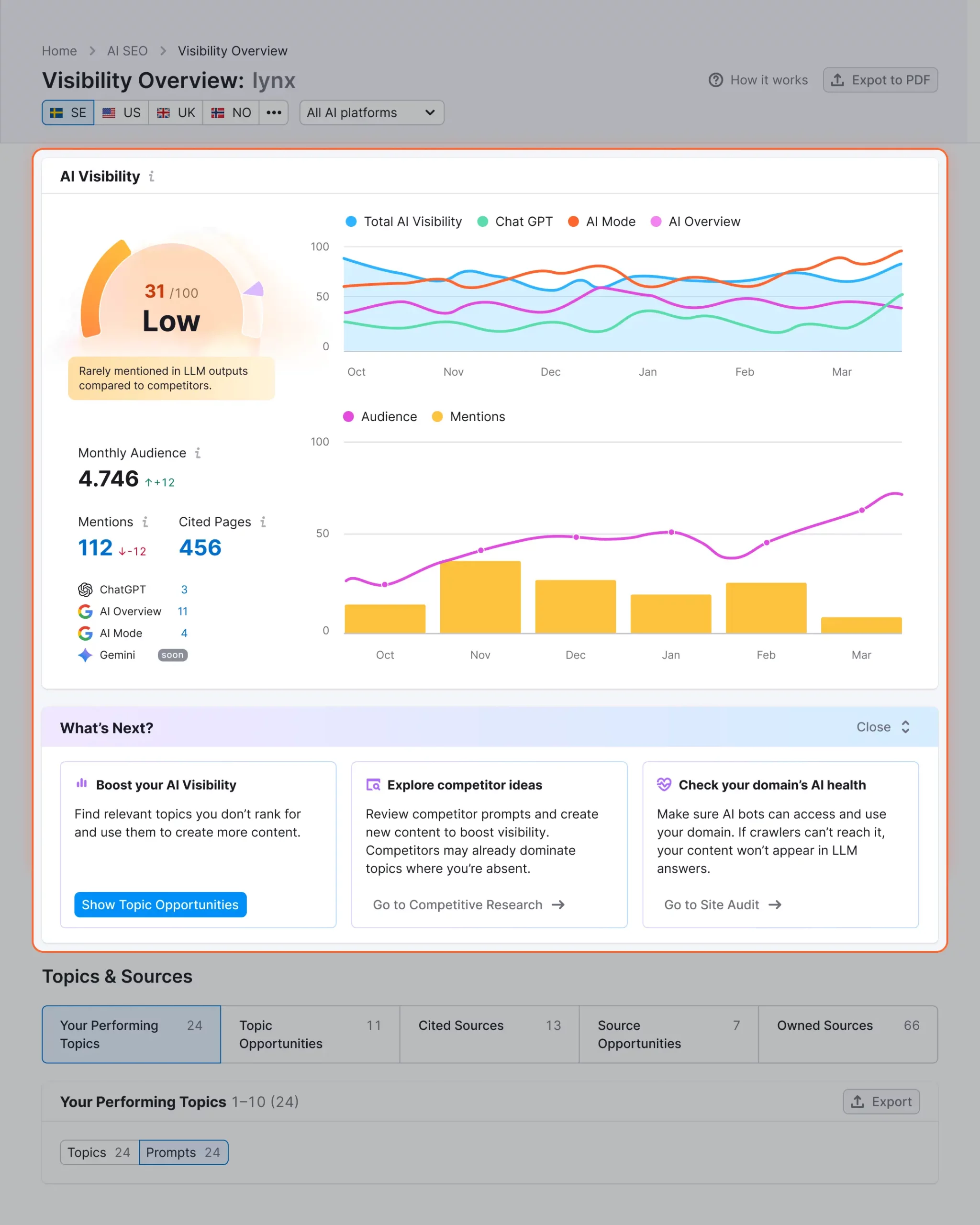
Semrush One combines classic SEO data with an AI Visibility Toolkit so you can see how generative engines talk about your brand alongside rankings and traffic. It tracks how often LLMs cite your brand, which prompts trigger mentions, and which pages or sources those answers come from. You get a single view of keywords, positions, and AI visibility, which makes it easier to explain AI impact on organic performance and prioritize fixes.
Read the full Semrush One review.
Key features:
- AI visibility metrics across multiple AI engines and regions
- Brand and topic share-of-voice reporting in AI answers
- Prompt research and tracking tied to your existing keyword data
- AI site audits for crawler and parsing issues
Pros:
- Combined reporting for SEO and GEO in one platform
- Familiar workflows for teams already using Semrush
- Strong filtering, segmentation, and trend analysis
Cons:
- Best value if Semrush is your primary SEO platform
- Can feel heavy for teams that only want AI monitoring
Semrush One works best when SEO is already a core tool for planning and reporting. SEO, content, and growth teams can use AI visibility reports to find topics where rankings look strong, but AI answers favor competitors, then feed that list straight into content and technical sprints. The shared interface also simplifies reporting because you don’t need a separate tool to explain AI impacts on organic visibility.
Integrations: Connectors and exports for analytics platforms, Looker Studio, major CMSs, and BI tools, plus an API for custom dashboards and internal reporting.
Quick tip: Start by tracking prompts around your brand name, top products, and one key category, then compare AI visibility against rankings to pick your first GEO optimization targets.
2. Conductor
Best for: Enterprise SEO and digital teams that want full AI + SEO reporting at scale.
Pricing: Custom enterprise pricing based on domains, data volume, and modules.
Conductor’s AI Search Performance module shows how your brand appears inside AI Overviews and other AI results. It tracks mentions, citations, and sentiment across multiple engines and ties them to your existing keyword and content data. You can see where AI systems already quote your content and where they favor competitors instead. That gives enterprise teams a clear view of AI impact on organic visibility and brand perception.

Key features:
- AI answer visibility across multiple search engines
- Brand mention and sentiment reporting inside AI answers
- Topic and market share dashboards for AI search
- Integration with Conductor’s content and SEO workflows
Pros:
- Enterprise-grade reporting and collaboration
- Strong connection between AI data and content strategy
- Useful for brands with many markets and stakeholders
Cons:
- Not a fit for small teams or single-site projects
- Requires time and process to implement properly
Conductor works best where SEO already has an established place in planning and reporting. Product, content, and SEO teams can use the AI Search Performance views to prioritize topics where AI coverage lags behind rankings. The platform also helps explain AI changes to leadership with clear charts rather than opinions. For global brands, the ability to compare markets and regions in one system is a practical advantage.
Integrations: Connects into analytics platforms, enterprise BI, and collaboration tools, plus native hooks into content workflows.
Quick tip: Use AI Search Performance to find keywords where you rank but rarely appear in AI answers, then focus your next content and schema updates on that short list.
3. Goodie
Best for: Startups and global brands that want an end-to-end GEO stack.
Pricing: Enterprise typically starts around $495/month with custom tiers.
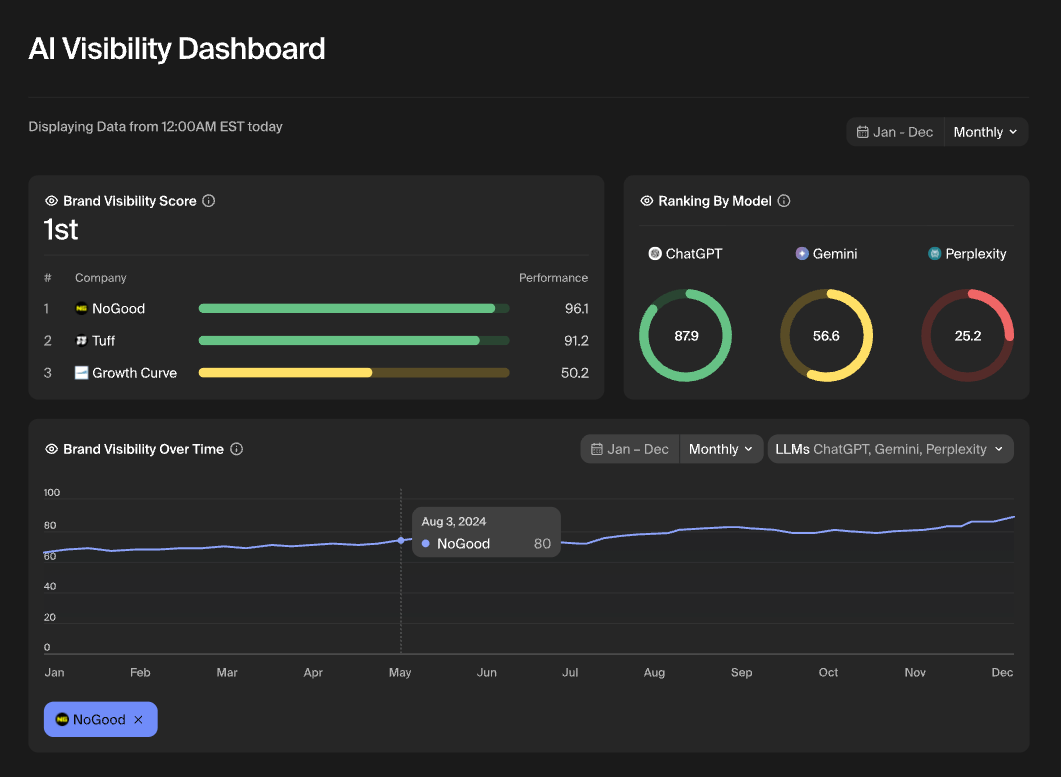
Goodie is a GEO-first platform that combines AI visibility monitoring, optimization workflows, and revenue-focused analytics in one product. It tracks how often your brand appears across major LLMs and AI answer engines, how those answers talk about you, and which sources drive those mentions. It also has an Optimization Hub, GEO/AEO content writing tools, and shopping modules so you can connect AI to traffic and product performance.
Key features:
- AI Visibility Monitoring across LLMs like ChatGPT, Gemini, Perplexity, Claude, and so on.
- Performance dashboard with global monitoring, visibility analysis, and sentiment analysis.
- AI Optimization Hub that shows opportunities and recommendations to improve.
- GEO / AEO Content Writer to create answer-ready, citation-friendly content.
- AI search analytics and attribution to tie AI visibility back to growth and performance.
- AI crawler and agent analytics plus Agentic Commerce Optimizer for AI shopping journeys.
Pros:
- Full suite that covers monitoring, optimization, content, and commerce in one platform
- User-friendly dashboards with up-to-date analytics and competitive benchmarking
- Coverage of major AI platforms, including DeepSeek and multiple shopping contexts.
- Actionable Optimization Hub that gives precise GEO insights at the source and page level.
Cons:
- Targets larger brands, with pricing and packaging skewed toward enterprise use cases.
- Integration options are improving but still lighter than long-standing SEO suites, and export/reporting features are more limited today.
Goodie works best when you want GEO to run as an independent tool and record for AI visibility, sentiment, and product placement. In-house SEO, content, and growth teams can use its dashboards to spot prompts where AI ignores or misrepresents the brand, then push fixes through the Optimization Hub and content writer. For ecommerce and multi-market brands, the combination of sentiment, geography, and SKU-level analytics makes it easier to see how AI answers influence both perception and revenue.
Integrations: Data exports and analytics hooks into existing reporting stacks, with more limited native integrations than mature SEO platforms; best treated as an overlay feeding BI and internal dashboards.
Quick tip: Start by loading one core product line or category into Goodie, then use AI Visibility Monitoring plus the Optimization Hub to build a small list of prompts where you want to win. Run a 4–6 week sprint focused only on those prompts, and measure changes in presence rate, sentiment, and SKU-level visibility before expanding coverage.
4. Scrunch AI
Best for: Large brands and agencies that need AI visibility monitoring and agent analytics.
Pricing: Plans start at $300/month for Starter, with further tiers up to $1,000+/month.
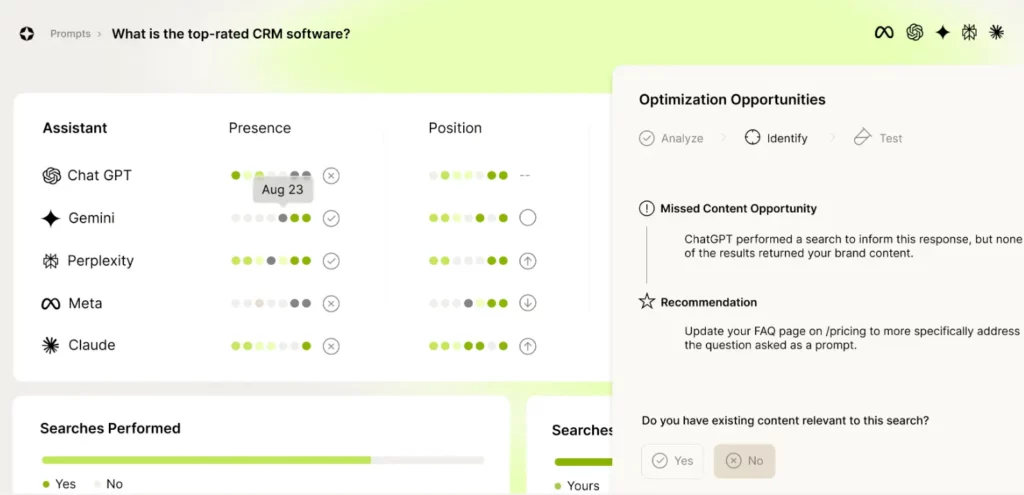
Scrunch AI is a GEO platform built around Monitoring & Insights plus an Agent Experience Platform (AXP). It tracks how your brand appears in AI-generated answers across ChatGPT, Perplexity, Claude, Meta AI, Gemini, and Google AI Overviews, including mentions, sentiment, and sources. It also has hallucination and misinformation detection, journey mapping, and AI traffic analytics, so you can see how AI agents access your site and where they misrepresent you. AXP then creates a parallel AI-optimized version of your site that is served only to AI agents, designed to make your content easier for models to consume and summarize.
Key features:
- Monitoring of brand and competitor mentions, sentiment, and share of voice across major AI platforms.
- Hallucination and misinformation detection for brand safety, especially in regulated categories.
- Journey mapping to visualize how users encounter your brand through AI paths.
- Agent Experience Platform (AXP) to generate and serve an AI-ready version of your site for agents only.
- AI bot traffic analytics to track which agents crawl which content and how that changes over time.
- Prompt analytics and dashboards for trends, topics, and performance across regions and personas.
Pros:
- Strong monitoring and insights layer focused on brand safety, misinformation, and hallucinations.
- Agent analytics and AI traffic views that expose otherwise invisible crawler behavior.
- AXP gives you control over what AI agents see without changing the human-facing site.
- Enterprise-focused security and scale, including SOC 2 and support for hundreds of brands.
Cons:
- Pricing starts high enough to exclude many small teams and early-stage projects.
- Primarily a monitoring and analytics platform; execution and content changes still rely on other tools.
- AXP adds technical complexity and is still early, with limited independent evidence of impact.
Scrunch AI works best for enterprises and agencies that treat AI visibility and brand safety as risk and reputation issues, not just SEO metrics. Comms, brand, and SEO teams can use its monitoring and hallucination detection to find harmful or outdated claims, then decide which pages, knowledge bases, and third-party listings to correct first. For organizations in regulated industries, the combination of visibility tracking, misinformation alerts, and agent analytics helps to reassure that AI exposure is being watched and managed.
Integrations: Enterprise Data API for piping Scrunch data into internal dashboards, plus CDN and site integrations for AI traffic monitoring (Cloudflare, Akamai, Vercel, WordPress and others). No free trial; access and rollout usually go through sales.
Quick tip: Start with one or two high-risk categories (for example, pricing, compliance, or medical claims), build a focused prompt set, and use Scrunch’s hallucination and journey-mapping views to prioritize the specific pages and third-party sources you need to fix before expanding coverage.
5. Profound
Best for: Enterprise brands, regulated industries, retailers, and agencies.
Pricing: Starting at $99/month for starter plans, going up to $399 and custom pricing.
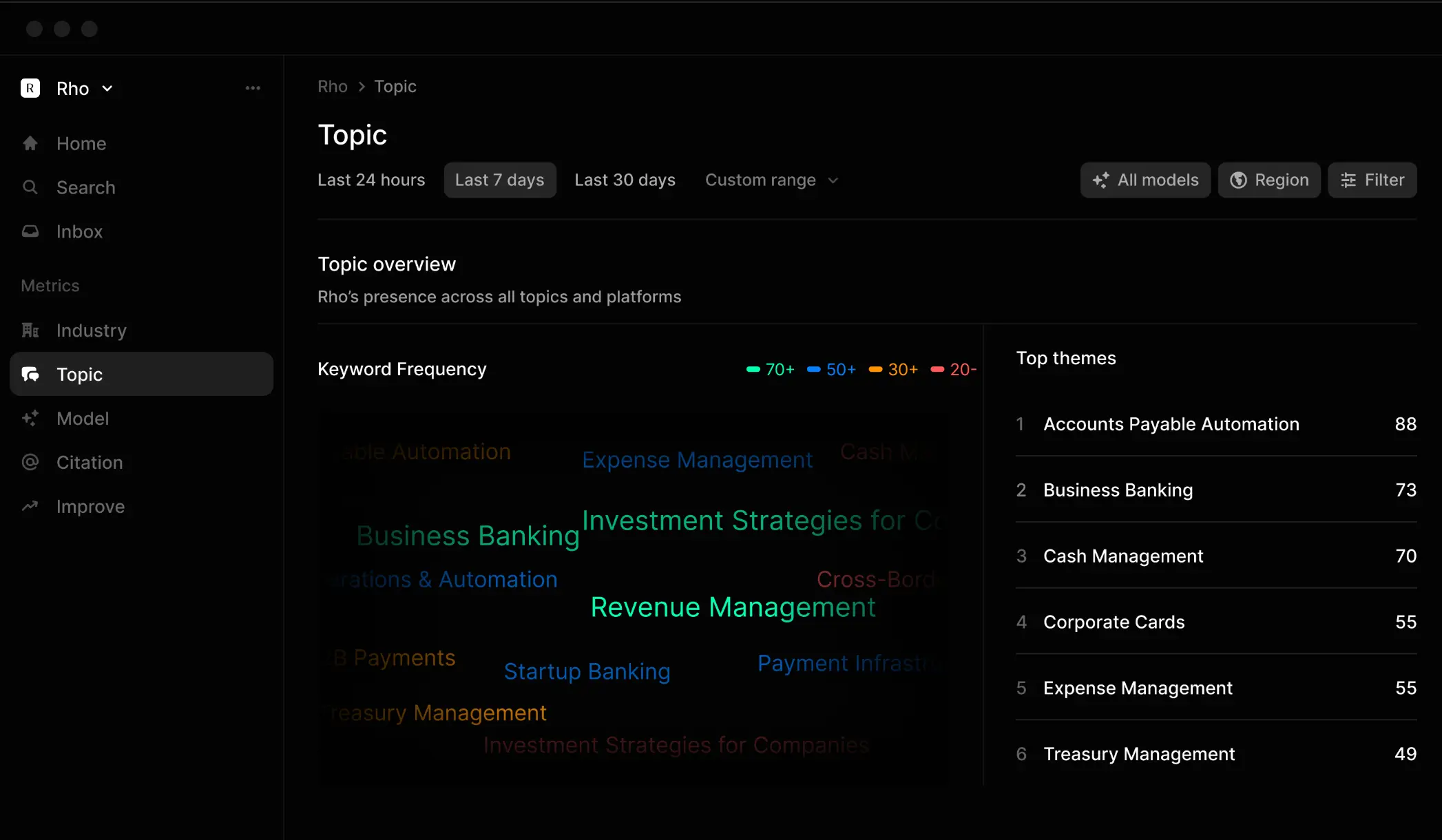
Profound is an enterprise GEO platform that captures real user-facing answers from AI engines and pairs them with crawler logs to show exactly when, where, and how your brand is cited. It tracks visibility, sentiment, and share of voice across multiple AI channels and then links those answers back to pages, sources, and technical signals. It also features Prompt Volumes, Query Fanouts, Shopping Analysis, and workflows so teams can move from ‘what AI says’ to specific content and distribution changes.
Key features:
- Answer Engine Insights for visibility score, share of voice, sentiment, and citation analysis across 10+ AI engines.
- Prompt Volumes and Query Fanouts to reveal what people actually ask AI and how models decompose those prompts into internal queries.
- Agent Analytics to track AI crawler activity, technical health, and how often specific pages are referenced in answers.
- Shopping Analysis to see how products appear in ChatGPT Shopping, including placement, attributes, competing SKUs, and retailers.
- Workflow templates and proven content formats (comparisons, how-tos, listicles) to build AI-optimized content at scale.
Pros:
- Empirical front-end answer data plus crawler analytics for a full view of what LLMs surface and why.
- Broad AI coverage and enterprise-grade security (SOC 2 Type II, HIPAA, SSO, role-based access) suited to regulated sectors.
- Strong citation, sentiment, and conversation analysis with useful views like Conversation Explorer and detailed sentiment themes.
Cons:
- Designed primarily for large enterprises, pricing and scope are often excessive for startups and most SMBs.
- Steep learning curve and data-heavy UX; reviewers note noise and feature gating on lower tiers.
- Not an all-in-one execution suite; you still rely on separate tools and teams to implement content and technical changes.
Profound works best when you have a central SEO or growth team plus data support and need audit-ready AI visibility across brands, regions, and product lines. Marketing, product, and analytics teams can use Answer Engine Insights and Prompt Volumes to find high-value prompts where competitors dominate, then feed those topics into existing content and distribution workflows. Retailers benefit from Shopping Analysis and agent data to understand how AI treats their SKUs and which attributes, reviews, and retailers correlate with more citations.
Integrations: Connectors for GA4, BI tools, CDP/CRM and data warehouses, plus edge and CDN integrations (Vercel, Cloudflare, Fastly, AWS CloudFront, Netlify) for traffic and crawler data collection.
Quick tip: Use Profound to build a short list of 20–30 prompts where you want to win, then compare your citations and Shopping Analysis data against the top two competitors and prioritize changes only on the pages and product feeds that actually drive those gaps.
6. AthenaHQ
Best for: Agencies and mid-market to enterprise teams.
Pricing: Self-serve plan from $295/month with credit-based usage and annual discounts, plus custom Enterprise plans with higher credits and advanced features.
AthenaHQ is a Generative Engine Optimization platform that shows how your brand appears across AI search systems like ChatGPT, Perplexity, Google AI Overviews more. It combines multi-engine monitoring with prompt volume modeling and an Action Center that turns AI visibility data into recommended changes. The homepage and case studies position it as a ‘command center for GEO,’ with customer stories around share-of-voice lifts, citation growth, and leads from AI search.

Key features:
- Multi-engine AI search monitoring for brand performance, perception, citations, and competitor presence across major LLMs and AI Overviews.
- Prompt Volume module with query volume estimation, trending prompts by vertical, and region-based prompt analysis (Enterprise only).
- Action Center with custom GEO recommendations by vertical, AI knowledge gap detection, ‘copy winning website strategies,’ and AI-optimized content drafts in your brand voice.
- Dynamic AI crawling, AI blindspot detection, LLM traffic analysis, authority and citation intelligence, and an ecommerce capability that ties GEO content and AI search to Shopify stores.
Pros:
- Consolidated view of AI search visibility with live, shareable dashboards across teams and roles (SEO, PR, brand, content, CMO).
- Actionable GEO workflow via the Action Center, including specific recommendations and content drafts instead of raw charts only.
- Broad AI engine coverage plus enterprise signals like SOC II, GDPR, SSO, RBAC, and advisory support from senior marketing leaders.
Cons:
- Premium pricing and credit-based billing make it hard to justify for small teams and can create spend uncertainty as prompt volume grows.
- Stronger on monitoring, share-of-voice, and recommendations than on deep revenue attribution, where some rivals emphasize GA4-first measurement.
AthenaHQ works best when you already treat AI search as a distinct channel and have SEO, content, and brand owners ready to act on the data. Teams use its monitoring and prompt volume views to find prompts where competitors dominate, then pull the Action Center’s GEO recommendations into existing content, PR, and outreach workflows. For agencies and larger in-house teams, the multi-brand dashboards, case-study-backed performance lifts, and role-based access control help standardize how you measure and report AI visibility across clients or business units.
Integrations: Direct Shopify integration for ecommerce, plus connectors and API support for GA4, CMS platforms, and analytics tools, so GEO metrics can feed your existing reporting stack.
Quick tip: Use AthenaHQ to find 15–20 high-volume prompts where your share of voice and citation rate are weakest, then focus one sprint on the specific pages, FAQs, and external sources the Action Center flags for those prompts before expanding coverage.
7. Peec AI
Best for: Lean marketing and SEO teams that want focused AI search analytics.
Pricing: Starter from €89/month (25 prompts), Pro at €199/month (100 prompts), Enterprise from €499+/month (300+ prompts and custom reporting).
Peec AI is an AI search analytics platform that shows how your brand performs across ChatGPT, Perplexity, Google AI Overviews, and (on higher tiers) engines like Gemini, Claude, DeepSeek, and Grok. You define prompt sets that match your key topics, then Peec runs them daily and turns the answers into visibility, position, sentiment, and citation metrics. The product is intentionally focused, aiming to avoid ‘all-in-one SEO suite’ bloat and instead focus on prompt-level insights marketing teams can actually act on.

Key features:
- Daily AI answer monitoring across ChatGPT, Perplexity, and AI Overviews on all plans, with optional add-ons for Gemini, AI Mode, Claude, DeepSeek, Llama, Grok, and more.
- Prompt-based tracking with visibility, average position, sentiment, and trend lines for your brand and competitors.
- Citation and source analysis to see which URLs and domains AI models reference most often for a given topic.
- Competitor benchmarking and topic-level workspaces so teams can prioritize where to improve coverage.
- Simple, Looker Studio–friendly exports and reporting so AI visibility can feed existing dashboards.
Pros:
- Clean, focused UX: set up your prompts, see your AI visibility, act on top citations, without extra SEO bloat.
- Strong customer feedback on clarity of insights and speed to value, including case studies showing 5x+ traffic and demo growth from LLMs after using Peec data.
- Unlimited seats and countries on all paid plans make it easy to roll out across teams and markets.
- Also offers SSO login and API access.
Cons:
- Pricing is high on a cost-per-prompt basis compared with some newer trackers, especially once you add extra engines beyond the core three.
- Primarily a monitoring and analytics tool; it does not include native content creation or technical SEO modules, so execution happens elsewhere.
Peec AI works best when you already have SEO and content workflows in place and just need a clear view of how AI engines talk about you. Marketing and SEO teams can use its dashboards to find prompts where visibility is low or sentiment is weak, look at the cited sources, and then decide whether to improve their own pages or pursue coverage on third-party domains. Agencies also benefit from the simple packaging and unlimited seats, using Peec as shared ‘AI visibility’ across multiple clients without retraining everyone on a full SEO suite.
Integrations: Native-friendly exports into Looker Studio and other BI tools, plus CSV and API-style access for pulling prompt and visibility data into custom reports and performance dashboards.
Quick tip: Start with 20–30 prompts mapped to your core product and competitor terms, then rank them by visibility and sentiment. Use Peec’s citation view to pick one owned page and one third-party site to improve for each low-visibility prompt, and re-check the data after 4–6 weeks before scaling to more prompts.
8. Otterly AI
Best for: SMB and mid-market teams that want affordable daily AI monitoring and audits.
Pricing: Lite from $29/month for 15 prompts, Standard $189/month for 100 prompts, Premium $489/month for 400 prompts. 14-day free trial.
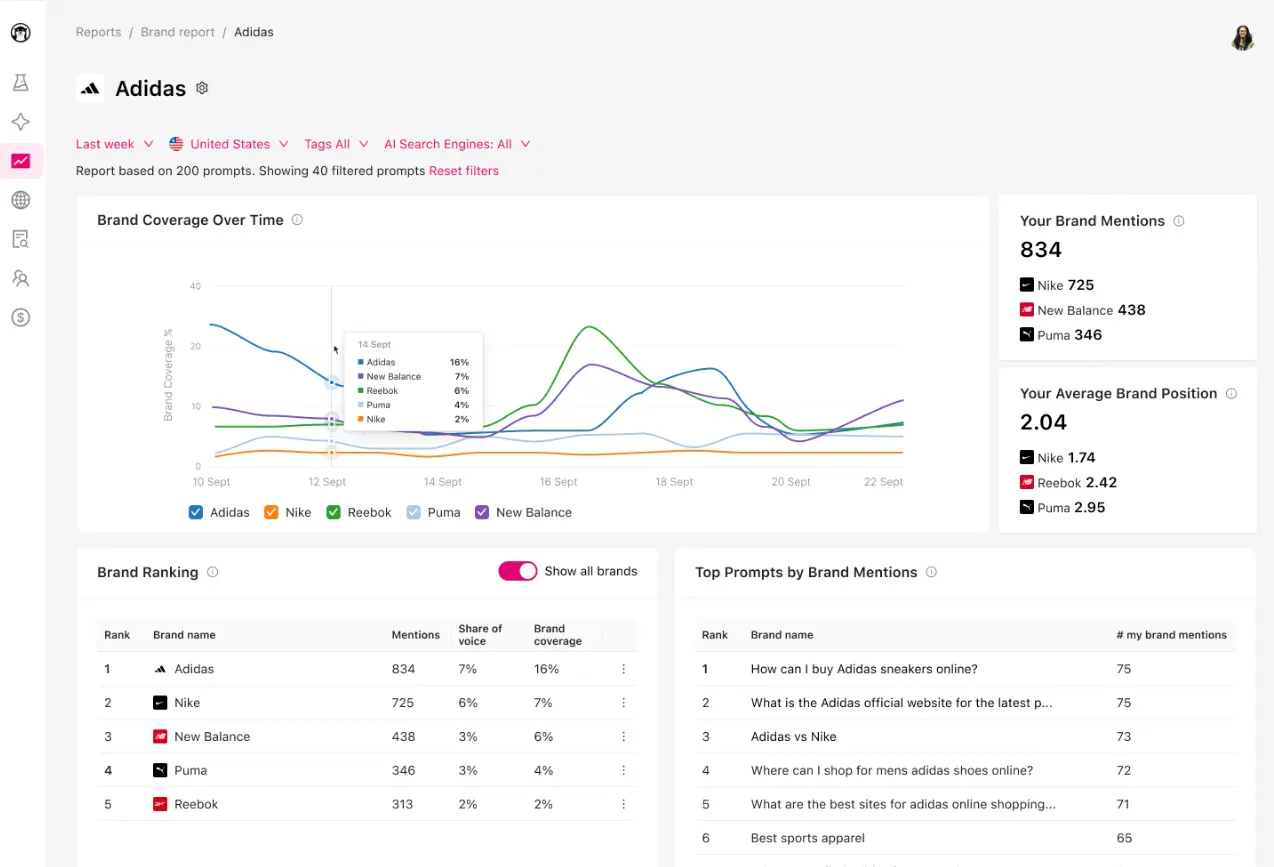
Otterly AI is an AI search monitoring and optimization platform built to track how your brand, content, and competitors appear in AI answers. It runs your prompt set daily across Google AI Overviews, ChatGPT, Perplexity, and Microsoft Copilot (with Gemini and AI Mode as add-ons), then aggregates visibility, sentiment, and link citations into a single dashboard. You can see which prompts surface your brand, which URLs get cited, and where competitors win, then use its GEO Audit to turn that data into concrete optimization actions.
Key features:
- Daily AI search monitoring across Google AI Overviews, ChatGPT, Perplexity, and Copilot, with optional Gemini and Google AI Mode.
- Prompt-based tracking for brand, content, and competitor visibility.
- Brand Visibility Index, domain ranking, and link citation analysis for each prompt set.
- GEO Audit that runs a structured SWOT-style review of your AI presence and recommends where to improve content and distribution.
- AI keyword research tool that helps turn classic keyword lists into AI prompts.
- Multi-country support (50+ markets), unlimited brand reports, and unlimited team members on paid plans.
Pros:
- One of the most affordable entry-level GEO tools, with a low starting price and 14-day free trial.
- Strong daily tracking cadence that keeps prompt and citation data fresh.
- Simple, focused UX that makes AI visibility understandable for non-technical marketers.
- Built-in GEO Audit and AI keyword research reduce the effort to move from what’s happening to what to change.
Cons:
- Prompt allowances on Lite are tight, and costs rise quickly as you add prompts or engines, which can be limiting for larger programs.
- Primarily a monitoring and analytics platform, you still need separate tools and workflows to execute content and technical changes.
- Less depth in advanced segmentation and revenue attribution than heavier enterprise GEO stacks.
Otterly AI works best when you want to start measuring AI visibility quickly without changing your SEO stack. SEO and content teams can define a small set of high-value prompts, let Otterly run daily checks, then use its citation and GEO Audit views to decide which pages to update and which third-party placements to pursue. For agencies and in-house teams on a budget, it is an approachable way to introduce GEO reporting and prove value before graduating to higher prompt volumes or additional tools.
Integrations: Exports and detailed reports suitable for BI tools and external dashboards; most teams use Otterly as an overlay feeding existing SEO, analytics, and reporting setups.
Quick tip: Start with 15–20 prompts tied to your brand and top products on the Lite plan, run one GEO Audit, and use its recommendations to focus updates on the 3–5 pages and citation sources that show up most often before paying for more prompts.
9. Ahrefs Brand Radar
Best for: SEO teams that already use Ahrefs and want AI visibility plus other SEO data.
Pricing: Available on all paid Ahrefs plans (from roughly $119/month).
Ahrefs Brand Radar is an AI visibility tool that maps how often your brand is mentioned and cited across AI answers, search, video, and Reddit. It runs against a large prompt index spanning AI Overviews, AI Mode, ChatGPT, Copilot, Gemini, and Perplexity, then turns those answers into metrics like AI Share of Voice and estimated impressions. On top of AI data, it adds Search Demand, Web Visibility, Video Visibility, and Reddit Visibility so you can see how web mentions and content feed back into AI answers, all inside the broader Ahrefs ecosystem.

Key features:
- Largest AI visibility database with 190M+ prompts across six AI platforms and zero setup.
- AI Visibility report with AI Share of Voice, mentions, impressions, and topic clusters for you and competitors.
- Cited domains and pages reports showing which URLs AI answers pull from most often.
- Search Demand, Web Visibility, Video Visibility, and Reddit Visibility views to connect AI mentions with broader discovery channels.
- Overview dashboard as an ‘AI visibility command center’ for brand-level tracking over time.
Pros:
- Native to Ahrefs, so AI visibility sits next to backlinks, keywords, and content data you already use.
- Huge prompt coverage and no setup make it easy to benchmark brands and competitors quickly.
- Strong competitive benchmarking and topic clustering for finding AI content gaps.
- Solid documentation, courses, and blog workflows for turning Brand Radar data into GEO actions.
Cons:
- Effective pricing for full AI coverage is high relative to newer, GEO-only tools, especially once you add platform bundles.
- Limited free access and no dedicated trial for Brand Radar itself, you need a paid Ahrefs plan to test it properly.
- Focused on monitoring and opportunity discovery; content creation and execution still happen in other tools.
Ahrefs Brand Radar works best when Ahrefs is already your primary SEO platform and you want to extend that view into AI search. SEO and content teams can use Brand Radar’s AI Visibility and topic clustering to find areas where competitors dominate AI answers, then pivot into Site Explorer, Content Explorer, and link tools to plan fixes. For brands with strong PR and digital PR programs, the Web, Video, and Reddit visibility reports also help target placements that are more likely to influence AI citations over time.
Integrations: Uses Ahrefs’ existing export and API capabilities so Brand Radar data can feed into external BI, reporting, and custom dashboards alongside standard SEO metrics.
Quick tip: Add your brand and two key competitors to Brand Radar, then filter the AI Visibility and Cited Domains reports to one high-value topic cluster. Use that short list of prompts and cited pages to decide which of your pages to rework and which third-party domains to prioritize for new coverage.
10. Promptmonitor
Best for: Startups, SMBs, and agencies that want budget-friendly AI visibility and analytics.
Pricing: Starter from $29/month (25 prompts), Growth from $39/month (50 prompts), Pro from $129/month (150 prompts), plus an agency plan and custom enterprise options; all paid plans include a 7-day free trial.
Promptmonitor is a GEO tool focused on tracking how often your brand appears in AI answers and which sources those answers come from. It calculates a visibility score across major models, shows which URLs and publishers AIs cite, and tracks when ChatGPT, Claude, and Perplexity visiting your site. On top of AI visibility, it bundles privacy-first web analytics and contact discovery so you can decide whether to improve your own pages or pitch third-party publishers.

Key features:
- AI Visibility Score (0–100%) combining presence rate and cross-model coverage across ChatGPT, Claude, Gemini, DeepSeek, Grok, Perplexity, Google AI Overview, and AI Mode.
- Brand mention tracking with full responses, context, and sentiment for each mention.
- Source and publisher analysis with domain filtering, SEO metrics (domain rating, backlinks, outline), and contact discovery (author email and social profiles).
- AI bot and crawler analytics plus simple, cookie-free website analytics so you see when models actually visit and learn from your site.
- Prompt and query insights that reveal which search queries AIs use internally to find information about your topics.
Pros:
- Low entry pricing with a 7-day free trial makes it easy for small teams to start tracking GEO without a big commitment.
- Multi-model coverage plus a single visibility score keeps reporting simple for stakeholders who do not want to manage separate tools per engine.
- Built-in source discovery, contact info, and SEO metrics help teams move from being missed to specific outreach or content actions.
Cons:
- Prompt and response limits on each plan can feel tight once you expand beyond a small core set, especially for multi-market brands.
- Focused on monitoring, analytics, and outreach inputs, you still need separate tools and processes for content production and technical SEO changes.
Promptmonitor works best when you want a clear, prompt-level view of AI visibility and sources without buying a full enterprise GEO suite. SEO, content, and PR teams can use its visibility score and brand-mention views to find prompts where they are missing, check which publishers AIs prefer, then decide whether to improve owned content or pitch those sites. Agencies benefit from the Pro and agency plans with more prompts and projects, using Promptmonitor as a shared GEO dashboard across clients while keeping execution in their usual stack.
Integrations: CSV export, web analytics scripts, and API-friendly data make it straightforward to push AI visibility metrics into BI tools and blended SEO/GEO reports.
Quick tip: Start with 20–30 prompts around your brand, core categories, and ‘best X’ terms, then use Promptmonitor’s source and contact views to pick one owned page and one publisher to improve for each weak prompt before expanding your prompt set.
Why Marketers Need GEO Tools
AI answers are impacting how people discover brands, compare options, and choose products long before they hit your site. Without GEO tools, you cannot see where you show up, where you are missing, or whether the ‘best GEO tools’ you invest in are actually changing what models say about you.
Rising share of AI-generated answers
A growing share of informational and commercial queries now end in an AI-generated answer instead of a classic results page. If you are not tracking those answers, you are blind to a large part of your real reach. Every time an AI lists competitors and leaves you out, you lose authority before the session even has a chance to turn into a click.
Zero-Click and conversational interactions
Zero-click AI results cut your traffic even when your SEO looks strong, and they also set expectations about pricing, features, and trust. GEO tools show which prompts trigger mentions of your brand, how often you appear in spoken or summarized answers, and where you need better content or entities to stay in the conversation.
How GEO and SEO Work Together
SEO gets you ranked pages and organic sessions. GEO makes sure AI systems use those pages as sources when they build answers, summaries, and shortlists. Schema, entity signals, internal linking, and keyword mapping all feed into both. The best GEO tools align AI visibility data with rankings and traffic so you can decide which queries need classic SEO work, which need GEO fixes, and which need both.
Which GEO Tool Is Right for Your Role?
Not every platform fits every team. The right GEO tool depends on whether you own SEO, content, growth, or client reporting, and which systems you already use as your main source of truth.
| Role / Team Type | Best Tool(s) |
|---|---|
| Content strategists | Semrush One, Conductor, Goodie |
| SEO managers | Semrush One, Conductor, Ahrefs Brand Radar |
| Growth & product marketing | Goodie, Scrunch AI, Peec AI |
| GEO specialists / analysts | Profound, AthenaHQ, Goodie, Otterly AI |
| Ecommerce & retail leads | Semrush One, Goodie, Scrunch AI |
| Agencies & enterprises | Conductor, Profound, Ahrefs Brand Radar, AthenaHQ |
| Lean in-house teams | Peec AI, Otterly AI, Prompt Monitor |
| Early-stage startups | Prompt Monitor, Otterly AI (entry plans), Peec AI (small prompt sets) |
Final verdict: Semrush One vs Profound. Which should you choose?
If you want one platform for SEO and AI search visibility, choose Semrush One. It fits when you want rankings, traffic, technical audits, and AI visibility in a single stack that your SEO and content teams already know how to use.
If you already have an SEO stack and need deeper AI-only analytics across many engines, choose Profound. It suits teams that treat AI visibility as its own data product and need citation, prompt, and agent analytics at enterprise depth.
If you want a GEO-first platform that covers monitoring, optimization, and commerce without being tied to a legacy SEO suite, look at Goodie. It is a strong option when you care about sentiment, product visibility, and AI shopping behavior as much as rankings.
If you are a lean in-house team or smaller agency and need something lighter than the big suites, Peec AI, Otterly AI, or Prompt Monitor are the safest places to start. They give you core GEO insights at prompt level so you can see whether they work for your reality before you step up into heavier enterprise platforms.
GEO Tools FAQ
GEO tools are Generative Engine Optimization platforms that track how AI systems like ChatGPT, Perplexity, Gemini, Claude, and AI Overviews talk about your brand. They monitor prompts, answers, citations, and sentiment so you can see when you appear, how you are described, and which sources drive those answers.
The best GEO tools in 2026 depend on your stack and team size. For all-in-one SEO + GEO, Semrush One and Conductor stand out. For GEO-first analytics and optimization, Goodie, Scrunch AI, Profound, and AthenaHQ lead. For lean teams, Peec AI, Otterly AI, Ahrefs Brand Radar, and Prompt Monitor cover the core use cases without a full enterprise build.
Yes, if AI answers matter for your category. SEO tools show you rankings and traffic in classic search. GEO tools show whether generative engines actually mention your brand, which competitors they prefer, and which pages get cited. Without GEO data, you can rank well in Google and still be invisible in AI answers.
Most GEO tools start from a set of prompts that match your key topics and buying questions. They run those prompts across AI engines on a schedule, store the answers, and turn them into metrics like presence rate, position, share of voice, sentiment, and citations. You then use that data to update content, schema, entities, and distribution, and re-run the same prompts to measure the change.
Pricing for GEO tools ranges from roughly $30–$100 per month for lightweight monitors like Prompt Monitor or entry-level Otterly, up to several hundred or thousands per month for enterprise platforms like Semrush One, Conductor, Profound, Goodie, Scrunch, or AthenaHQ. Most tools price based on prompt volume, engines covered, and features like multi-brand support or advanced workflows.
For small teams, the best GEO tools are usually Peec AI, Otterly AI, or Prompt Monitor. They keep pricing and setup simple, focus on prompt-level visibility and citations, and do not force you to switch SEO platforms. You can prove the value of GEO on a small prompt set before you consider heavier suites.
Enterprise and agency teams usually get more value from Semrush One, Conductor, Goodie, Scrunch AI, Profound, AthenaHQ, or Ahrefs Brand Radar. These platforms support multiple brands and markets, larger prompt sets, advanced security, and integrations with analytics and BI so GEO data can feed leadership reporting.
Most teams should start with 20–50 prompts mapped to brand terms, top products, and core “best X” and “compare X vs Y” queries. That is enough to see patterns in AI visibility and citations without drowning in data. Once you have a working GEO workflow and can show movement, expand to more prompts and categories.
GEO tools themselves do not generate traffic. They show where AI engines already use or ignore your content so you can make targeted changes. When you align pages, entities, and citations with those insights, you increase the chance that AI answers mention and link to you, which can drive more high-intent visits and better qualified leads.
Most “AI SEO,” “AI visibility,” and “Generative Engine Optimization” tools solve the same core problem: tracking and improving your presence in AI-generated answers. Some focus on pure monitoring, some add content and optimization workflows, and some bundle GEO into broader SEO suites. The key is not the label but whether the tool helps you see prompts, answers, citations, and changes over time for your brand.