
GEO content frameworks are what make your content usable by AI, not just visible.
ChatGPT, Gemini, and other generative engines don’t care how clever your writing is. They’re scanning for structure. If your content isn’t easy to parse, it won’t get cited, referenced, or echoed back in answers.
This article shows you exactly how to format content so it gets picked up by LLMs. Not hypotheticals, real frameworks that marketers, SEOs, and content teams can apply now. Whether you’re writing definitions, guides, or comparisons, these structures give your content a shot at being used by the systems that matter most.
Let’s get into it.
Why Structure Is a Ranking Signal for LLMs
Structured content is easier for LLMs to parse and summarize. If your layout is unclear, even great ideas get skipped.
Generative engines don’t rank, they extract. ChatGPT, Gemini, and similar tools aren’t looking at backlinks or metadata the way Google does. Instead, they rely on structure and semantics to decide which content to cite, paraphrase, or ignore.
LLMs are trained on tokenized text, which means they break down content into chunks, headings, bullets, definitions, and patterns. The clearer and more modular your structure, the easier it is for them to parse and repackage your content.
A 2023 analysis by Averi.ai found that LLMs are 28–40% more likely to cite content with structured formats like headings, bullet points, and clear Q&A blocks.
According to OpenAI’s documentation on custom GPTs, models are more effective when content includes clear headings, short answers, and structured blocks. Similarly, Google’s Search Generative Experience relies on summarization models that prioritize content with semantic cues, lists, questions, definitions, and answer-first formatting.
Under the hood, large language models like GPT-4 use attention mechanisms to assign weight to different tokens based on context. Well-structured content, such as question-based headings followed by concise answers, gives the model stronger signals about which parts are useful.
Paragraph breaks, bullets, subheadings, and entity consistency all act as semantic flags. These markers help the model decide what to extract, what to summarize, and what to skip. If your content is buried in dense paragraphs with vague transitions, it’s far less likely to be picked up or reused.
This is about aligning with how LLMs actually process language. Long, fluffy paragraphs get skipped. Sharp, structured, factual content gets reused.
If you want your content to show up in generative answers, structure is the signal.
The Anatomy of GEO-Optimized Content
These are the core formatting patterns that help AI tools interpret and reuse your content reliably. Most content fails the AI test, not because it’s wrong, but because it’s unreadable to a model.
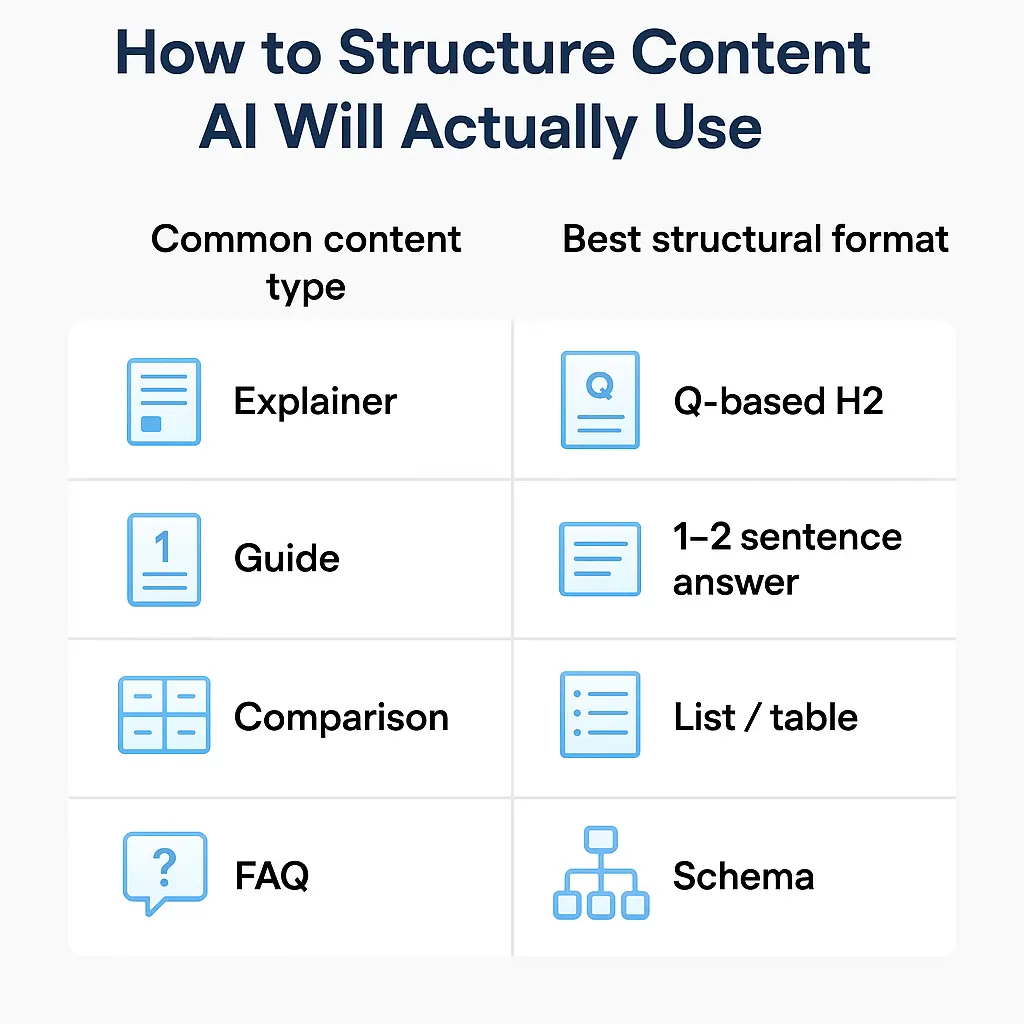
GEO-optimized content isn’t just well-written. It’s well-structured for how large language models extract and reuse information. Tools like ChatGPT and Gemini don’t scroll or skim, they parse. So your content has to give them clean signals, fast.
Here’s what that looks like in practice:
H2s: Use Natural Language Questions
- Think like your audience, and phrase headers the way they’d search or ask.
- Instead of “Content Strategy Tips,” write “How Do You Build a Content Strategy?”
H3s: Deliver Definitions or Steps
- Use H3s to answer the H2 directly.
- Keep it tight, 1 to 2 sentences max. Avoid fluff.
Paragraphs: Short, Factual, Clear
- Aim for 2–3 sentence chunks. Use direct language and lead with the key point.
- No meandering intros. No filler.
Lists: Scannable 3–5 Bullet Blocks
- LLMs love lists. They’re easy to extract and paraphrase.
- Each bullet should add value, facts, steps, tips, or stats.
(Structured content like bullet lists, Q&A formats, and short definitions make up 66% of all featured snippets, an indicator that both search and AI tools prioritize this type of formatting).
Schema: Use Article + FAQ Markup
- Apply structured data to help AI models interpret your content type.
- Use JSON-LD to wrap your article and FAQs. Tools like Merkle’s Schema Markup Generator or Rank Math make this simple.
GEO Template #1: Explainer
Explainers work well for definition-based prompts. This layout ensures your answer shows up when users ask ‘What is…?’ They’re perfect for top-of-funnel queries, definitions, exactly the type of prompts LLMs are trained on.
Explainer GEO Structure:
H2: What is [Topic]?
Start with a natural language question that mirrors how users ask it. This becomes a direct signal for both ChatGPT and Google’s SGE.
H3: [Topic] is…
Answer immediately in 1–2 clear sentences. Lead with the definition. Strip out intro fluff.
Bullets: Key Facts or Concepts
Break the explanation down into 3–5 bullets:
- Core features or components
- Related terms or entities
- Relevant stats or real-world uses
- Credible source or quote (hyperlinked)
- Common misunderstandings or differentiators
Bonus: Add a quote from a trusted source or original research. Example:
“Content strategy is how a brand plans, creates, and manages content to meet business goals.” Content Marketing Institute
This layout makes your content easy to extract, summarize, or cite, especially when it’s cleanly formatted and supported with schema.
GEO Template #2: Step-by-Step Guide
Instruction-tuned models favor short, clear sequences. This format mirrors how AI delivers actionable guidance. “How to” guides are one of the most reused formats in generative search. When a user asks ChatGPT or Gemini for instructions, models pull from clear, numbered steps with concise, actionable phrasing.
Step-by-Step Guide GEO Structure:
H2: How to [Do X]
Lead with a question that mirrors the search prompt. Keep it literal, models scan for intent-match phrasing.
Numbered Steps:
Break the process down into logical steps. Each step should start with a verb and be no longer than 2–3 lines. Example:
- Define your target audience – Understand who you’re speaking to and why they care.
- Map your content goals – Align each piece with a business objective.
- Choose the right format – Blog, video, whitepaper, match format to intent.
- Distribute and track – Promote content and monitor performance metrics.
Add an FAQ Section:
At the end, include 2–4 FAQs addressing edge cases, objections, or related tasks. Wrap in FAQ schema for AI recognition.
Example:
Q: What’s the best tool to start with?
A: Use something scalable like Notion or Airtable if your team collaborates frequently.
Why it works:
Gemini, Perplexity, and ChatGPT use instruction-tuned submodels to detect processes. Clear sequences, step headers, and short descriptions increase your chance of being paraphrased or directly cited. The structure does half the work.
Research on instruction tuning shows that LLMs assign higher confidence scores to content with clear step formatting and instructional clarity, leading to more frequent reuse.
GEO Template #3: Comparison Blocks
AI tools love ‘X vs Y’ prompts. A tight summary and structured table can position your content as the go-to source. “X vs Y” is one of the most common prompt formats across ChatGPT and Gemini. When someone asks, “What’s the difference between SEO and GEO?”, LLMs look for structured comparison data they can lift fast.
Comparison Blocks GEO Structure
H2: [Tool A] vs [Tool B]: What’s the Difference?
Frame the headline as a natural question. This increases inclusion odds in both AI answers and featured snippets.
Short Summary Paragraph:
Open with 2–3 lines explaining the key difference and when you’d use each. Lead with clarity.
Example:
SEO helps you rank in Google. GEO helps you get cited by ChatGPT. Both matter, but for different stages of content visibility.
Comparison Table:
Use a clean table that contrasts features, outcomes, or formats. Keep the column headers consistent. Focus on concrete points.
| Feature | SEO | GEO |
|---|---|---|
| Primary Goal | Rank in Google search | Get cited in AI-generated answers |
| Format Style | Long-form, keyword-rich | Structured, concise, factual |
| Traffic Impact | Drives clicks | Builds visibility and authority |
| Tools Used | Ahrefs, SEMrush | Nozzle.ai, prompt testing tools |
Structured Subheadings:
Break down additional points using H3s, like:
H3: When Should You Use GEO Instead of SEO?
Answer directly beneath it in 1–2 short sentences.
Why it works: LLMs often generate answers by summarizing tables and comparisons. Using consistent formatting and phrasing makes it easier for the model to extract your content cleanly, especially when paired with schema markup or structured HTML.
GEO Signals That Strengthen AI Pickup
Once your structure is solid, these enhancements can push your content over the line, making it more likely to be cited, summarized, or echoed in AI outputs.
- Insert Branded Terms Early
Mention your brand, product, or framework in the first 100 words. LLMs associate early signals with topical authority. - Add Stats with Citations
Verified numbers plus hyperlinks build factual trust. Cite sources like Statista, Pew Research, or industry whitepapers. - Refresh High-Performing Content
Take your top-ranking or backlink-heavy pages and reformat them using GEO templates. Add schema and answer-first structure without changing the URL. - Use Internal Linking Smartly
Link back to your core GEO pillar or related support articles. This helps LLMs map the topical depth and entity relevance of your content.
Each of these signals helps build confidence that your content is both relevant and authoritative, making it more likely to be selected, even if you’re not the biggest name in the space.
| Element | Why It Matters for GEO |
|---|---|
| Question-based H2s | Increases match rate with natural language prompts used in AI tools. |
| Short answer under headers | Helps LLMs extract high-confidence responses quickly. |
| List formatting (bullets or steps) | Improves extractability and reuse in structured answers. |
| Schema markup (FAQ + Article) | Reinforces content structure for better AI parsing. |
| Comparison tables | Supports paraphrased outputs for “vs” prompt formats. |
| Internal linking to topic cluster | Signals topical depth and reinforces entity relevance. |
| Short paragraphs (2–3 lines) | Makes token parsing easier for LLMs and improves readability. |
| Early brand/entity mentions | Boosts semantic association and AI model recall. |
| Direct citations or stats | Adds credibility and supports factual integrity in AI responses. |
Structure Content That AI Actually Uses
Structure is the key aspect of AI visibility.
You can have the right message, the right keywords, and the right intent, but if your format fails, LLMs will skip right past it.
Use these content templates to build pages that models can actually parse, understand, and reuse. That’s how you get included, not just indexed.
A GEO content framework is a structured layout designed to make content easy for large language models (LLMs) to parse, reuse, and cite. It includes answer-first formatting, question-based headings, and extractable elements like bullets, definitions, and tables.
Structure acts as a signal for generative engines like ChatGPT and Gemini. Clean formatting helps models identify useful content blocks, increasing the chance of inclusion in AI-generated responses.
Yes. Question-based headings and short bullet lists are easier for models to extract and summarize. They increase the likelihood your content will be paraphrased or cited in an AI-generated answer.
Schema isn’t required, but it helps. Adding Article and FAQ schema improves content clarity for AI and search engines, especially in combination with strong internal structure.
Track repeated phrasing, paraphrased usage, and AI-generated answers that reflect your structure. Tools like Nozzle.ai and prompt testing help confirm inclusion, even if you’re not directly cited.