
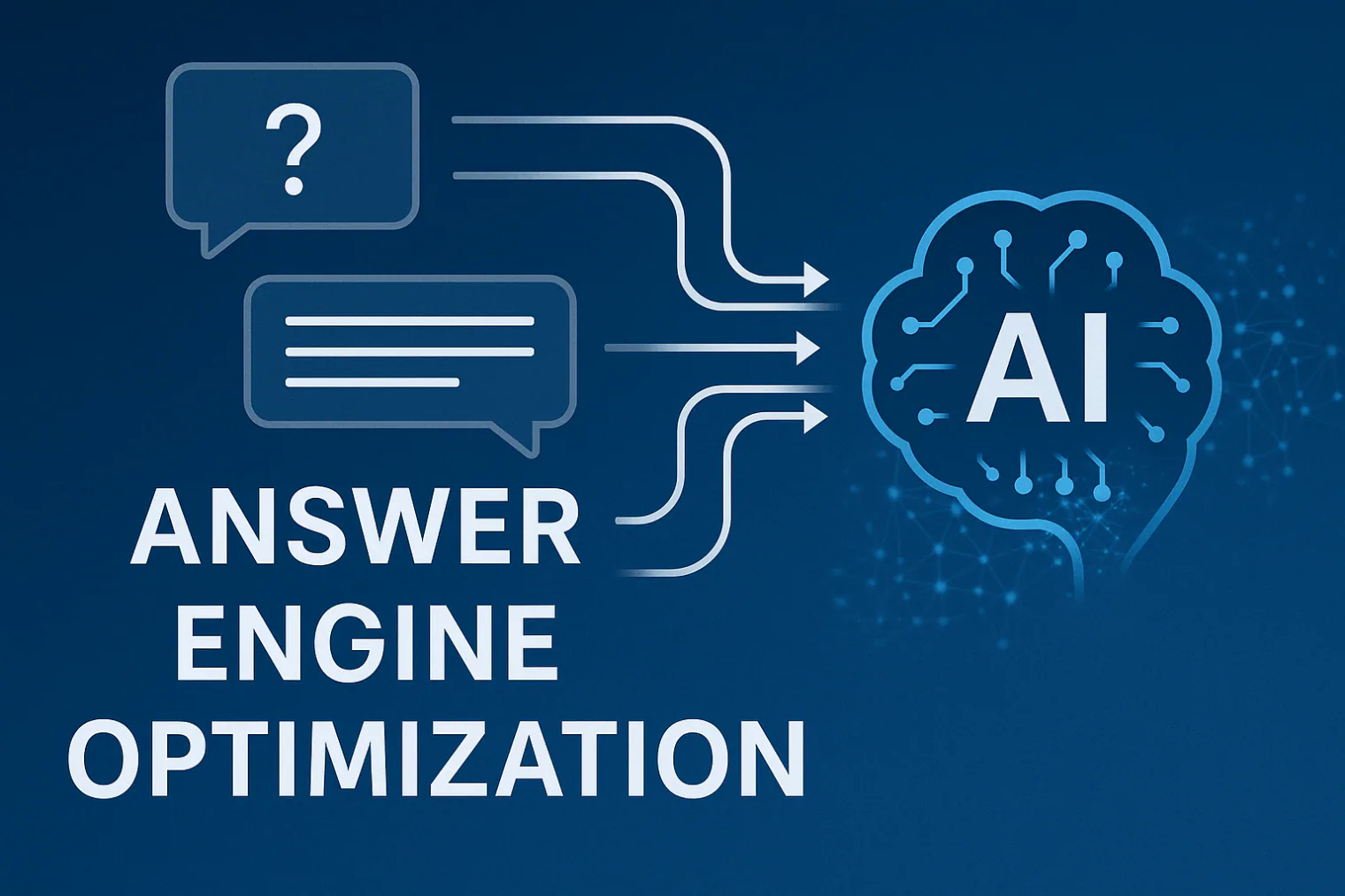
Search behavior is changing fast. Users aren’t just typing keywords into Google anymore. They’re asking full questions to tools like ChatGPT, Perplexity, and Google’s Search Generative Experience (SGE). And those tools aren’t showing 10 blue links. They’re giving direct answers. Which is why you need to shift some focus to Answer Engine Optimization (AEO).
What Is Answer Engine Optimization (AEO)?
Answer Engine Optimization (AEO) is the process of optimizing your content to be cited directly by AI tools like ChatGPT, Google’s Search Generative Experience (SGE), Perplexity, and others. Tools that generate answers. And increasingly, those answers are built from your content, if it’s structured the right way.
This isn’t a trend. It’s already changing how people discover and trust information online.
We’re seeing a shift from click-driven traffic to AI-summarized visibility. And the implications are serious: by 2026, brands that rely solely on traditional SEO could see up to 40% drops in organic traffic, simply because they’re not being included in AI responses.
AEO is how you stay visible when search engines stop sending clicks. It’s how you make sure your expertise still informs buying decisions, even when there’s no website visit.
Why Is AEO Important?
Answer Engine Optimization (AEO) matters because the way people discover information online is rapidly changing. Instead of clicking through traditional search results, users are now getting direct answers from AI tools. These systems don’t always rely on top-ranking SEO content; they pull responses from structured, conversational, and well-cited content.
By 2026, Gartner predicts a 25% drop in traditional search engine volume as users turn to AI chatbots and answer engines like ChatGPT and Google SGE. That’s a huge shift, not just in how people search, but in visibility too.
Meanwhile, tools like Perplexity are scaling fast: with around 780 million queries processed in May 2025 (roughly 26 million searches per day), up from just 3,000 on launch day in 2022. This growth shows user preference for answer-first experiences over traditional click‑through search.
AEO is important for many other reasons:
1. AI Is Replacing Search as the First Step in the Customer Journey
Whether it’s ChatGPT, Claude, or Google’s SGE, users are starting with answer engines to solve problems, vet brands, and get recommendations. If your content isn’t showing up in those answers, you’re not even in the conversation.
AEO ensures your expertise is actually used, not buried three clicks deep in a blog archive.
2. AI Engines Bypass Clicks; Visibility Happens Without Traffic
With traditional SEO, you measure success in pageviews. In AEO, success means your content is cited or used by an AI, even if no one clicks. That’s a radical change in how content ROI is measured.
Brands must start optimizing for influence over traffic.
3. Structured Content Is Easier to Extract and Reuse
Large language models (LLMs) are trained to pull concise answers. If your content is buried in dense paragraphs or unclear structures, it gets skipped. But format it with proper schema, short paragraphs, and list-based answers? It’s infinitely more reusable by AI systems.
AEO helps you write for humans and machines.
4. AEO Future‑Proofs Your Content Strategy
Google is blending SGE into its main results. Other tools like Perplexity, You.com, and AI browser extensions are growing. This is where search is headed.
Brands that adapt now will dominate the AI citation layer later.
5. Being Present in AI Results Builds Brand Authority Fast
When AI tools repeatedly surface your explanations or brand name in responses, users start to trust you, even if they never visit your site. It’s the new version of “thought leadership,” and it’s earned through AEO.
Optimizing for AI is how you earn mindshare in a no-click world.
AEO vs SEO vs GEO: What’s the Difference?
If you want your content to stay visible in AI, you can’t rely on just SEO anymore. While Search Engine Optimization (SEO) focuses on ranking pages in traditional search results, Answer Engine Optimization (AEO) is about getting your content pulled into direct answers inside tools like ChatGPT, Perplexity, or Google SGE. Then there’s Generative Engine Optimization (GEO), a newer layer, focused on long-form AI responses and being cited within full conversations.

Each serves a different function, but they aren’t mutually exclusive. In fact, the best strategy now blends all three.
| Category | SEO | AEO | GEO |
|---|---|---|---|
| Main Objective | Rank web pages in traditional search | Provide short, direct answers in AI tools | Get cited inside longform AI-generated content |
| Target Surface | Google, Bing, YouTube | Chatbots, voice assistants, Google SGE | ChatGPT, Perplexity, Gemini, Claude |
| Optimization | Keywords, backlinks, metadata | Structured Q&A, schema, conversational answers | Factual tone, internal links, citations, format |
| User Outcome | Clicks through to website | Zero-click answers or citations in chat | Influence over AI narratives without direct traffic |
| Metrics | Traffic, rankings, bounce rate | Inclusion in snippets, brand mentions | Prompt tests, visibility in LLM output |
Core Principles of AEO
Answer Engine Optimization relies on structuring content for how AI tools interpret, extract, and deliver answers. Traditional SEO might help you show up on page one, but AEO ensures your content gets used in the answer itself. These are the foundational principles to follow if you want to increase your chances of inclusion in AI-powered responses:
Conversational Q&A Content
Search engines used to reward keyword density. AI answer engines reward natural phrasing.
AEO content needs to reflect how real people ask questions. That means framing your H2s and H3s as full, conversational queries, and answering them clearly, directly, and immediately underneath. This improves your content’s match rate with natural language prompts used by tools like ChatGPT or Perplexity.
Best practices:
- Use H2s and H3s that mirror search queries (e.g. “How does AEO work?” instead of “AEO Functionality”).
- Start answers with a short, direct summary (1–2 lines).
- Expand with optional depth below using bullets or examples.
- Avoid jargon unless you explain it simply.
Tip: Use tools like AlsoAsked, AnswerThePublic, or SearchEye’s prompt insight features to find real queries being asked.
Structured Formatting & Schema
AI systems parse structure more than style.
Using clean formatting, like bullet points, numbered lists, short paragraphs, and schema markup, helps AI tools identify and extract key information faster. It also increases your odds of getting picked up in featured snippets, Google SGE panels, or voice results.
Best practices:
- Use FAQ schema for common questions at the end of articles.
- Break up long text blocks into 2–3 line paragraphs.
- Use unordered or ordered lists for instructions or comparisons.
- Add Article, FAQ, and HowTo schema via JSON-LD where appropriate.
Tip: Use Google’s Rich Results Test to check if your schema is valid and indexable.
Authority Signals and Citations
AI systems look for trustworthy sources, just like users do.
When tools like ChatGPT or Perplexity are selecting content to cite, they often prioritize domains with strong reputations, consistent signals of expertise, and clear factual grounding. Even anecdotal content performs better when it includes citations to primary sources.
Best practices:
- Link to reputable sources (studies, research papers, government sites).
- Include statistics or definitions with proper attribution.
- Mention named experts or companies when quoting information.
- Keep factual tone, don’t oversell or use clickbait phrasing.
Tip: If you’re referencing your own data, publish it as a dedicated resource page or PDF and link to it, this builds brand authority over time.
Together, these three principles form the foundation of any AEO-focused content strategy. Implement them consistently across your pages to increase the odds of inclusion in AI-powered answers and snippets.
How Answer Engines Select Your Content
AI answer engines don’t just memorize content; they retrieve it. Most modern tools like ChatGPT (when browsing is enabled), Google SGE, Perplexity, and others use retrieval-augmented generation (RAG). This means the language model first scans live web content and then generates an answer based on what it finds most relevant and reliable.
Unlike traditional search engines that return a list of links for the user to choose from, answer engines do the heavy lifting: they assess your content’s quality, structure, authority, and clarity in real-time to decide whether it deserves inclusion in the answer output.
This means less-known brands and smaller publishers can win visibility, if they align with what these AI models are prioritizing:
1. Live Web Indexing
Answer engines like Perplexity and ChatGPT with browsing rely on real-time scraping and web crawling. Your content must be publicly accessible, load fast, and follow basic SEO practices (e.g., no broken links, no blocking via robots.txt).
2. Clarity and Structure
LLMs favor content that is easy to parse. This means:
- Short, structured paragraphs
- Use of question-based headers
- Bullet points, numbered lists, and summary boxes
These patterns help models extract usable content chunks with higher confidence.
3. Topical Authority and Relevance
The more your site demonstrates consistent coverage on a given topic, the more likely it will be surfaced for related queries. That’s why content clusters and internal linking matter for AEO just as much as they do for SEO.
4. Citation Trust Signals
Models lean toward citing sites that display:
- Real authorship or organization identity
- Factual claims with verifiable sources
- Consistent content tone (factual, neutral, and helpful)
5. Prompt Relevance and Language Matching
If your content reflects how people actually phrase questions, it has a higher chance of matching prompts. Tools like SGE and ChatGPT prioritize conversational tone, so exact keyword targeting takes a back seat to intent-matching.
AEO Optimization Techniques
Utilizing the latest AEO strategies is the most effective way to get your content selected. Consider these techniques:
How to write conversational headers
Use natural language that mirrors how real people phrase questions in AI tools.
- Start headers with “What,” “How,” “Why,” “Can,” “Does,” etc.
- Avoid abstract, SEO-driven phrasing; use full-sentence questions.
- Pull from real queries on tools like Answer the Public or People Also Ask results.
- Keep H2s and H3s short and specific (ideally 5–10 words).
- Example: “What Is Answer Engine Optimization?” instead of “AEO Overview.”
How to structure FAQs and short answer blocks
Write responses that deliver the key takeaway in the first sentence, followed by optional context.
- Use the inverted pyramid style: lead with the answer, then elaborate.
- Keep paragraphs 1–3 sentences max.
- Create a dedicated FAQ section with H3s or
<strong>questions + clear answers. - Use bullet lists when outlining steps or features.
- Example:
Q: How does AEO help with AI visibility?
A: AEO improves your chances of being cited in AI-generated responses by using structured, clear, and question-based content.
How to use schema markup (FAQ + Article)
Add structured data to signal your content type and format to search engines and answer engines.
- Use JSON-LD format (not Microdata or RDFa).
- Add FAQ schema to common question sections.
- Use Article schema for every editorial post.
- Include
author,headline,datePublished, andpublisherproperties. - Tools: Merkle Schema Generator, Rank Math, Yoast SEO.
How to include citations and trustworthy sources
Reference authoritative sources to build factual credibility and increase inclusion likelihood.
- Link to primary data sources, research studies, or expert publications.
- Use brand names or source attribution directly in sentences (e.g., “According to Gartner…”).
- Avoid vague terms like “experts say”; be specific.
- Include external links where appropriate; LLMs parse these during retrieval.
- Ensure all facts are verifiable and not speculative.
Tracking AEO Success
Unlike traditional SEO, AEO lacks clear, dedicated tracking platforms. There’s no “rank tracker” for AI citation, yet. But you can still measure impact through a mix of AEO tools and manual validation.
Key methods and tools to track AEO visibility:
- Prompt testing in tools like ChatGPT and Perplexity: Manually run target queries and check if your brand, domain, or phrasing appears in answers.
- Monitor branded mentions in AI-generated content: Set up alerts or use tools like Brand24 or Mention to track citations across AI tools, blogs, and newsletters.
- Use general SEO and content tools with AEO overlap:
- OmniSEO – Some early tracking of AI visibility via custom SERP overlays
- AI EngineBoost – Still in beta, but built to log AI citations across engines
- MarketMuse – Useful for improving authority and structured content coverage
- Clearscope – Helps align content tone and clarity for machine parsing
AEO tracking today is mostly manual. But the same way zero-click SEO developed analytics layers, AEO tooling is coming fast.
How Long Does AEO Take?
There’s no instant win with AEO, but results can start to appear faster than with classic SEO.
Most brands start to see early inclusion in ChatGPT or Perplexity within 2–6 weeks, depending on:
- Existing SEO health – Authority and crawlability are still factors.
- Content clarity and structure – AI engines parse better-structured answers more easily.
- Update frequency – Sites that refresh or publish often tend to see faster traction.
- Prompt alignment – Content that directly mirrors user phrasing wins earlier inclusion.
- Citation-worthy tone – Factual, confident content tends to surface more reliably.
If your content is already solid and well-structured, even small tweaks (like adding an FAQ or schema) can speed up inclusion.
Should You Prioritize AEO?
Answer Engine Optimization isn’t a replacement for SEO or GEO, it’s the next layer of visibility. Where SEO helps you rank and GEO gets you cited in generative responses, AEO gets you quoted in the answer itself.
Here’s a simple way to think about it:
| Your Situation | Should You Prioritize AEO? |
|---|---|
| Rely heavily on organic traffic? | Yes. You’re vulnerable to AI displacing clicks. |
| Already ranking well in SEO? | Yes. AEO helps capture non-click visibility. |
| Building topical authority? | Yes. AEO reinforces your credibility in answers. |
| Publishing new content? | Yes. Start optimizing early for faster inclusion. |
| Small site or brand? | Still yes. AI doesn’t care about size, it cares about clarity. |
If you’re not optimizing for AEO, you’re invisible in the fastest-growing layer of search: AI-driven answers.
Why AEO Matters for Future Visibility
Organic search has evolved from clickable blue links to conversational, AI-focused answers. AEO is how you stay visible when users don’t click, because they don’t have to.
If your content isn’t optimized for answer engines, you’re not just missing traffic, you’re missing relevance.
Now’s the time to run your first AEO audit:
- Rework your headers as questions.
- Add short, direct answers.
- Use schema markup.
- Include citations.
- Track your AI visibility manually.
The brands that start now will shape what AI shows tomorrow.
FAQ
SEO focuses on ranking webpages in traditional search results based on keywords, backlinks, and technical optimization. AEO (Answer Engine Optimization), on the other hand, is about structuring content in a way that gets directly cited or quoted in AI-generated answers, like in ChatGPT, Google SGE, or Perplexity. It’s not about ranking but about being the source of the answer itself. Both serve different layers of discoverability and should work together.
Technically yes, but your chances are limited without foundational SEO in place. AEO thrives when search engines and AI tools can easily crawl, trust, and understand your site. That means having proper indexing, internal linking, clean site architecture, and some level of domain authority. SEO lays the groundwork that AEO builds on.
Run AI queries in tools like ChatGPT, Google SGE, or Perplexity using prompts related to your content. If your phrasing, brand name, or links show up, you’re likely being cited. You can also track paraphrased mentions using tools like MarketMuse or SearchEye, though detection remains imperfect today.
Strongly recommended. FAQ schema, Article schema, and How-To schema give AI systems additional context about your content’s structure, purpose, and credibility. While not a guarantee of inclusion, schema improves your chances of being selected as a source and helps answer engines extract information cleanly.
Yes, and in some cases, they have an edge. Answer engines don’t only prioritize domain size; they prioritize clarity, structure, and relevance to the query. A smaller site that delivers clear, well-formatted answers with citations can absolutely show up in AI responses, even above enterprise competitors still stuck in old SEO habits.