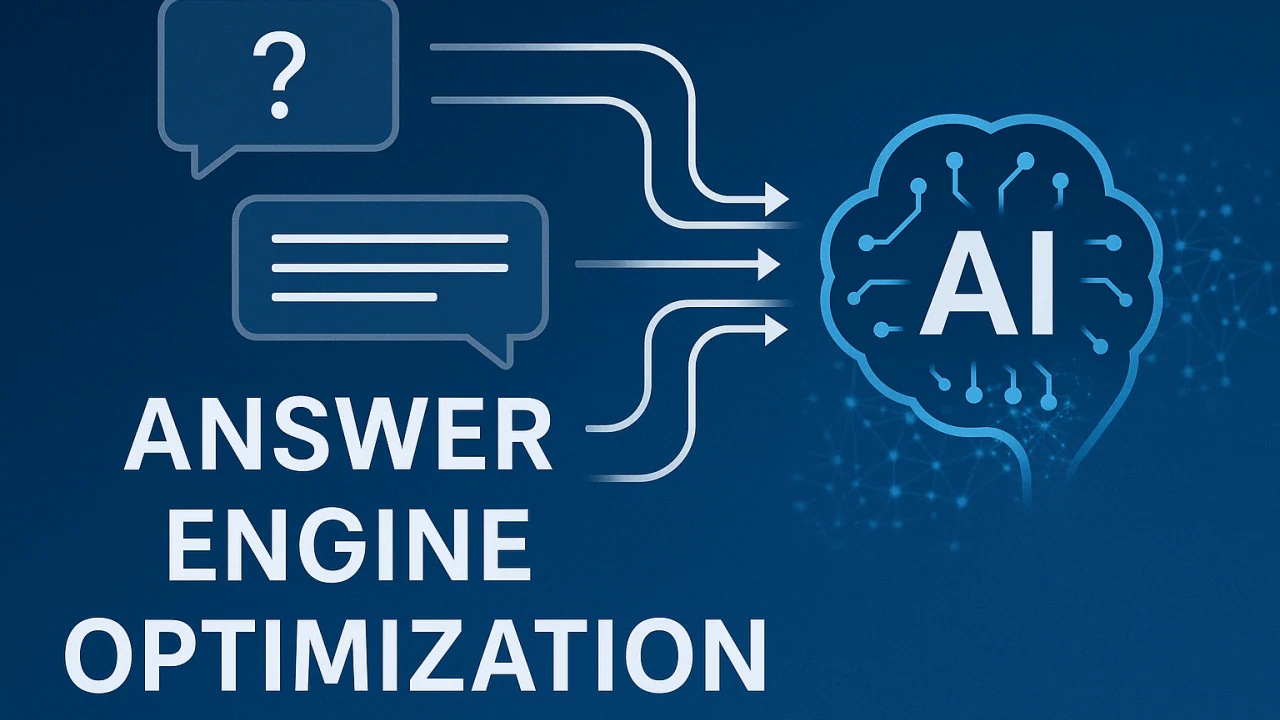

Answer Engine Optimization (AEO) is the practice of structuring and writing content specifically to be surfaced in AI-powered tools like ChatGPT, Gemini, Google SGE, and Perplexity. Unlike traditional SEO, which fights for search rankings and clicks, AEO focuses on getting your content cited directly in AI-generated answers.
And that’s now essential.
AI-driven platforms are quickly becoming the default way users discover information. Perplexity alone served over 780 million queries in a single month. Google’s Search Generative Experience (SGE) is already live in multiple regions, and ChatGPT continues to dominate attention with its conversational summaries. Users aren’t clicking links, they’re scanning answers. If your brand isn’t showing up in those answers, you’re not visible.
This shift toward zero-click, answer-first behavior demands a new layer of optimization, and this guide dives into the strategies that actually get you included.
Key AEO Strategies to Improve Your Visibility
To get cited by AI answer engines, your content must align with how these systems retrieve and prioritize data. Below are high-impact tactics to improve your inclusion and visibility.
| Strategy | What It Does | How It Helps With AEO |
|---|---|---|
| AI Answer Competitor Analysis | Identifies who’s getting cited and why | Helps reverse-engineer successful formats and content patterns |
| Target Conversational Queries | Focuses on real questions users ask in natural language | Increases alignment with AI prompt phrasing and improves match rate |
| Front-Load Direct Answers | Places the core answer in the first 100–200 words | Boosts chances of being extracted and cited by answer engines |
| Use Q&A Headers + Schema | Structures content with question-based H2/H3s and FAQPage markup | Enables easier parsing and citation by LLMs |
| Add Author Credentials & Sources | Includes bios, timestamps, and external citations | Improves trustworthiness and content authority scoring |
| Monitor AI Presence Regularly | Tests prompts and tracks inclusion across ChatGPT, SGE, etc. | Allows content optimization based on real-time visibility performance |
1. Competitive AI Answer Analysis
AI-generated answers often pull from a small set of reliable sources. Your first move is to reverse-engineer what’s already being cited.
- Run prompt tests in ChatGPT, Gemini, or Perplexity using key queries in your niche. Take note of which domains or phrasing patterns appear.
- Use tools like OmniSEO or search analytics platforms to monitor citations, content structure, and brand mentions.
- Benchmark competitors by reviewing their FAQ blocks, schema usage, intro paragraphs, and how they phrase answer-first responses.
- Look for structural trends, short paragraphs, conversational headers, bulleted summaries, and clear source references.
By decoding what’s already working, you can shape your content to mirror high-performing formats without copying.
2. Target Conversational Queries
Answer engines are trained on how people speak, not how marketers optimize. That means your strategy must shift from keywords to questions.
- Mine long-tail questions using tools like AnswerThePublic, “People Also Ask” results in Google, and your internal search/chat logs.
- Focus on natural-language phrasing: “How do I fix X,” “What’s the best way to Y,” or “Why does Z happen?”
- Use these conversational queries as your H2/H3 headers. Answer them directly in the following paragraph, one or two sentences, max.
- Incorporate Q&A schema whenever possible, especially for recurring questions.
- Prioritize real user intent over high-volume keywords. In AEO, relevance and clarity beat density and backlinks.
Search engines are evolving to think more like humans. Your content should do the same.
Ask ChatGPTFront‑Load Value and Use Q&A Format
AI answer engines don’t read your whole article; they skim for high-confidence answers up top. If your value isn’t front-loaded, it won’t get cited.
- Answer the query within the first 100–200 words. Treat it like a TL;DR that could be quoted directly.
- Use question-style H2/H3 headings that match how people prompt AI: “What is X”, “How do I Y”, “Why does Z happen”.
- Keep answers short and structured. Follow with detail or context further down the page.
- Format Q&A blocks clearly and consistently. These are easy for LLMs to identify and reuse.
Answer-first writing isn’t just good UX, it’s how answer engines extract responses.
3. Apply Structured Formatting & Schema
AI models prefer predictability. The more structured and consistent your content, the easier it is to parse and cite.
- Use FAQPage, HowTo, Article, or Speakable schema (depending on context) to signal purpose.
- Break content into bullet lists, short paragraphs, and clear tables. Each element adds retrievability.
- Incorporate anchor-linked TOCs, section dividers, and consistent styling patterns for headers and body content.
- Use Google’s Rich Results Test to validate your schema markup.
Structured formatting isn’t optional, it’s what helps content survive the LLM filter.
4. Add Credibility & Citations
Answer engines don’t just look for good answers, they look for trustworthy sources. You need to make trust obvious.
- Include author bios, headshots, and credentials, even short ones can boost authority scoring.
- Show updated timestamps and include an editorial process or review note if applicable.
- Link to reputable external sources (e.g., government, educational, industry-standard) to support claims.
- For medical, financial, or legal content, cite guidelines or regulatory bodies directly.
- Don’t hide behind “anonymous brand” tone, AI systems value transparency, clarity, and sourceability.
If your content reads like it was written by a ghost, AI engines will treat it like one.
5. Iterate & Monitor AI Presence
AEO isn’t set-it-and-forget-it. Answer engine results are fluid, updates happen frequently, and AI models retrain often. Staying visible means staying proactive.
- Run regular prompt tests in ChatGPT, Perplexity, SGE, and Gemini using real user questions.
- Track when and how your brand or phrasing appears. If it disappears, review what changed.
- Use AEO tools like OmniSEO, SearchEye, Profound, or MarketMuse AI visibility dataset to monitor inclusion patterns.
- Update content titles, schemas, and answer blocks based on what’s being favored or omitted.
- Refresh citations and dates, recency often matters in AI output selection.
If you’re not tracking how often you show up, you won’t know when your visibility starts to drop, or why.
Why These Strategies Work Together
AEO isn’t a checklist. It’s a layered system, each tactic reinforces the others and helps your content meet answer engine standards.
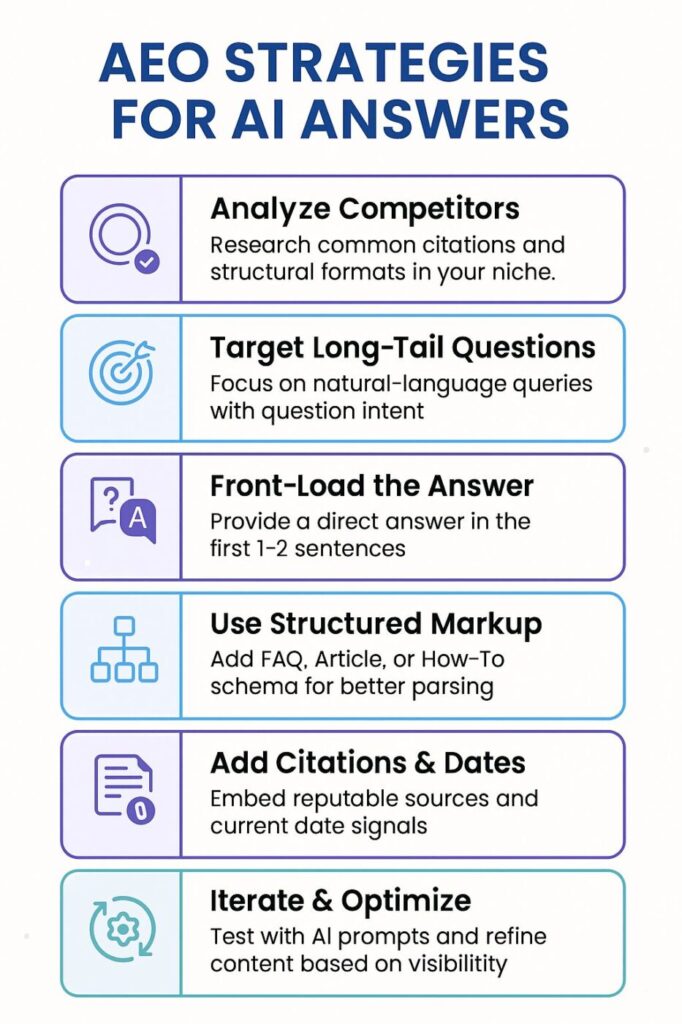
- Competitive analysis shows what’s already working and where you can differentiate.
- Conversational targeting aligns your phrasing with real prompts, increasing your match rate.
- Structured formatting and schema allow LLMs to parse, trust, and cite content cleanly.
- Citations and author signals give your pages the authority AI engines look for.
- Ongoing monitoring and updates keep your presence alive across dynamic answer feeds.
Together, they build what AI models consider high-confidence content, the kind worth surfacing, citing, and serving directly to users.
AEO isn’t a bolt-on tactic, it’s a new layer of visibility designed for the way people now get answers. Brands that embrace competitive analysis, conversational phrasing, structured formatting, trusted citations, and continuous testing won’t just get indexed, they’ll get cited.
In an AI-driven landscape, that’s the difference between being seen and being used.
FAQ
AEO gets your content cited in AI answers. SEO ranks your pages in traditional search engines. AEO focuses on conversational responses; SEO focuses on click-through traffic.
It can, but it’s harder. AEO relies on content structure, site authority, and crawlability, all of which SEO improves. Strong SEO makes AEO more effective.
Test prompts manually in ChatGPT, Perplexity, or Google SGE. Look for direct mentions of your brand, snippets, or phrasing. Tools like OmniSEO and SearchEye can help.
Yes. FAQ, Article, and HowTo schema help AI tools understand and trust your content structure. It’s a core signal for visibility in answers.
Yes, if your content is clean, direct, and useful. Answer engines care more about clarity and accuracy than domain size.