
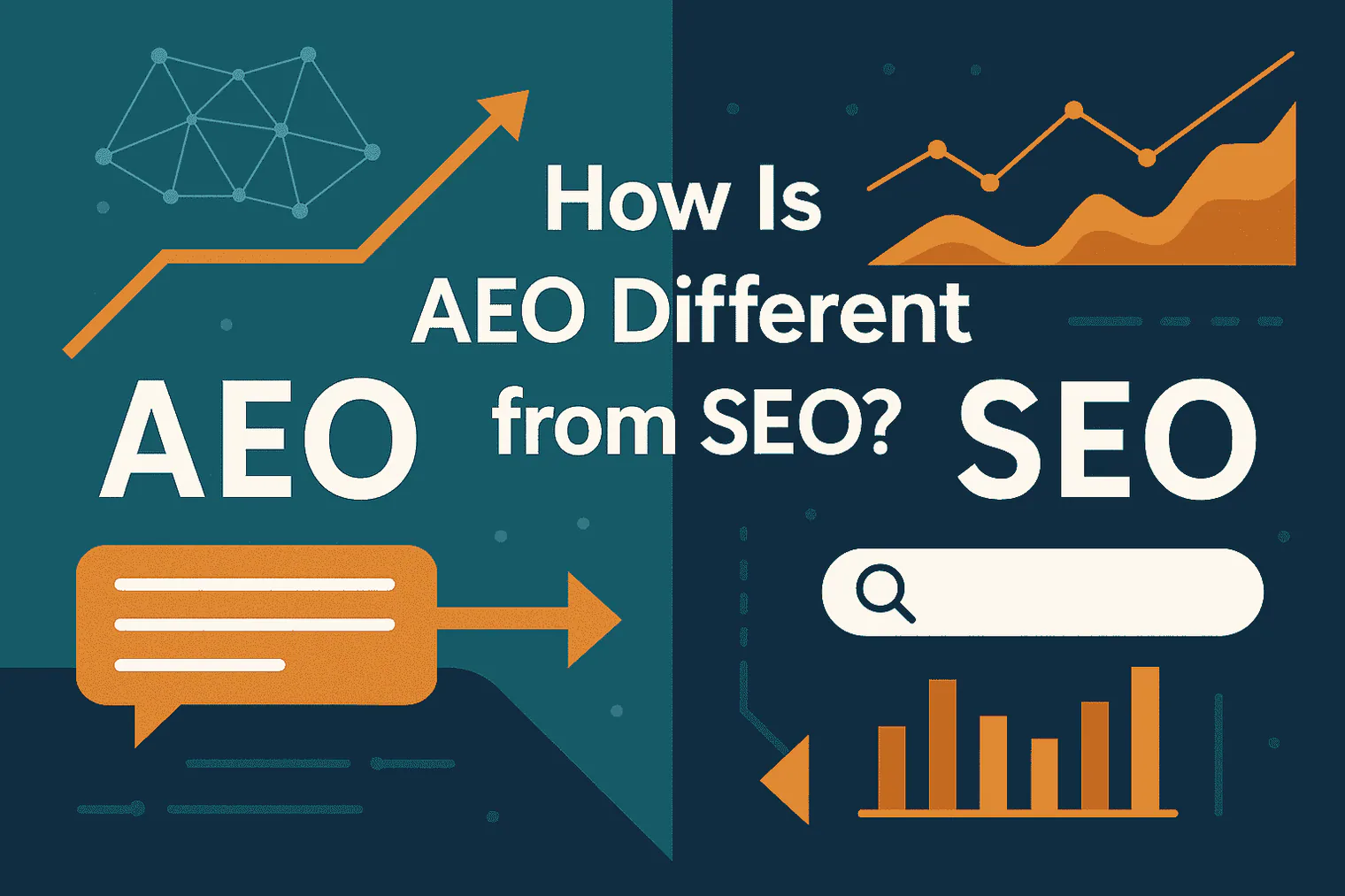
SEO helps you rank. AEO helps you get used.
While search engine optimization focuses mainly on Google search results, answer engine optimization is about showing up directly in AI-generated answers, whether that’s in ChatGPT, Gemini, Perplexity, or Google SGE.
These tools are how people are discovering information now. If your content isn’t structured for both search and answers, you’re not just losing clicks, you’re invisible altogether.
This guide breaks down the key differences between AEO and SEO, shows where they overlap, and gives you a clear way to structure your content for both.
SEO vs AEO
Search Engine Optimization (SEO) is the practice of optimizing content to rank in traditional search engines like Google. It focuses on signals like backlinks, keyword placement, meta tags, and technical site structure. The goal: appear in the top organic results and drive clicks to your website.
Answer Engine Optimization (AEO), on the other hand, is about getting your content cited directly in AI-generated responses, no clicks required. Tools like ChatGPT, Perplexity, Gemini, and Google SGE pull information from the web (or their training data) to generate answers. AEO ensures your content is structured in a way these systems can easily parse, trust, and use.
| Element | SEO Focus | AEO Focus |
|---|---|---|
| Primary Platform | Google Search, Bing | ChatGPT, Perplexity, Gemini, Google SGE |
| Goal | Rank in top 10 search results | Be cited or used in AI-generated answers |
| Format Targeted | Webpages for human readers | Structured content for LLM parsing |
| Optimization Signals | Backlinks, keywords, meta, speed | Clarity, structure, freshness, source trust |
| Output Type | Links + Snippets | Instant answers + citations (if visible) |
In short: SEO helps you get found. AEO helps you get featured. And today, both are essential.
Why AEO Matters Right Now
Answer engines are replacing traditional search for many users. AEO helps marketers stay visible in zero-click environments by getting their content cited directly in AI-generated responses.
Real Trends Marketers Need to See
AI summaries and zero-click behaviors are now how most users consume information. These trends make traditional SEO alone insufficient for visibility.
- Zero-click is mainstream: In 2025, nearly 60% of Google searches resulted in no clicks, especially on mobile, where answer panels dominate screen space (WSJ).
- AI Overviews are everywhere: Google’s AI summaries now show on up to 47% of searches, with informational queries most affected (Ridge Marketing).
- Perplexity is surging: In May 2025, it processed 780 million queries, a 5x jump from 2024 (WeAreTenet).
Why It Matters for Marketing Teams
If AI engines are answering the questions your audience is asking, and you’re not included, you’ve already lost visibility. AEO strategies get you back in.
- Less traffic, less impact: If AI answers appear above your content, clicks dry up, even if you still “rank.”
- Invisible influence is real: AI may summarize or paraphrase your ideas without giving credit unless you format for retrieval.
- Structured content wins: Brands using Q&A blocks, schema, and clear answers upfront are more likely to get cited.
For Marketers Considering ROI
AEO extends the life of your existing content by making it reusable in AI-generated answers. It also lowers dependency on ever-shrinking organic click-through rates.
- 80% of users now expect answers on-page or in-summary, and this trend is hurting traditional traffic funnels by 15–25% (Ridge Marketing, Bain).
- 88% of marketers now use AI daily. Over half optimize their content structure to improve retrieval in tools like Perplexity and ChatGPT (Semrush).
If you’re not visible in AI, you’re not visible at all. AEO is the difference between being part of the answer or erased from the conversation.
Key Differences Between AEO and SEO
While SEO focuses on ranking links, AEO optimizes for inclusion in direct answers. The two approaches overlap, but differ in structure, outcomes, and how success is measured.
Marketers often assume AEO is just another SEO trend, but it’s a different optimization layer altogether. AEO prepares your content for language models that summarize, paraphrase, and select only the most structured and trusted inputs. To help distinguish the two, here’s a breakdown across the areas that matter most.
| Aspect | SEO (Search Engine Optimization) | AEO (Answer Engine Optimization) |
|---|---|---|
| Goal | Rank high in search engine results pages (SERPs) | Be cited, paraphrased, or linked in AI-generated answers |
| Primary Output | Link-based results shown in Google/Bing search | Text-based summaries in ChatGPT, Perplexity, Gemini, and Google SGE |
| Content Format | Long-form pages, blogs, pillar content | Q&A blocks, lists, tables, TL;DRs, schema-structured sections |
| Query Type Focus | Keyword-centric: “buy hiking boots”, “email templates” | Prompt-like: “What’s the best AI tool for content marketers?”, “How do I optimize X?” |
| Ranking Factor Focus | Backlinks, technical SEO, content depth, keywords | Content structure, clarity, trust signals, source authority, schema, and freshness |
| Measurement | Traffic, CTR, bounce rate, rankings | Citations in AI tools, inclusion in answer boxes, zero-click impressions, paraphrasing |
| Optimization Tools | Surfer SEO, SEMrush, Ahrefs, Screaming Frog | Otterly.ai, OmniSEO, Profound, prompt testing across AI engines |
| Update Cadence | Algorithmic shifts (Google Core Updates) every few months | Constant, LLMs retrain weekly/monthly and AI tools update citation behavior frequently |
| Best Practice Example | Internal linking, keyword density, backlink profile | Direct answer in first 100 words, FAQ schema, structured headings, author credentials |
How AEO and SEO Overlap (and Support Each Other)
AEO and SEO aren’t in conflict; many of the core best practices support both. When done right, one reinforces the other.
Structured data like FAQPage, Article, and HowTo schema improves parsing for both AI answer engines and traditional search bots. Google still relies on schema for rich results, while AI models use it to extract and summarize key points.
Authority signals, such as E-E-A-T (Experience, Expertise, Authoritativeness, and Trustworthiness), are essential in both domains. Google uses these to rank, while AI engines look for similar cues to determine citation-worthiness.
Clean internal linking also matters more than ever. It helps Google understand your site hierarchy and helps AI tools follow topical clusters and entity relationships across your content.
And of course, user experience and readability are non-negotiables. Clear structure, scannable sections, and well-defined headers not only support SEO but are also easier for LLMs to interpret and reuse.
When to Use AEO Over SEO
Use AEO when your content’s main goal is to be included in AI responses. Use SEO when ranking and traffic are the top priority. Most modern strategies need both.
If your audience is discovering content via AI assistants like Perplexity, ChatGPT, or Gemini, you need AEO. These environments don’t deliver blue links, they deliver synthesized answers. AEO helps you get included in that response layer.
Use SEO when you need to capture search intent and guide users to your site, especially for high-volume, competitive, or transactional queries. Traditional search still dominates for many product- and service-based decisions.
In practice, AEO and SEO should operate together: AEO increases brand reach and authority via AI inclusion. SEO supports deeper journeys, conversions, and owned-channel engagement.
Signs You’re Focusing Too Much on One (and Losing the Other)
When you lean too far into either AEO or SEO, performance suffers. A strong page balances direct answers and search-friendly depth.
Pages built solely for SEO often start with bloated intros, vague storytelling, or keyword-stuffed fluff. AI engines skip over this. If your answers are buried 600 words deep, you’re invisible to LLMs.
On the flip side, pages optimized only for AEO may offer fast answers up top, but lack substance. These shallow snippets give AI something to cite but offer no reason for real users to visit or convert.
The right balance? Use prompt-aligned headings (“How does X work?”), answer the question in the first 100–200 words, and then layer SEO-rich sections below. Include internal links, supporting detail, and semantically rich content to give both humans and machines what they need.
Do You Need Separate Pages for AEO and SEO?
No. One page, built intentionally, can serve both answer engines and traditional search. Splitting them only creates extra work, and often harms performance.
The misconception that AEO and SEO need separate strategies often leads to chaotic content calendars and duplicated efforts. In reality, you don’t need two pages. You need one page that respects both use cases: fast retrieval for AI models, and structured depth for human searchers.
AEO success starts at the top. Use prompt-style H2s and answer-focused intros to front-load your value, this is what tools like ChatGPT, Gemini, and Perplexity are scanning for. Summarize your core point within the first 150 words, and format it clearly: bold text, short paragraphs, bullet lists, or Q&A blocks.
Below that, build out your SEO content: deeper insights, keyword clusters, internal links, long-form explanations, and supporting context. This middle and bottom content is where search engines like Google evaluate topical authority, E-E-A-T signals, and crawlable structure.
Use both:
- FAQ, Article, and Table schema to guide AI parsing
- Optimized meta titles and internal linking for SEO
- Structured formatting that helps both audiences skim, parse, and reuse your content
Think of your page as having two modes:
- AEO mode answers the question fast
- SEO mode supports long-tail discovery and site engagement
Done right, one page does both jobs, and ranks, gets cited, and converts.
Common Mistakes That Hurt AEO and SEO
Many pages fail to rank or get cited because they overlook fundamentals that matter to both AI and search engines.
The biggest issue? Burying the answer. If your key takeaway is hidden beneath a bloated intro or fluffy storytelling, AI models skip it, and human readers bounce. Answer engines like Gemini and Perplexity are designed to extract direct value fast. If it’s not front-loaded, it’s ignored.
Ignoring schema is another silent killer. Without FAQ, Article, Table, or HowTo markup, your content becomes harder for machines to parse and understand. It may be insightful, but it’s unreadable to systems looking for structure.
Marketers also fail to monitor where (or if) their content is being used. Without regular prompt testing or tools like Otterly.ai and Profound, you won’t know if AI is referencing your site or paraphrasing it invisibly.
And finally, chasing backlinks without clear, scannable content structure doesn’t work anymore. Authority matters, but so does clarity. If AI engines can’t extract your value, they won’t use you, no matter how many links you’ve built.
Tools to Track Both AEO and SEO Performance
You can’t improve what you don’t monitor. To optimize for both answer engines and traditional search, you need visibility into how your content is being used, cited, or ignored across channels.
The AEO tools below help marketers spot content usage in AI-generated responses, identify zero-click trends, and uncover SEO performance gaps. AEO and SEO don’t operate in silos, your toolkit shouldn’t either.
| Tool | Use Case | Good For |
|---|---|---|
| Otterly.ai | AI answer tracking | AEO/GEO visibility |
| SearchEye | LLM usage detection | Citations and hallucinations |
| Ahrefs | SEO performance and gaps | Link + keyword audits |
| Profound | AI phrasing + pattern detection | Indirect usage signals |
| Google GSC | Impressions + click loss tracking | SEO + zero-click issues |
FAQ – AEO vs SEO
AEO, or Answer Engine Optimization, is the practice of designing your content so it appears directly in the answers generated by AI systems like Perplexity, ChatGPT, Gemini, and Google SGE. While SEO focuses on improving your visibility in traditional search rankings, AEO focuses on inclusion in AI-generated responses, often in zero-click environments where users read summaries without visiting your site. It involves using structured formatting, clear Q&A phrasing, and answer-first writing to make your content easy for language models to identify and cite.
No. AEO and SEO serve different but complementary purposes. SEO ensures your content ranks in search results and brings users to your site. AEO ensures your content is visible in AI tools and answer engines, which may not link back at all. As platforms like Google SGE and Perplexity grow in adoption, optimizing only for traditional SEO risks missing visibility in high-volume, zero-click environments. The most effective marketing strategies today integrate both: SEO for depth and long-term visibility, AEO for reach and real-time inclusion in AI summaries.
To optimize for AEO, start by thinking like an AI prompt: structure your content with natural-language headers like “What is X?” or “How do I Y?” and place direct answers immediately below those headers. Use schema markup like FAQPage, HowTo, or Article to clearly signal your content’s intent to machines. Keep answers short, ideally 1–2 sentences, and free of unnecessary fluff. Include citations, author information, and external references to improve authority scoring by AI systems. Clear formatting, predictable structure, and freshness all improve your chances of being used in AI outputs.
No. While Google’s Search Generative Experience (SGE) is a high-profile example, AEO applies to many platforms. Tools like ChatGPT, Claude, Gemini, Meta AI, and Perplexity all generate answers using a mix of static and live web data. Each platform has different citation behaviors, Perplexity often includes source links, while ChatGPT rarely does. Optimizing for AEO means writing in a way that multiple AI engines can parse, understand, and reuse, regardless of whether they crawl live data or rely on trained snapshots.
You can assess AEO performance by monitoring AI tools directly and watching for signs of inclusion. In Perplexity, look for your site in source boxes or links. In ChatGPT or Gemini, run prompt tests and see if your phrasing or brand is echoed in responses. Use tools like Otterly.ai or Profound to track citations, paraphrased phrases, and model hallucinations. In Google Search Console, a spike in impressions without matching clicks, especially on answer-friendly pages, can signal that your content is being used in zero-click formats by AI models.
Yes, and that’s one of the biggest advantages of AEO. Unlike traditional SEO, which can heavily favor large sites with strong backlink profiles, AEO levels the playing field by focusing on structure, clarity, and answer quality. If your content is well-formatted, front-loaded with value, and easy for models to parse, you can show up in AI-generated responses even without top-tier domain authority. Smaller brands that publish clean, trustworthy, schema-backed content often outperform bigger players in answer engines.
You don’t need tools to get started, but they’re crucial for monitoring and scaling your strategy. Platforms like Otterly.ai and Profound help you see if and how AI engines are using your content, whether through direct links, citations, or paraphrased passages. Tools like SearchEye provide alerts when your site is mentioned or summarized in AI channels. For broader insight, combine them with SEO platforms like Ahrefs or Google Search Console to catch changes in visibility, impressions, and usage. These tools close the feedback loop between publishing and performance in an AI-driven landscape.