
Search has now split into two channels: AI answer engines (LLMs and AI Overview) and traditional search results like Google. People still use the traditional method, but now users are having more conversational search experiences directly inside AI responses.
This changes how brands reach audiences and where discovery and information stages now happen. Some buyers compare options and form shortlists inside the LLM, before they ever reach a landing page, resulting in fewer touchpoints for marketers.
If your strategy focuses only on rankings and organic traffic, you are missing the part of that exposure. You need content that can rank in SERPs and also be cited inside AI-generated answers.
When you understand how each system works and where it informs decisions, you can adjust content, measurement, and funnels to perform across both.
How Are AI Search and Traditional Search Different?
AI search interprets the full query, understands intent, and returns a summarized answer, often with supporting sources. Traditional search retrieves pages from its index, ranks them, and shows a list of pages the user must look through manually. Both aim to satisfy the same need, but they control attention and decision-making in different ways.
AI search centralizes the answer. It decides which data to include, which brands to mention, and how to compare. Meaning users are now researching within a single conversation, so your influence depends on whether your content is selected as a source and how it is summarized.
Traditional search distributes attention across multiple results. Users look at titles and snippets, choose which pages to open, and conclude their own answer. You have more influence, but it also depends on position, snippet relevance, and whether the page resolves the intent.
For marketers, this creates two channels to manage. You need pages that can win clicks in classic SERPs and content that is structured, consistent, and reliable enough to be cited in AI answers, where attribution is messy and performance is not guaranteed.
| AI Search | Traditional Search |
|---|---|
| Generates direct answers in one interface | Displays ranked lists of sources to explore |
| Uses conversational, broad, multi-step queries | Uses keyword-focused, intent-specific queries |
| Compresses the discovery journey | Creates multi-touch research paths |
| Produces fewer clicks but higher intent concentration | Produces more clicks and broader exploration |
| Depends on entity clarity and structured explanations | Depends on depth, authority, links, and technical SEO |
| Visibility tied to citation or inclusion | Visibility tied to ranking position |
| Best for fast clarity and complex or layered queries | Best for commercial intent and verification-heavy research |
| Trust built by model-driven summaries | Trust built by user comparisons across multiple sources |
| Influences content toward extractable answers | Supports full-funnel, long-form content depth |
Why compare search functions?
Marketers now compare traditional and AI search because they drive discovery and traffic in different ways. User behavior is going from clicking through search results to having personalized conversations in a different experience.
When an AI satisfies the query, people stop earlier in the journey. One study showed that AI summaries cut the top organic click-through rate from roughly 28% to around 19% for certain queries, which shows how sharply clicks can drop as a result of AI (source).
This is important to know when budgets tighten and you need to know where content still gets traffic and where it is more likely to be used by AI with no click.
New AI features across Google, Bing, and social platforms all handle intent, brand mentions, and attribution differently. Each system decides which entities to show, how often, and when to show them.
By understanding how each search function works, marketers can adjust strategies to maximize performance and returns across both.
How Does Traditional Search Work?
Traditional search engines crawl the web, store pages in an index, and rank individual URLs against each query based on relevance, authority, freshness, and engagement. Users then scan titles and snippets, click options, and update the query manually until they find what they need.
Traditional search starts by discovering your pages through crawling and adding them to an index. The system evaluates on-page content, links, and basic technical health to understand what each URL is about and which queries it can match.
Ranking models then score those indexed pages for a specific query. Factors like keyword relevance, internal and external links, page quality, and recency all influence where you appear. If you do not rank competitively, your page is effectively invisible for that query.
From there, discovery is manual. People see a list of results, look at titles and other modules, and choose which URL looks most relevant or trustworthy. They may open multiple tabs, skim, and close pages quickly if the content does not answer the question.
When answers feel incomplete, users adjust the query, add qualifiers like ‘best’, ‘pricing’, or ‘for B2B’, or run a new search with a different angle. Each one generates a fresh results page where your content has to compete again for position and clicks.
This click-based, list model is what most reporting is built around. Rankings, impressions, and organic sessions reflect performance and selection inside that traditional results page.
Ranking, crawling, and intent models
Traditional search depends on three layers working together: crawling, indexing, and ranking, with intent models sitting on top to decide which types of pages to show first (source).
Crawling and indexing
Crawlers discover URLs through links, sitemaps, and structured data. They fetch the HTML, follow internal links, and decide whether a page is worth keeping based on accessibility, duplication, and basic quality.
If a page passes those checks, it is added to the index. The index is the searchable database of URLs, content, entities, and relationships that ranking models work from. If you are not in the index, you do not exist.
Ranking signals
Ranking systems then score indexed pages against a specific query. They look at:
- Topical relevance and content depth
- Internal and external links
- Page experience signals like load speed and mobile usability
- Basic behavioral data, such as very short visits on obviously mismatched results
The goal is to predict which URLs will best satisfy that query, not just which ones mention the keywords most often.
For years, the top organic result has captured somewhere around a quarter of all clicks on a typical results page. That is why position is still important for potential traffic and revenue, even if AI features and SERP layouts are starting to impact it.
Intent classification
On top of ranking, intent models classify what the user is trying to do. Common buckets include informational, navigational, commercial research, and transactional.
That classification influences:
- Whether guides, category pages, or product pages appear first
- How many rich results and comparison modules show up
- How much space is given to a single brand result vs a mix of options
If your page format does not match the primary intent, it will struggle to appear, even if the content is strong.
User and buyer behavior in traditional search
In traditional search, users move through a sequence of queries that loosely maps to their buying journey, using multiple clicks and tabs to test options before they decide.
Early, mid, and late stage queries
- Early stage: broad questions that look for definitions, context, and how something works.
- Mid stage: comparison terms that test segments, approaches, or vendors against each other.
- Late stage: tight terms around pricing, reviews, implementation, and brand names.
The same person might run several searches across days or weeks, each time narrowing their options and expectations.
How people interact with results
Traditional search supports this behaviour because it is built around lists of links.

People:
- Scan titles and snippets for relevance, trust, and matching intent
- Open multiple tabs from the same SERP
- Bounce quickly from weak pages and spend time with content that answers the next question in their head
Each click is a separate micro decision. For marketers, those micro decisions are touchpoints that build familiarity, inform preferences, and move someone closer to conversion.
SEO and traditional search
SEO is how you make sure your pages are discoverable, indexable, and competitive for queries. It connects the structure of your site, the content you publish, and the signals search engines use to rank pages.
Core SEO principles
Effective SEO work covers:
- Site structure and internal links so crawlers can reach and understand key pages
- Technical basics like speed, mobile readiness, and clean HTML
- Content that clearly answers the dominant intent for a query, with the right depth and format
- Authority from relevant external links and consistent brand mentions
When these elements line up, search engines can classify your pages accurately and will be more likely to show them to users.
Why SEO still matters
Organic search still drives a large share of traffic for many B2B and SaaS sites, particularly for problem-led and comparison queries. That makes ranking a primary acquisition focus point.
Strong SEO also:
- Lowers blended acquisition costs by sending high-intent traffic without paying per click
- Supports paid and lifecycle channels by building repeated exposure to your brand
- Creates a stable base of demand you can forecast and plan around
Even as AI features change how results are presented, you still need well-structured, high-intent pages for any system to understand and show your brand.
Paid advertising
Paid search lets you buy immediate awareness on specific queries, especially those with clear commercial intent or where organic slots are competitive.
How paid interacts with traditional results
Paid placements appear above or alongside organic results. You choose keyword targets and audiences, then bid to show an ad unit that leads to a dedicated landing page.
Budget caps how often your ads show. Relevance and landing page quality influence your cost per click and position. If the ad matches the query and the page delivers what was promised, performance improves, and effective costs drop.
Why most brands run paid and organic together
Most brands run paid and organic search together because they solve different problems:
- Paid covers high-value queries where you cannot yet rank or where competition is intense
- Organic builds durable coverage for strategic topics and recurring demand
- Running both lets you occupy more SERP real estate and stay visible when rankings move or AI features compress clicks
The goal is to decide which queries justify paid coverage, which belong in organic only, and where overlap is worth the extra spend for brand protection or revenue density.
How Does AI Search Work
AI search interprets the full query, predicts intent, and generates an answer in one step. It combines a language model with retrieval systems that pull in relevant sources, then composes a response often personalized to the user. This changes how people discover, encounter, and recall your brand.
AI systems also learn from preferences, location, and interaction patterns tied to an account. Over time, responses tilt toward what that user is most likely trying to do, which makes answers faster and more specific, but also narrows which brands are exposed.
This means your content is now competing to be included inside the answer itself, not just on the results page behind it.
Below is a video example from Google, which covers its AI mode; however, the retrieval process for AI models is different across platforms (ChatGPT, Perplexity, and Claude, for example).
Generative answers and conversational queries
AI search handles open-ended and multi-step questions by generating structured responses. Users type conversational prompts, adjust the request in natural language, and ask for more depth or a different angle without starting a new search.
The model uses each message in the thread as context. It tracks entities, preferences, and constraints, then updates the answer to match the new intent rather than matching a fresh keyword string each time.
Take a look at this example from a query ‘what are the best laptops for a graphic designer?’ and see how the intent is matched:

This creates a continuous discovery path. Early context, comparisons, and decision criteria all sit in one conversation, with the model doing the work that users previously did by opening and comparing multiple pages.
For brands, this means visibility is split into three layers: being named inside the text, being cited as a source, and occasionally being linked as a click-through option. If you are not present in those layers, you are effectively absent from the conversation.
How do models pull from sources?
Most AI search systems combine three inputs: model training data, retrieval layers that query external content, and fresh indexed pages. Retrieval components look for pages, facts, and entities that match the intent and then pass that material to the model as evidence.

The model does not copy a single page. It blends multiple snippets, checks for agreement, and generates a new answer that fits the prompt. This is why factual consistency, clear definitions, and aligned numbers across your content are important.
Citation handling varies by platform. Some tools show links and source cards. Others minimize or delay attribution or only reference domains when hovering. In every case, the same pattern applies: models tend to prefer sources that are stable, structured, and easy to verify.
Pages that meet the following are more likely to be pulled into retrieval results and reused in generated answers:
- Explain concepts clearly in the opening lines
- Use headings, bullets, and tables to structure information
- Maintain consistent terminology and entity usage
How do GEO, AEO, and SEO fit together?
AI search adds two new optimization processes on top of traditional SEO. Answer Engine Optimization (AEO), which is about becoming the direct answer snippet. Generative Engine Optimization (GEO) is about becoming a preferred source when models retrieve evidence.
AEO focuses on making your content extractable. You write answer first sections, use clear question-style headings, and structure explanations so a model can pull a sentence or short block as the definitive response for that query type.
GEO focuses on becoming a retrieval target. You build topic depth, keep data current, and strengthen entity signals so models treat your domain as a safe, high-confidence source whenever they look for an answer in your area.
Neither replaces SEO. You still need crawlable pages, clean technical foundations, and intent-aligned content for any engine to find, index, and trust your material. The change is that you now plan pages to:
- Rank in traditional results
- Provide extractable answers for AEO
- Offer consistent, well-sourced coverage for GEO
How does user and buyer behavior change with AI search?
AI search compresses the funnel. Early research, comparisons, and late-stage validation often happen inside one thread instead of across multiple sessions and sites.
Users ask for definitions, then follow with prompts like ‘compare these options for my use case’ or ‘show pros and cons for teams of this size’. The model aggregates information across sources, which means the user gets context and recommendations in one place.
Continuing the laptop example, I asked in the same conversation to compare two for the use case specified; see how it responds to my preferences and requests with minimal input from the user.
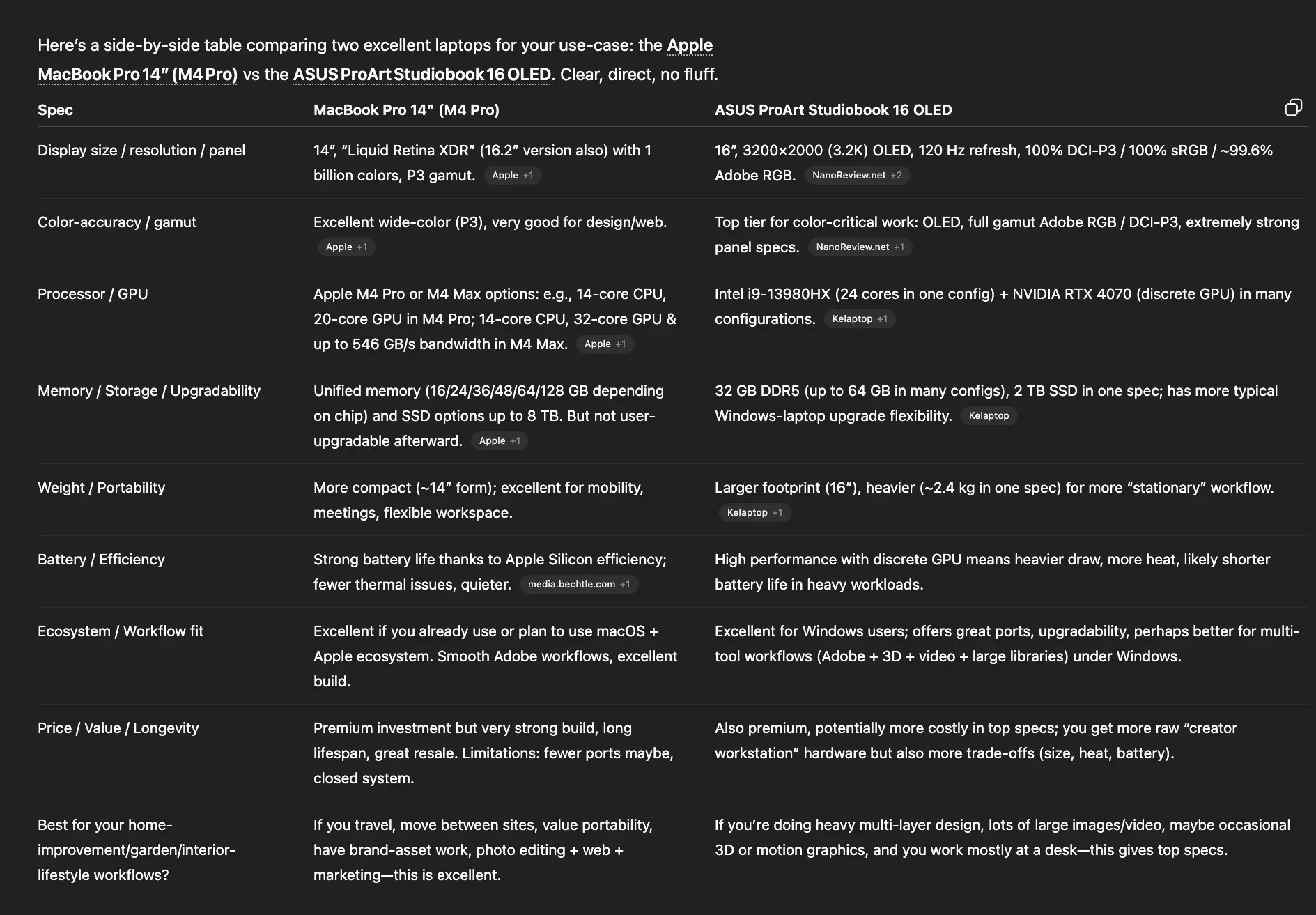
This reduces the number of touchpoints you can see. There are fewer light visits to top-of-funnel content and more invisible influence happening inside the AI interface. Though when someone does click through from an AI result, they often arrive with a clearer understanding of the problem and a shorter distance to a decision.
As conversational discovery grows, brands compete not only for rankings but for mentions and citations inside AI responses. The goal changes from owning every SERP to being consistently included when the model answers the questions that inform buying decisions.
How Should Marketers Adapt Strategy for AI and Traditional Search?
You should plan content for two outcomes at once: ranking in classic results and being used as answers inside LLMs. That means structuring pages so models can extract and cite you, while still giving traditional search the depth and authority it needs to rank and convert.
This requires understanding where AI discovery is most likely to inform decisions in your market and adjust topics, formats, and measurement around that.
Use search mechanics to design content, not just optimize it
Start by mapping how your buyers actually discover information across both search types. Identify:
- Queries that still trigger classic, link-heavy SERPs
- Queries that consistently show AI summaries or assistant-style experiences
- Moments where people are likely to ask conversational, multi-step questions
You use this map to decide which topics need full pages, which need supporting explainers, and where you are really competing for mentions inside AI answers rather than rankings.
For each key topic, define the role of the page: rank for a query, feed AI summaries, support internal linking, or all three. This keeps you from publishing generic assets that neither rank well nor get referenced by models.
Structure content for both ranking and extraction
Structure each important page so a model can understand it in seconds and a human can explore it in detail. That means:
- Clear, question-style headings that match real queries
- Direct, answer first summaries at the top of each section
- Supporting depth in short, well-scoped paragraphs under those summaries
- Tables, bullets, and definitions for concepts, comparisons, and data
This layout helps retrieval understand the section quickly and gives AI clean blocks to reuse. It also gives traditional search the signals it looks for: topical depth, completeness, and a clear match to intent.
When you review content, ask whether a model could pull two or three sentences from a section as a reliable explanation. If not, tighten the language and surface the core point earlier.
Balance keywords and entities
Keep using keywords to align with how people search, but adjust your strategic focus to entities. For important topics, define:
- The core entities involved (problems, products, roles, industries)
- How they relate to each other in your solution and messaging
- The exact terms you will use consistently for each entity
On page, make those entities explicit in headings, introductions, and schema where relevant. Explain definitions clearly and avoid switching labels for the same concept.
This reduces ambiguity for both search engines and AI models. Keywords then support these signals rather than driving them. You still research keywords for demand and phrasing, but you design content around clear topical and entity structures.
Operationalize GEO and AEO
Treat GEO and AEO as constraints on how you write and maintain content, not as separate techniques. In practice, that looks like:
- Rewriting key sections so they open with a concise, factual answer or definition
- Standardizing formats for recurring blocks such as ‘pros and cons’, ‘steps’, or ‘requirements’
- Keeping data points, frameworks, and explanations aligned across pages so models see consistent evidence
For AEO, you prioritise answer first clarity on pages that map to common questions. For GEO, you build and maintain deeper topic clusters, updating them when numbers, regulations, or best practices change.
Build review cycles where high-value pages are checked for optimization: clean sentences, minimal fluff, explicit outcomes, and up-to-date data.
Build hybrid visibility across the journey
Plan visibility by journey stage, not channel. For each stage, decide how you will:
- Appear in classic rankings for the main query set
- Be referenced or cited in AI answers that inform decisions
- Support paid where organic or AI coverage is thin or volatile
Use topic hubs and internal linking to give both crawlers and models a clear view of your authority areas. Create hub pages that summarise a topic with strong internal links to deeper explainers, comparisons, and implementation guides.
This structure helps traditional search understand your site architecture and helps AI retrieval pick up multiple relevant documents from your domain for the same topic, increasing your chance of being used in generated responses.
Don’t lose SEO fundamentals
You cannot perform in AI search at scale without the foundations of SEO. You also can’t rely on AI search as an independent organic traffic source. Models and search engines still rely on:
- Crawlable, technically sound pages
- Clear intent alignment between query and content
- Demonstrated authority and consistency over time
Maintain a consistent SEO process that keeps site health, schema, and core rankings stable. Use AI search insights to build upon that work, not replace it.
Measure both traditional metrics like rankings, organic sessions, and assisted conversions, and newer signals like branded mentions in AI tools, citation patterns, and performance of pages that users reach from AI.
This gives you a complete view of how well your content is working across both classic and AI discovery.
Where Does AI Search Outperform Traditional Search?
AI search outperforms traditional search when queries are open-ended, multi-step, or highly contextual to a person or situation. It is strongest when users want a condensed perspective or a tailored explanation rather than a list of sources to open.
For marketers, this is where discovery moves inside the model and where your content needs to be answer-ready.
Multi-step and contextual queries
AI handles chained instructions in one place. Queries like ‘explain data clean rooms for a mid-market B2B SaaS, then suggest 3 evaluation criteria’ are difficult to show with a single landing page and a classic SERP.
In AI search, users can:
- Ask broad questions and refine the angle without retyping everything
- Add classifiers such as team size, budget band, or tech stack
- Move from definition to comparison to recommendation in one thread
Traditional search forces these into multiple queries and multiple clicks. AI search keeps the context and builds on it, which is more efficient for the user and gives the model more control over which sources inform the answer.
Clarity and structure
When someone wants a clear explanation or a structured overview, AI search is better at producing a clear, step-by-step answer than sending them through ten articles.
Typical patterns:
- ‘Summarize the main GTM motions for PLG companies’
- ‘List the pros and cons of first party vs third party data for B2B advertising’
- ‘Explain this concept as if I am new to marketing operations’
Here, the model pulls from multiple sources and resolves conflicts, rather than asking the user to do that work. If your content is cleanly structured and factually consistent, it can be reused as part of these explanations even if the user never visits your site.
Exploratory and adjacent topic discovery
AI search is also strong when users are still identifying the problem. Queries like ‘I am seeing rising CAC in paid search, what could be causing it, and what should I check first’ do not map neatly to a single keyword or page.
The model can:
- Find likely causes and frameworks from multiple categories
- Suggest adjacent topics or checks that the user had not considered
- Turn vague concerns into a list of concrete next steps
Traditional search can support this, but usually through repeated refinement and manual browsing. AI compresses that into a smaller number of prompts, which means more of the early framing and influence happens before any click.
Where does traditional search still dominate?
Traditional search still dominates where queries have clear commercial or transactional intent, where users want to verify details, or where visual and structured SERP elements carry the decision. These are the areas where rankings, ads, and on-site experience still have the most direct impact on revenue.
Commercial and transactional queries
When someone is close to buying, they often want to see real options, real pricing, and real implementations. Queries like:
- ‘B2B intent data platforms comparison’
- ‘[your category] pricing’
- ‘[product] vs [product]’
These still lean heavily on classic SERPs, review platforms, and vendor sites. Users expect to click through to:
- See full pricing pages and packaging
- Read detailed comparison tables and feature lists
- Check implementation details, integrations, and support terms
AI may suggest vendors or summarize differences, but users usually confirm those suggestions by visiting actual sites. This is where strong SEO, paid coverage, and conversion-focused pages still drive the bulk of measurable performance.
Verification, proof, and risk checks
In higher-risk or higher spend decisions, buyers want to verify and validate information. They do not rely on a single generated answer when the stakes involve security, compliance, or large budgets.
For these queries, people:
- Cross-check multiple vendor and analyst sources
- Read detailed case studies or documentation
- Look for signals like certifications, customer logos, and integration partners
Traditional search supports this by making it easy to open several sources at the same time. AI search can help with summaries and checklists, but trust is still built through direct interaction with multiple properties.
Local, visual, and marketplace style results
In many local and ecommerce contexts, classic SERPs and platform-specific search (app stores, marketplaces) are still primary. Map packs, product listing ads, and vertical search experiences are optimized for:
- Location, opening times, and proximity
- Real prices and stock
- Images, reviews, and filters
AI can add context or suggestions, but the final click and conversion usually happens through these structured results or within closed ecosystems. Marketers still need strong SEO and paid search in these spaces.
FAQ – AI vs Traditional Search
AI search shortens the journey because users receive direct answers and refine queries inside one interface. Fewer comparison steps occur, which shifts early research away from traditional navigation patterns.
Yes. Traditional SEO continues to drive steady demand and reliable conversion paths. It remains the foundation that supports visibility across both search models.
Yes. Pages with strong entity coverage, clear definitions, and structured formats still earn inclusion. Traffic often concentrates on fewer but higher-intent visits.
Clear sections, direct answers, and structured explanations perform well. Tables, lists, and concise summaries help retrieval layers interpret content accurately.
Branded queries, homepage lifts, assisted conversions, and engagement quality provide better signals than raw session volume. These indicators show whether visibility improves even when fewer clicks appear in analytics.
Users still seek product pages, pricing details, and clear comparisons. Traditional SERPs present these options in predictable formats that support purchase decisions.
Yes. A hybrid approach creates stability. Content must meet the clarity standards AI systems prefer while maintaining the depth traditional engines reward.