
For nearly two decades, SEO has been the playbook for organic traffic: understand the algorithm, target the right keywords, climb the rankings, and watch the clicks roll in.
But the arrival of generative engines, AI systems that can answer questions directly, has thrown a wrench into that formula. Instead of letting users decide where to click, platforms like Google AI Overviews, ChatGPT Search, and Perplexity now write the answer for the user, pulling from multiple sources and citing only a select few.
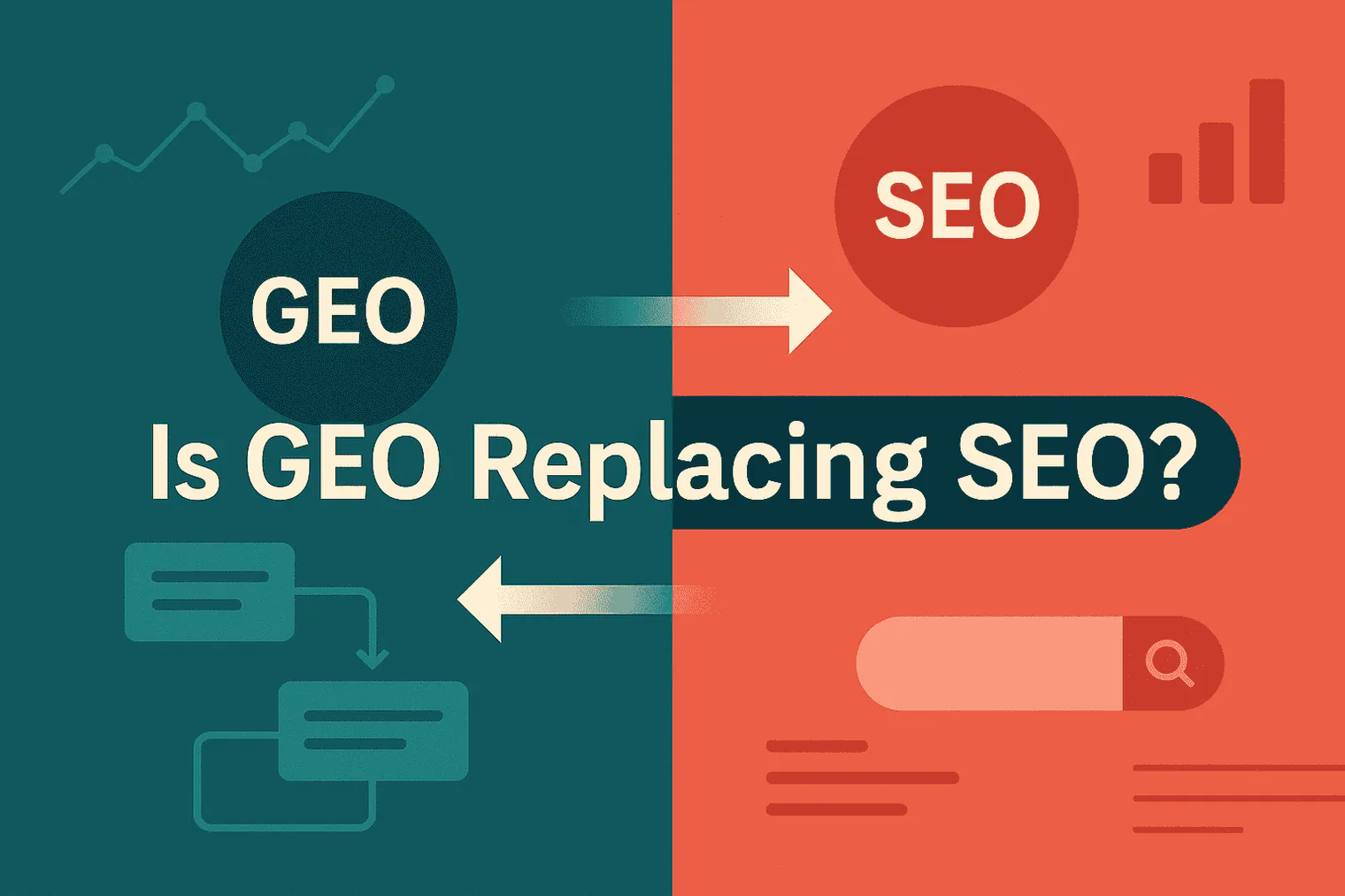
This raises a question for marketers, publishers, and businesses: if AI can answer the query without sending a click, is SEO still the main game, or is it being replaced by GEO?
The truth is, there’s no simple yes-or-no answer. GEO, Generative Engine Optimization, isn’t a replacement for SEO, but it is redefining what online visibility means. Click-through rates are falling for certain queries. Informational searches are increasingly ‘zero-click.’ The competition is no longer just for a top-10 ranking; it is for inclusion inside the AI-generated response.
In this article, I’ll dig into how GEO works, the evidence for and against it replacing traditional SEO. There’s no denying the AI impact on SEO, but how far does it go.
TL;DR:
Generative Engine Optimization (GEO) isn’t replacing Search Engine Optimization (SEO), but it is changing where clicks go and who gets them.
Users now see AI-generated summaries at the top of search results. Google AI Overviews lead the way, followed by ChatGPT Search and Perplexity. These AI layers pull from multiple sources, turn them into a direct answer, and link back to only a few sites.
Being first in the blue links no longer guarantees visibility or traffic.
Research shows how AI summaries change user behavior. In tests:
- Click-through on traditional links dropped from 15% to 8% when AI Overviews appeared.
- Clicks on the AI summary’s source links were just 1%.
- Session abandonment rose to 26% with summaries, compared to 16% without.
Publishers report the same trend. Many see double-digit drops in Google referrals for informational content.
Search usage overall is still rising. But the clicks are changing. More people get their answers without visiting a site.
This is why many SEO’s are focusing on GEO too. Your content must be clear, authoritative, and structured so that AI chooses it as a source. Ranking in a SERP is not enough.
What wins now:
- Distinctive expertise: Show authority, originality, and recency. Generic content gets skipped.
- Clean citations and extractable structure: Use direct, sourced statements. Format for easy parsing and attribution.
- Inclusion-focused optimization: Track your inclusion rate in AI answers, not just your rankings.
- Entity clarity: Build topical authority and semantic depth to surface in both SEO and GEO.
Position one is no longer the goal. You need to be inside the answer.
What Do SEO and GEO Mean, and Why Does This Debate Exist?
SEO and GEO represent two different but overlapping approaches to online visibility. SEO focuses on ranking in traditional search results, blue links, snippets, and media packs, while GEO focuses on being included in AI-generated answers from tools like Google AI Overviews and ChatGPT Search.
The debate exists because AI is intercepting traffic that once went to organic results, forcing marketers to adapt their strategies. GEO isn’t replacing SEO, but it is changing how users find information.
Search Engine Optimization (SEO)
SEO is the long-standing discipline of earning visibility and clicks from search engines like Google, Bing, and YouTube. The goal is to rank as high as possible in traditional results, blue links, featured snippets, news, maps, or image packs, and drive clicks to your site.
Every SEO tactic, from technical fixes to keyword targeting and link building, aims to climb those rankings.
Generative Engine Optimization (GEO)
GEO is the newer discipline of earning inclusion and citation inside AI-generated answers from tools like Google AI Overviews, ChatGPT Search, Perplexity, Gemini, and Microsoft Copilot.
You’re not just competing for a ranked spot, you’re competing to be selected by the answer generator.
Generative engines don’t list results. They synthesize answers from multiple sources and cite only a few, sometimes none. Winning means your content is:
- Structured for extraction.
- Written so AI can interpret and quote it.
- Authoritative enough to outrank other sources.
Generative Engines to Watch
- Google AI Overviews / AI Mode: AI-generated summaries embedded in Google Search, most visible on informational queries.
- ChatGPT Search: Live-search tool blending web results with natural language responses and inline citations.
- Perplexity AI: Conversational AI search with live web retrieval and always-cited sources.
- Gemini: Google’s AI platform, integrated into Search and Workspace.
- Microsoft Copilot: AI assistant pulling from Bing and other sources to answer directly in context.
SEO and GEO overlap, but they don’t run on identical rules. Traditional SEO still wins in many transactional and local searches.
But for informational queries, where generative engines dominate, the content format, structure, and authority you bring decide whether you’re cited in the AI’s answer or left behind.
What Changed in 2024–2025 to Trigger GEO?
In 2024 and 2025, search engines rolled out large-scale AI-generated summaries, starting with Google AI Overviews and OpenAI’s ChatGPT Search. Research from Pew and Semrush shows that click-through rates on blue links fell when these summaries appeared, while overall search volume continued to grow. This is where GEO was recognized as a discipline: ranking in SERPs was no longer enough.
2024: The Breakthrough Year
The first turning point came in 2024, when Google rolled out AI Overviews in the U.S., later expanding worldwide. It was the first large-scale integration of generative summaries into search results, placed above the blue links.
At the same time, OpenAI launched prototypes of SearchGPT (now ChatGPT Search). The tool blended live web browsing with conversational answers, complete with inline citations.
These launches reframed the search experience. Instead of options to click, users received a single synthesized answer. For SEO’s, this was the signal that brand visibility could now mean ‘in the AI answer’ instead of ‘ranked #1.’
2025: Scaling and Measurement
By 2025, the trend was no longer a test. It was at scale.
- Pew Research confirmed what publishers feared. Click-through rates dropped from 15% without summaries to 8% with them. Only 1% of users clicked the links inside AI summaries.
- Semrush reported that AI Overviews triggered on 13.14% of queries in March 2025, up from 6.49% in January, doubling in two months.
- SISTRIX added AI Overview tracking to its SEO suite, proof that inclusion in AI answers had become a measurable KPI.
2025 was the moment GEO stopped being an idea and became part of core search visibility.
Market Dynamics: Growth Without Clicks
Even as publishers sounded alarms, platforms pointed to growth. Google claimed AI Overviews drove more engagement, with users submitting more queries and spending more time exploring related topics.
Yet SparkToro showed the other side. Search volume grew about 20% in 2024, but the share of clicks going to the open web kept shrinking.
The paradox: search is bigger than ever, but publishers now get a thinner slice of traffic.
Licensing & Rights Battles
Another change came with licensing deals. OpenAI signed agreements with publishers including the Financial Times, Vox, Dotdash Meredith, the Associated Press, and News Corp. These deals let OpenAI legally train on and surface their journalism inside ChatGPT.
Meanwhile, Google’s AI Overviews faced backlash. Publishers argued that Overviews reproduced content without enough attribution or compensation. Reports from Nieman Lab, Bloomberg, and Reuters brought to light the calls for clearer opt-out options and possible regulation.
What Evidence Shows GEO Is Replacing SEO?
Evidence from multiple independent studies shows GEO is replacing parts of SEO’s traditional role, especially for informational and news-driven queries. Click-through rates for top results have collapsed, with one study finding the #1 organic link’s CTR fell from 7.3% in March 2024 to just 2.6% in March 2025.
Reports from other sources reveal publishers losing up to 79% of referral traffic when AI Overviews appear, with zero-click searches climbing as high as 69% for news. Mobile behavior makes the problem worse, as fewer than one in five users tap citation links inside AI summaries.
Together, these findings suggest that GEO is impacting visibility once guaranteed to high organic rankings.
CTR and Traffic Hit
Evidence is showing that AI-generated summaries, Google’s AI Overviews and similar features, continue to steal clicks from traditional web results. But the picture has become more nuanced and sometimes more severe since earlier studies.
Dramatic Drops in Clicks for Top Organic Results
A study by analyzing 300,000 informational keywords, found that the average click-through rate (CTR) for the #1 result on queries triggering AI Overviews plummeted from 7.3% in March 2024 to just 2.6% in March 2025, a 34.5% relative drop. (Source 1) (Source 2)
Up to 79% Loss in News Site Traffic
A report revealed that publishers ranked #1 saw organic referrals fall by up to 79% when AI Overviews appeared above their links, especially harmful to news-driven traffic. (Source)
Mobile and Desktop Behavior Diverges Inside AI Overviews
A user-experience study found that citation links inside AI Overviews were clicked only about 19% on mobile and 7.4% on desktop. The median scroll depth within the AI summary is just 30%, showing users often don’t reach linked content. (Source)
Branded vs. Non-Branded Keywords: A Tale of Two Outcomes
One analysis shows non-branded keywords experiencing an average CTR decline of –19.98% when AI Overviews are present. However, branded keywords buck the trend—with AI Overviews boosting CTR by +18.68%, likely due to inherent brand affinity and user intent. (Source)
Rising Zero-Click Rates and Traffic Collapse for News
Another report shows that news-related searches ending without a click (zero-click) surged from 56% to 69% within a year. At the same time, aggregate organic referral traffic to news sites fell from 2.3 billion to under 1.7 billion visits, showing the range of impact. (Source)
What This Means; Context and Strategy
- CTR collapses for top content, even ranking #1 no longer guarantees clicks when AI answers steal visibility.
- News publishers face an existential threat, with some experiencing more than 50–80% traffic drops on affected queries.
- Mobile behavior is problematic, with most users never clicking inside AI summaries or scrolling to citations.
- Branded content offers a rare escape, name recognition can still drive clicks even inside AI-overview environments.
- Zero-clicks are the new normal, especially in informational and news categories, demanding new strategies.
Query Coverage
The footprint of AI Overviews is expanding fast, not just in frequency, but in scope. Several new studies show they’re becoming far more frequent across different query types, with uneven distribution across devices and industries.
Here’s what’s changed:
- Increased overall presence: In March 2025, a report showed AI Overviews in 13.14% of all queries, up from 6.49% in January, a rise of over 100% in just two months (Source)
- More queries affected by April/May: Antoher report shows AI Overviews reached over 20% of US desktop searches by April, rising slightly to 19.9% in May. (Source)
- Dramatic global expansion: One study showed AI Overviews appearing in 11% of Google queries, noting a 22% year-over-year increase, especially for longer and more complex questions. (Source)
- Even higher prevalence across broader datasets: An analysis of 118 million keywords in July 2025 found AI Overviews triggered in 18% of queries, an increase of 112% since April 2025. (Source)
- Long-tail queries dominate: Data from a GEO tool showed over 52% of AI Overviews are triggered by long-tail queries (more than 4 words), compared to just 4.2% for single-word queries. About 20% of results stem from question-style searches. (Source)
What This Expanding Coverage Means
| Trend | Implication |
|---|---|
| Steep rise in AI Overview triggers (11–20%) | Generative search features are becoming a core part of Google’s interface and impacting zero-click numbers. |
| Broader query types now affected | Extended types of queries are now intercepting traditional traffic. |
| Long-tail and conversational queries dominate | Brands must optimize for AI visibility across specific, user-intent-driven queries, not just head terms. |
Zero-Click Pressure and On-SERP Answers
Generative search is amplifying the zero-click trend. Various studies and research finds that:
- Zero-click searches are surging: SparkToro’s 2024 study found just 360 out of 1,000 U.S. searches resulted in a click to the open web, meaning nearly two-thirds of searches stay ‘in-platform.’ (Source)
- Zero-clicks dominate mobile: By 2025, about 60% of searches ended without a click, rising to 77% on mobile. (Source)
- Organic CTRs are declining: In March 2025, just 40.3% of U.S. searches led to an organic result click, down from 44.2% a year earlier. In the EU/UK, it slipped from 47.1% to 43.5%. (Source)
- News traffic collapsing: Data shows news referral traffic dropped from 2.3 billion to under 1.7 billion visits, with zero-click rates for news searches jumping from 56% to 69% over the year. (Source)
- Traffic loss up to 80%: Analytics reported publishers ranking #1 can lose up to 79% of search traffic when AI Overviews appear. (Source)
- Overall CTR decline: One study found search impressions are up 49% year-over-year, yet click-through rates are down 30%, driven by AI Overviews. (Source)
Why This Matters
The increase in zero-click behavior means that even high-ranking pages are no longer guaranteed traffic. With AI Overviews and on-SERP answers intercepting user intent, publishers lose clicks at the exact moment users get what they need without leaving Google or another AI interface. For brands, the answer is simple: visibility now also depends on being the cited source inside the generative answer.
| Metric | Without AI Overview | With AI Overview / Trend |
|---|---|---|
| CTR on Blue Links | 15% | 8% |
| CTR on AI Summary Links | N/A | 1% |
| Session Abandonment | 16% | 26% |
| Zero-Click Share (Overall) | 56% (news-specific 2024) | 60%–77% across searches; 69% for news queries |
| Traffic Loss (News & Publishers) | – | Up to 79% drop when AIO appears. |
AI Search Traffic May Be More Valuable Per Visitor
Semrush projects that AI-driven visitors could surpass traditional search visitors by 2028. Early findings show each LLM-sourced visitor is worth 4.4× more than a traditional organic visitor, thanks to stronger intent and better conversion performance. This is supported by a range of data:
Adobe (May 2025):
- AI-driven traffic to retail websites grew 12× between July 2024 and February 2025.
- Engagement metrics were stronger: 23% lower bounce rates, 12% more pageviews, and 41% longer sessions compared with non-AI visitors.
- Conversions improved sharply: in July 2024, AI traffic was 43% less likely to convert, but by February 2025 that gap narrowed to just 9%. In some verticals (electronics, jewelry), AI visitors now out-convert traditional search users (Source).
Ahrefs (June 2025):
- AI search visitors convert at a 23× higher rate than traditional organic visitors.
- Volume is still small (0.5% of traffic), but the conversion performance is disproportionately strong (Source).
Okoone (August 2025):
- AI visitors are 4.4× more valuable than organic ones.
- Arriving already primed by AI-generated answers, they show sharper purchase intent and shorter paths to conversion (Source).
Traditional vs. AI Search Visitors
| Metric | Traditional Search Visitors | AI Search Visitors |
|---|---|---|
| Bounce Rate | Baseline | 23% lower |
| Pageviews per Visit | Baseline | 12% higher |
| Session Duration | Baseline | 41% longer |
| Conversion Rate | Baseline | Up to 23× higher |
| Value per Visitor | Baseline | 4.4× higher |
While generative engines reduce raw traffic, the clicks that make it through are more valuable. AI-driven visitors stay longer, engage more deeply, and convert at much higher rates, especially in research-heavy or high-tick
What Evidence Shows SEO Still Matters?
Despite the rise of GEO, SEO continues to play the main role in driving discovery and revenue. Search demand is growing, with Google reporting higher engagement after launching AI Overviews, and some publishers benefit from stronger, more valuable clicks. Transactional, local, and branded queries still depend heavily on traditional rankings. The evidence suggests GEO is displacing parts of SEO, but not replacing it entirely.
Overall Search Volume Is Still Growing
Despite the rise of AI Overviews and generative search, Google search activity itself continues to grow at record levels. Rather than impacting the opportunity for SEO, the data shows demand is expanding year-over-year:
- Google disclosed that it handled more than 5 trillion searches in 2024, roughly 14 billion per day. Around 15% of daily searches are completely unique, showing constant evolution in user demand. (Source)
- Google’s global market share is 89.57% in 2025, slightly down from 91.47% in 2024 but still overwhelmingly dominant. In markets like Nigeria, Google drives 98.69% of all search traffic, and worldwide usage now reaches 5.65 billion people. (Source)
- Annual query totals are already above 5 trillion as of 2024, with signs of further growth in 2025. (Source)
- Independent data published in March 2025 shows Google search volume grew 21–22% year-over-year, marking the largest single-year increase in recent history. (Source)
- Global usage growth continues to fuel search: Google’s user base jumped from 4.9 billion in 2024 to 5.65 billion in 2025. (Source)
Analysis
Search volume isn’t plateauing, it’s accelerating. Even as AI systems capture attention within results pages, the growth in queries and global users means there are more opportunities than ever for SEO to capture demand. The challenge is no longer whether people are searching, but whether your content appears both in SERPs and inside generative answers.
Some Publishers Still See Gains or More Valuable Clicks
Not every publisher is losing with GEO. While aggregate numbers show click-through declines, certain content types, especially forums, video platforms, podcasts, and original analysis, are actually seeing stronger engagement. Google leadership has leaned into this, arguing that clicks from these are ‘higher quality,’ with longer sessions and deeper interaction.
Google Leadership:
- Liz Reid said that forums, videos, and original analysis often gain more engaged visitors from AI Overviews (Source).
- VP Nick Fox disputed publisher traffic-loss studies, calling them based on flawed timeframes. His line: ‘the web is thriving.‘ (Source)
Google Q2 2025 Earnings:
- AI Overviews drove 10% more queries in categories where they appeared.
- Reported 2 billion monthly users globally, with 100M active in the U.S. and India.
- Sundar Pichai highlighted that forums, podcasts, and original commentary benefit most from this added activity. (Source)
Kevin Indig / Similarweb:
- Pageviews grew 22% for forums, video platforms, and sites with original commentary in AI Overview-triggered queries.
- Engagement metrics (session duration, interaction) improved for these formats.
- Commodity publishers (e.g., generic news aggregators) saw declines in both traffic and engagement. (Source)
Winners vs Losers in AI Overviews
| Content Type | Trend with AI Overviews |
|---|---|
| Forums / Communities | +22% pageviews, longer sessions |
| Video Platforms | Higher engagement, more valuable clicks |
| Podcasts / Original Analysis | Benefiting most from added queries & depth demand |
| Commodity News Sites | Traffic and engagement declining |
Analysis
It’s not completely negative. Yes, AI Overviews cut aggregate clicks, but formats that deliver depth, discussion, or multimedia are winning. Publishers reliant on thin content are losing visibility, while those offering unique perspectives are building more valuable, engaged audiences. Strong SEO still pays, but only if paired with formats AI prefers to amplify.
Transactional and Local Queries Still Depend on SEO
While AI Overviews are impacting metrics in informational queries, transactional and local searches remain firmly tied to traditional SEO. These are the types of queries closest to revenue, and the evidence shows SEO is still needed.
- 46% of all Google searches have local intent, meaning nearly half of search demand is inherently tied to local SEO visibility (Source).
- ‘Near me’ searches have grown by 500% over the past five years, reflecting explosive demand for location-based results (Source).
- 76% of people who search for something nearby on their smartphone visit a related business within a day, proving the direct conversion power of local SEO (Source).
- 28% of local searches result in a purchase, underlining the high commercial intent behind these queries (Source).
- For transactional terms more broadly, 61% of SERPs display business websites, showing that strong SEO is still central to capturing commercial opportunities online (Source).
- Mobile drives 62.5% of organic search traffic globally (late 2024), reinforcing the need for mobile-optimized SEO in both local and transactional contexts (Source).
Analysis
Local and transactional intent is where SEO remains irreplaceable. These queries directly lead to visits, purchases, and revenue, and AI Overviews have far less penetration here compared to informational searches. Businesses that neglect local and transactional SEO will miss out on the most conversion-rich parts of the search funnel.
SEO Still Drives Bottom-of-Funnel Conversions
Despite AI changing top-of-funnel discovery, SEO is still a revenue engine at the bottom of the funnel, driving high-intent traffic and outperforming other channels in conversion efficiency.
- Organic dominates web traffic: Organic search drives 53.3% of all website visits, making SEO the single largest channel for capturing intent-rich audiences (Source).
- Strong industry conversion rates: SEO delivers conversion rates ranging from 3.8% in SaaS to 12.3% in Legal, proving its impact on lead generation and transactions across verticals (Source).
- SEO vs. paid efficiency: The top organic result earns 19× more clicks than the top paid ad, generating more conversion volume and proving organic is the better channel for bottom-funnel demand (Source).
- Content depth drives performance: Long-form SEO content (3,000+ words) attracts 3× more traffic and 3.5× more backlinks, both tied to stronger conversions and revenue outcomes (Source).
- SEO ROI advantage: Businesses with strong SEO presence achieve an average ROI conversion rate of 14.6%, outperforming many paid channels (Source).
- Branded search intent: Branded organic queries convert at much higher rates, showing SEO’s role in capturing users already primed to buy.
Analysis
With the majority of web traffic coming from organic search and conversion rates that beat paid campaigns, SEO remains important at the bottom of the funnel. High-intent users still rely on search to make final purchase decisions, meaning businesses that double down on SEO continue to capture disproportionate pipeline and ROI.
Entity Clarity and Topical Authority Drive 2025 SEO Performance
Entity clarity and topical authority are proving decisive not only for traditional rankings but also for visibility inside generative engines. Sites with strong semantic signals and clear topical relationships are more likely to appear in AI Overviews and other GEO surfaces.
- Entity-based visibility growth: Websites that optimize for entity clarity and semantic connections see up to a 1400% increase in search visibility, proving the outsized returns of semantic SEO over keyword stuffing (Source).
- Entities dominate SERPs: In 87% of search results, Google now features rich snippets, knowledge panels, or other entity-driven enhancements, showing how much the algorithm relies on entity recognition and topical authority (Source).
- Expert perspective: SEO authority Dawn Anderson states: ‘Entity-based optimization isn’t optional anymore, it’s the foundation of effective SEO in 2025.‘ (Source)
- Local and GEO advantage: Clear geographic entities and structured schema markup improve Google’s ability to tie content to specific places, boosting local rankings without heavy citation building (Source).
Analysis
Entity optimization now covers both SEO and GEO. For SEO, clear entities strengthen topical authority and improve visibility in SERPs through snippets, panels, and context-driven rankings. For GEO, entity clarity makes content more likely to be selected, cited, or summarized by generative engines, which depend on structured knowledge to build accurate answers.
Internal Linking Remains a Core SEO Factor
Internal linking is one of the most controllable and impactful factors in SEO. By shaping crawl paths, distributing authority, and improving user journeys, it continues to be important. This matters because internal linking is an entirely SEO-specific advantage, generative engines don’t crawl your site structure in the same way.
Strong internal linking ensures your core pages rank, attract backlinks, and build topical authority, the very signals that generative engines then use to choose sources. In other words, without effective internal linking driving SEO visibility, your content is less likely to be surfaced or cited in GEO.
- Google confirmation: John Mueller states that internal linking is ‘super critical for SEO‘ because it directly improves crawling, indexing, and rankings (Source).
- Traffic impact: Studies show that a well-planned internal linking strategy can deliver a 5–10% uplift in organic traffic when properly optimized (Source).
- Optimal link volume: Research across 23M internal links found that pages with 45–50 links saw the strongest traffic increases, while over 50 links often diluted authority and harmed SEO (Source).
- Best practices in 2025: Effective internal linking now prioritizes optimized anchor text, placing links high on the page, eliminating orphan pages, and applying correct
relattributes for maximum SEO value (Source). - Engagement benefits: Strong internal linking boosts dwell time and reduces bounce rates by encouraging users to explore related content and stay deeper within the site (Source).
Analysis
Internal linking proves why SEO remains important. Generative engines may impact how clicks are distributed, but they rely on strong SEO signals to determine credibility. Internal linking is one of those irreplaceable signals, if you neglect it, you lose visibility in both traditional rankings and in the answer layers powering GEO.
Link Building and Mentions Still Drive Visibility
Despite claims that links matter less in a AI-first search, data shows that backlinks and brand mentions remain key. Rankings, authority, and even AI Overview inclusion continue to correlate strongly with strong link and mention profiles.
- Volume impact: High-ranking sites have 3.8× more backlinks than lower-ranking competitors, underscoring the weight of link equity (Source).
- Business adoption: 58% of businesses believe link building significantly impacts SERP performance, and 72% of marketers say it directly drives organic traffic growth (Source).
- Digital PR effectiveness: In 2025, digital PR is rated the #1 link building tactic, followed by content marketing, proving quality sources and mentions matter more than raw link volume (Source).
- Mentions in AI results: Recent research shows that unlinked brand mentions are now highly correlated with AI Overview visibility, sometimes outperforming traditional backlinks in signaling authority (Source).
- Expert consensus: 67.5% of SEO experts still cite backlinks as a major ranking factor, while 85% of marketers credit link building with strengthening brand authority (Source).
Analysis
Links remain one of the strongest predictors of SEO success, especially when paired with authoritative mentions. AI engines are valuing citations and mentions alongside backlinks, but the evidence is clear: sites that invest in digital PR, authoritative content, and link acquisition outperform those that neglect links.
How Do Generative Engines Choose Sources?
Generative engines don’t work like traditional search rankings. They don’t just rank articles, they retrieve supporting documents, then decide which ones to cite in their generated answers. Whether it’s Google AI Overviews, ChatGPT Search, Perplexity, Claude, or Gemini, the mechanics boil down to a few shared factors:
Retrieval Relevance and Authority
If your content isn’t retrievable, it will never be cited. Classic SEO signals (authority, clarity, helpfulness) remain important.
- All engines start with a retrieval step, pulling from search indices, licensed corpora, or the open web.
- Sources with strong topical authority, clear entities, and relevance are more likely to be pulled into the grounding set.
For example: Google fans queries out across Search; Perplexity runs retrieval-augmented generation (RAG); OpenAI partners with publishers but also crawls and retrieves the public web.
Parseability and Extractability
Engines favor content they can easily parse and anchor.
- Generative engines need to quote or ground facts. Clean, HTML-accessible content with headings, lists, tables, and schema that matches visible text makes this easier.
- Engines like Perplexity and ChatGPT attach citations sentence by sentence; messy or JavaScript-buried text often gets skipped.
Freshness and Specificity
Generative engines are designed to give current answers, old pages lose inclusion odds fast.
- Generative systems bias toward recent, precise, and fact-rich content.
- Perplexity and Gemini emphasize live, real-time search grounding. Google AI Overviews cite up-to-date sources for fast-changing queries (health, science, finance).
- Static, vague, or undated material is far less likely to surface.
Trust and Attribution
Generative models prioritize verifiable content from credible domains. If your site is trusted in its niche, you’re more likely to be cited.
- All major engines (OpenAI, Google, Anthropic, Perplexity) stress source trust to prevent hallucinations.
- Clear citations, transparent sourcing, and alignment with established authority (E-E-A-T-like signals) improve chances of being cited.
- Unlinked brand mentions and entity clarity also influence grounding, especially in AI summaries that need authoritative anchors.
Partnerships and Ecosystem Signals
Licensing is only a small part. Parseability, freshness, and authority decide inclusion for the vast majority of sites.
- While licensing deals (e.g., OpenAI with News Corp, FT, Vox) guarantee inclusion for those outlets, most websites compete on open-web retrieval signals.
- Perplexity’s ‘Publisher Program’ and OpenAI’s revenue-share pilots hint at hybrid ecosystems, but optimization remains the main focus for everyone else.
What to Do Now With GEO
The rise of generative search doesn’t mean abandoning SEO. It means adding a GEO layer on top of it, so your content remains discoverable in both traditional rankings and inside AI-generated answers. Think of it as dual optimization: protecting the traffic that still flows through SERPs, while positioning yourself for visibility with advancements in AI.
Keep the SEO Core
Even as AI summaries capture user attention, classic SEO remains the backbone of high-intent discovery. Commercial, navigational, and local searches, where users want products, services, or directions, still depend heavily on standard search listings. The fundamentals shouldn’t be dropped:
- Maintain speed and mobile performance to meet Core Web Vitals.
- Build topical authority with consistent, in-depth coverage of your niche.
- Ensure entity clarity so search engines (and AIs) understand exactly what your brand, products, and people represent.
- Invest in product and local content since transactional and ‘near me’ queries still resolve primarily in SERPs.
- Use internal linking to signal importance and distribute authority across your site.
Add a GEO Layer
Where SEO keeps you competitive, GEO ensures you’re visible in generative answers. That requires deliberate changes in how content is structured and presented. Applying some of the latest GEO frameworks can help you too.
- Create answer-first sections on key pages: Open with a one-sentence response, followed by 3–5 bullet points containing facts or steps, each backed by citations.
- Publish original data: Surveys, benchmarks, and proprietary research provide non-commodity content that engines are more likely to cite.
- Cross-reference your sources: Explicitly name and link authoritative references throughout your content.
- Use schema that maps to answers: Implement FAQPage, HowTo, QAPage, Product, Organization, and Author markup.
- Build attribution bait: Include ready-to-quote elements, stats, definitions, and checklists, that are easy for engines to lift with a backlink.
- Maintain entity hygiene: Add clear ‘About’ sections for brands, products, and people.
- Monitor your inclusion rate: Track how often you appear in AI Overviews with GEO tools, and manually test queries in ChatGPT Search and Perplexity.
- Hedge with licensed ecosystems: Pitch research and original assets to publishers with licensing agreements (e.g., Financial Times, News Corp).
The winners in the GEO era won’t be those who abandon SEO, but those who layer GEO principles on top of a strong SEO foundation. You can’t dictate which sources generative engines select, but you can control whether your content is structured, authoritative, and distinct enough to be chosen.
FAQ
Industries that rely heavily on informational queries, such as health, science, news, education, and finance, are most affected by GEO. Semrush found that 88% of AI Overview triggers in 2025 came from informational searches, where traditional click-throughs dropped the most. These sectors are seeing the steepest declines in referral traffic from Google.
Not as much. Transactional queries (like product purchases) and local searches (‘near me’) still rely heavily on traditional SEO because users often need specific businesses, services, or checkout pages. Data from Semrush shows AI Overviews currently appear in only about 13% of searches overall, with most being informational. That means commercial and local SEO remain core revenue drivers.
Success in GEO is tracked through inclusion rate, citation position, and referrals from AI platforms like Perplexity or ChatGPT Search. Unlike SEO, where ranking position is the primary KPI, GEO success depends on whether your content is chosen as part of the AI-generated answer. Tools like SISTRIX and Semrush now provide AI Overview tracking.
Generative engines prioritize recent and authoritative content, especially on topics where accuracy changes quickly (science, health, society). Updating at least quarterly, or sooner for fast-moving fields, improves inclusion odds. Google’s developer guidance emphasizes freshness as a key factor for helpful content.
Yes, but it’s harder. Licensing agreements give large publishers an advantage, but smaller sites can win visibility by offering distinctive expertise, original data, or highly structured formats like FAQs and lists. GEO favors clarity and originality over generic content, so niche authority remains a winning strategy.