
SEO is changing. Yeah, it’s been said a thousand times before, but this time it’s true, and probably not in a good way either. AI is impacting SEO heavily.
This isn’t one of those ‘how AI is amazing’ articles, either.
AI might be good for simplifying SEO tasks and marketing activities, but in the background, it’s disrupting the industry and current practices as we know them. Of course, SEO professionals are used to disruption from algorithm updates and having to pivot, but this is something entirely different. Something that will shift how SEO is performed now and even more in the future.
I’m not saying SEO is dead or SEO doesn’t work anymore; this is more awareness of how those conducting SEO need to adjust practices. It’s research for marketers, SEOs, and business owners trying to understand what’s different, what’s next, and how to adapt. Not to chase every new tool or panic about traffic, but to rethink SEO and visibility with this new focus on AI-driven search.
AI will be looked at in terms of Search Engines and AI models such as ChatGPT, Perplexity, Claude, etc.
How AI Has Changed Search Experience
AI has impacted how users search for and find information in 2 different ways;
The first is through AI models such as ChatGPT, Claude, Perplexity, etc., where information is provided directly in the chat. Resulting in the user not using a search engine at all or using sources to access websites directly in the model, skipping the search engine part.
The second is through AI Overviews in the search engine results. Something which Google has been testing for a few years (I tested in the beginning) and is finally rolling out around the world. This implementation has completely altered the SERP real estate, where users see the AI overview first, then ads, then suggestions, then possibly more before even getting to a page to click on. This also includes AI Mode, which has only been rolled out in the US.
Both of these changes are causing problems for SEO, whether it’s in attribution or fighting for the top Google spot, only to be replaced by an AI Overview.
Though there are some positives for the user end, which are worth understanding:
The Good: Convenient Information for Users
For users seeking information, AI has turned the search experience into a more intuitive, personalized, and efficient process. Especially when it comes to quick answers and lately, more complex queries. This has been achieved in several ways:
Deeper Understanding of User Intent
Google’s AI models play a huge part in this improved search experience for users, which hasn’t been instant; it’s rolled out over a number of years. These models have improved the search engines’ ability to interpret user intent, enabling them to provide better results and information for the user. AI has been implemented and continuously improved upon in Google models since 2015:
- RankBrain (2015): Helps Google understand unfamiliar or ambiguous queries by learning to associate them with existing concepts, delivering more relevant results.
- BERT (2019): BERT improved Google’s understanding of the full context of words within a sentence, including the nuances of small words like “to.” This allows for a deeper understanding of conversational queries and long-tail searches.
- MUM (2021): MUM was designed to understand information and generate content across different modalities (text, images, audio, video) and in multiple languages. The model can process highly complex queries that might require information synthesis from various sources and formats, providing detailed answers for questions that would previously require multiple searches.
Instant Answers
Google’s AI Overviews (previously Search Generative Experience) have changed how users receive information. Instead of listing ten results with links and leaving the user to do the work, Google now generates a summary that pulls key points from various sources. These summaries display at the top of the results page and often include images and follow-up questions.
For the user, and as a user myself, this is a real time-saver. You don’t need to click several links to find the information you want, it’s just there in a fraction of the time. Google describes these features as a way to ‘understand a topic faster,’ and the use case supports that. The summaries often link out to the sources they use, but many users never need to click. It’s a more efficient experience with fewer steps and faster results, but a problem for SEO’s trying to get webpage visibility.
Early data on AI Overviews showed a drop in clicks and a rise in zero-click searches. That’s because users can now get the information directly, without visiting the original sites behind it.
A More Context-Aware Search Experience
Search personalisation isn’t new, but AI is slowly taking it to the next level, making it more adaptive and predictive. I have noticed this subtle change personally when conducting local searches. As most people are aware, Google already tailors results based on location, device type, previous searches, and usage patterns. What’s different now is the way that AI uses and interprets that data in real-time to provide more responsive and relevant results.
For example, someone searching for ‘best Thai food’ from a phone at lunchtime in Manchester (UK) will get a very different result than someone asking the same question from a laptop at home in Glasgow. Which has always been the case, but now, Google may adjust the type of results it shows (map listings, AI Overview, videos, or menus) depending on the context of that search.
Google Discover continues to push this idea forward. It provides articles, videos, and recommendations before a user types anything. What shows up is influenced by past activity, app usage, and engagement patterns, which is ultimately an AI-led attempt to guess what you’ll want next.
While this raises questions about filter bubbles and user tracking, the benefits to the user are less effort > more relevance.
AI Tools – Your Own Personal Assistant
There’s no denying that AI is a lifesaver and has made us all lazy. It does pretty much everything the average person could need. Including personalised information in a conversational way. All a user has to do is type (or speak) their query into an AI model, and they will get a detailed answer, which is quite accurate (data discrepancies aside). This is even less effort than using Google WITH the AI Overviews because the user doesn’t have to scroll anywhere or click, they just have the information served to them.
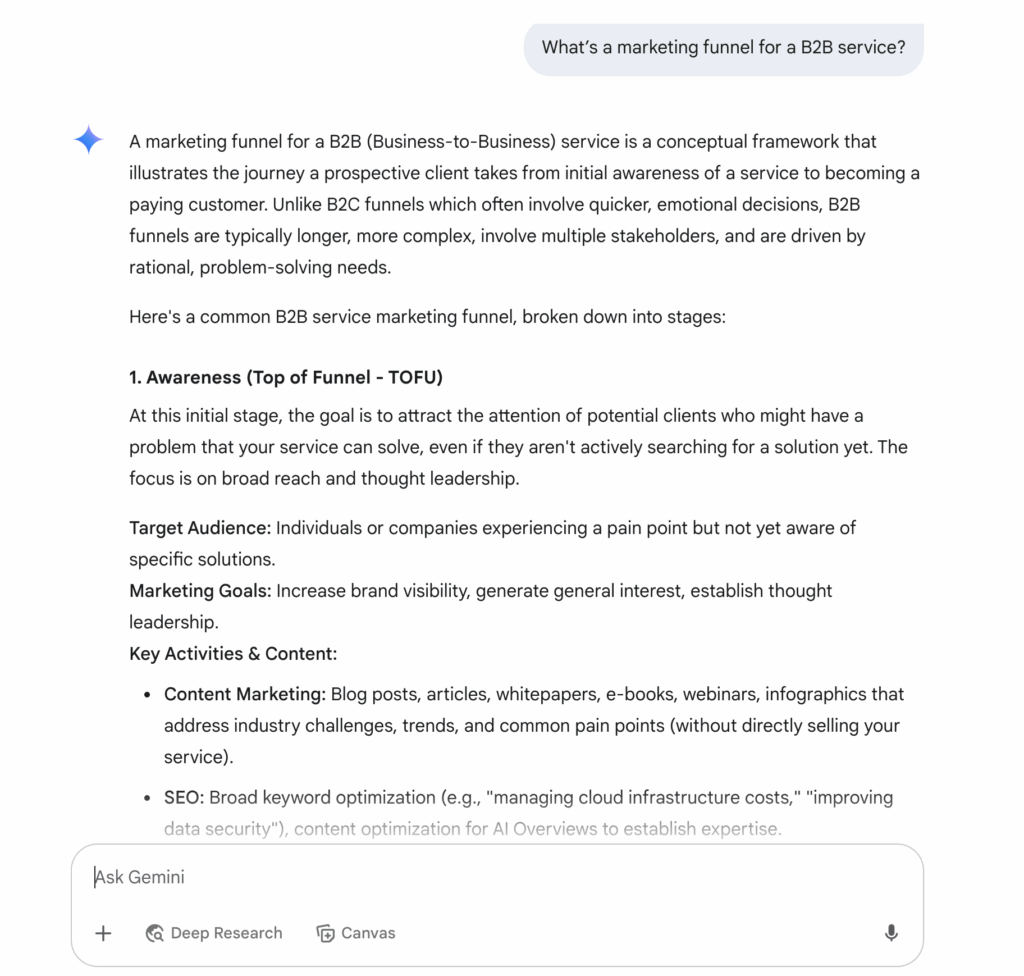
For example, instead of typing a query and reading through results, a user can ask something broad like ‘What’s a marketing funnel for a B2B service?’ which will return a result that gives a detailed explanation AND supporting imagery and sources.
The user can then refine it through follow-ups like ‘What metrics should I track at each stage?’ or ‘Can you give me a list of tools to support it?’. This conversational method is more personalized, and as the AI model learns what the user likes, it becomes even hyper-personalized.
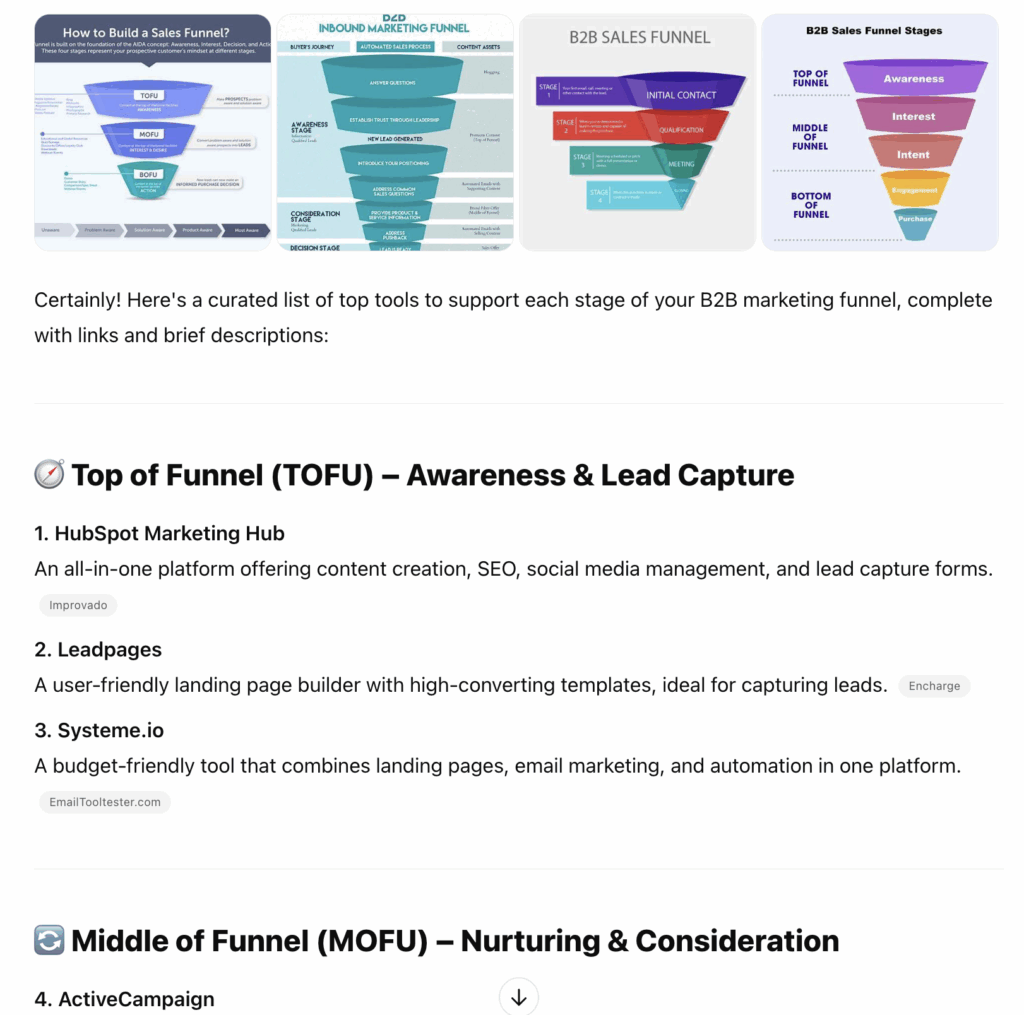
Then you have the ‘deep-research’ features, which have been released more recently. Where the AI model will spend a larger amount of time scouring the web and its information resources to provide the user with every piece of information they could need, saving HOURS of research time. I have used this for product research/comparison, and the results were out of this world.
Again, as a user, there’s no arguing against the value these tools provide. But as marketers, we can’t see how users are interacting with content inside these AI tools and what causes them to click to the source or make a purchase, which is a problem.
The Bad: Challenges in SEO & Marketing
While AI is improving the search experience for users, I believe, based on practice and research, that it’s coming with some challenges for marketers, SEOs, and businesses. Traffic is harder to win, attribution is cloudy, and metrics are all over the place. Of course, in some cases, this isn’t always a bad thing, if a business is driving more sales thanks to information provided in ChatGPT, for example, that’s ok. But if those sales cannot be attributed, this poses problems for marketers.
Zero-Click Searches Are On The Rise
These are queries where users find what they need directly on the search results page and never click through to a website. In the past, even an informational search would typically result in the user visiting several sites. Now, users are satisfied by the summarised response generated by Google’s AI, and never leave the SERP. According to a 2024 study, over 58.5% of searches in the U.S. in 2024 ended without a click. Additionally, in the EU, nearly 6 in 10 searches also ended without a visit to a third-party website.
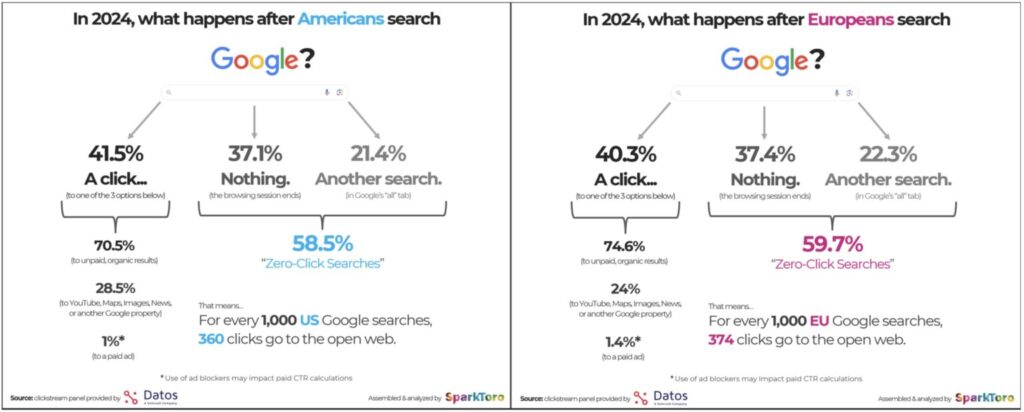
What was a starting point for brand discovery, a user clicking through to read a guide, compare products, or watch a video, is now being altered. This change has major implications across the funnel. For top-of-funnel strategies, zero-click outcomes cut off the opportunity before it begins. For example, users may consume your insight via the AI overview, but you lose the chance to guide them deeper through that funnel. That limits email signups, remarketing opportunities, and the soft trust-building interactions that typically start with low-intent visits.
This isn’t limited to Google. Users asking questions in ChatGPT, Claude, or Perplexity often receive complete answers that don’t require the user to click the ‘source’. They get the benefit of your research, your examples, or your original language, without ever visiting your site. From a marketing standpoint, it’s a loss of brand exposure, a missed opportunity for engagement or conversion, and functionally invisible. There is no session, no referral, and no measurable impact. The value exists, but it’s untrackable and uncontrollable.
Marketers are investing in high-quality, well-structured content that AI models increasingly rely on to generate answers. But because those answers are delivered how the AI wants to deliver, without clicks, there’s no feedback loop. You can’t see what’s working, and you can’t prove ROI using traditional attribution models. The challenge is not only becoming a source for AI, but finding new ways to track performance.
CTR Decline – AI or Bad SEO?
According to multiple studies conducted (sources at the end), when an AI Overview appears, organic CTR declines. One study showed a 67.8% decrease in organic CTR when AI Overviews are present, and another went from 2.94% to just 0.84%, which is a decline of up to 70%. Even outside of the extremes, keywords that trigger AI Overviews have seen an average CTR drop of up to 15.49%.
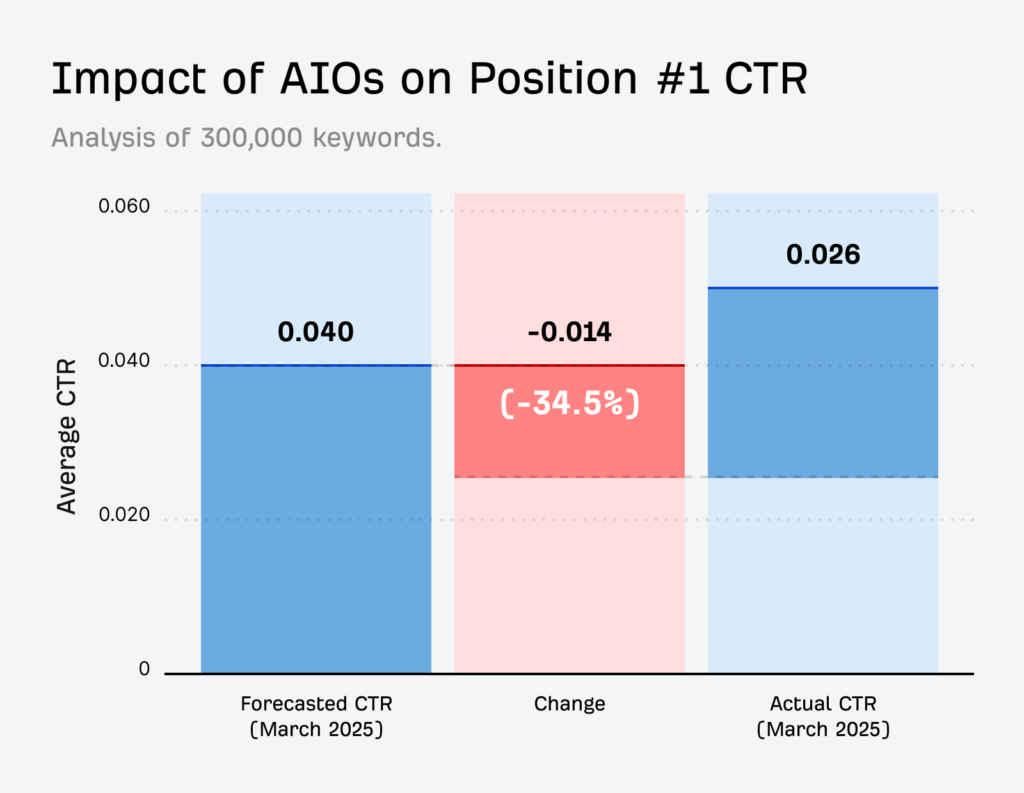
It’s not hard to point the finger here: AI Overviews take up prime real estate at the top of the results page. They push organic page results further down, often below the fold. But it’s even more than that, because if there are sponsored queries, video results, people also ask, and so on, your number one result could be either lost in the middle or require the user to scroll down and find it.
Yeah, one could argue that the users can still click the source in the AI overview or AI model, but they generally aren’t doing that due to getting the correct information in the overview. It would be easy to assume that maybe meta page titles and descriptions are not ‘click-worthy,’ but I think the root cause is a lot deeper than that. Take the Mail Online, which maintained top organic rankings for specific keywords, when the AI Overview came along, it caused a 56.1% reduction in desktop CTR and a 48.2% reduction on mobile.
Additionally, another report found that despite an increase of 49% in impressions, sites have seen a 30% overall CTR drop year-over-year. Two metrics that don’t usually work in opposition. I have seen this first hand with data on different websites, it’s unexplainable but understandable when bringing AI into the picture.
Impact on Non-Branded Queries
Non-branded queries, a key target for SEOs, have also been hit. These are high-volume, research-driven keywords that many businesses rely on to attract top-of-funnel traffic. When AI Overviews show up on these queries, the average CTR drop is around 20% or 27% if your page ranks below position three. Whereas branded queries seem to remain consistent, which is logical, as those have obvious search intent behind them.
Non-branded queries often trigger AI Overviews because they only require general answers. For example, ‘how to increase email open rates’ doesn’t require a branded response, but an AI overview of the best practices from multiple sources is a much better fit. As a result, users get a clear answer directly without needing to click, compare sources, or enter a branded customer journey.
Why is it such a big deal?
Generally speaking, non-branded queries make up the majority of informational search traffic, including a focus on long-tail keywords. That meant your content could rank for multiple variations on one topic. But with AI collating those queries into a single on-SERP answer, that could now reduce the number of keyword opportunities. Fewer impressions are reaching individual URLs, and fewer low-intent users are entering the funnel at all.
Again, this has a ripple effect. Potentially reducing newsletter signups, demo requests, time-on-site, and assisted conversions. Not only impacting immediate SEO metrics, but going much deeper into marketing and business performance.
Businesses that have built strategies around educational content, problem-solution guides, and keyword-targeted thought leadership now need to reassess. AI is not only stealing the click, it’s also taking the entire entry point.
Impressions & Clicks
In many cases, sites are reporting that impressions are on the rise, but clicks are declining. The logical attribution to this is impressions being included in AI overviews (or still regular impressions), but the click is either not needed, or the user can’t find it. One report shows that in general, impressions are up 49% year-over-year, and clicks have declined by 30%. Where another shows a 67.8% decrease in organic CTR when AI overviews are displayed, a drop from 3.07% to 0.99%..
However, one key problem here; Google is not tracking clicks from AI Mode (in the US) at all, meaning the data will not show in Search Console. Users could well be clicking your link from this AI experience, but you will have no idea, although I still believe clicks will be lower, as not everyone will click. But now you can see the problem, not only is it a traffic/business problem, but also an attribution problem.
If I really push it, this could also prompt a behavioral change in user search. Previously, users would scroll down immediately to the first results, avoiding ads and the useless info taking up real estate on the SERPs. But now users will become custom to expecting answers at the top of the page and using that as a natural ‘search function’. They scroll less, compare fewer links, and engage with fewer sources.
When you bring AI tools into the mix, it becomes worse. There’s no way of tracking ‘impressions’ in ChatGPT (how many times it presents your info as a source). There are ways to track clicks, which are arguably more important, but it’s still not good enough to have incomplete marketing data.
This mismatch between visibility and engagement is probably one of the most disruptive aspects of AI in SEO. It’s not just frustrating, it also makes performance reporting, ROI analysis, and even strategy alignment harder to execute.
The Fight for SERP Real Estate
The SERP layout has changed drastically in the last 5 years or so, with Google trying to provide value and earn revenue over providing links to actual sites. Not only are you dealing with competition for SERP positions, but also competition for visibility within its features. Ranking number one is simply not enough to maintain dominance with the way the SERPs are.
Obviously, there’s the AI overview section, which now takes up nearly the entire screen of results, but is also effective at preventing users from clicking sites. For example, this, combined with existing features like Featured Snippets, has led to a CTR decline of up to 37% for organic listings. The more information that Google provides to users early on, the more satisfied they are likely to be with their search query, leading to an end in that user journey.
The we have paid ads which will continue to occupy key positions on SERPs, appearing above organic results, as they drive revenue for Google Nothing new here, but with the addition of new features and combination of old, it reduces the space available for organic listings, making it more difficult for businesses to attract clicks or even be seen.
If that’s not enough, the SERPs are populated with various other features such as People Also Ask, Knowledge Panels, and Local Packs. All of these provide users with quick access to information, but also take up real estate and overshadow links to sites. As a result, the opportunity for organic listings to capture user attention and drive traffic is reduced.
Granted, not all of these are the fault of AI, but now that the AI Overview section has been added, it causes more overcrowding in the SERPs; in my opinion, it’s an even bigger disruption than any of the other features Google has implemented.
SEO Objectives and Attribution
The primary goal of SEO has always been to secure the top organic ranking spot for high-value keywords. However, with AI Overviews now appearing in approximately 42.5% of search results, the goal is now shifting towards being cited within these AI-generated summaries.
While one could argue that the optimization practice itself is still the same as what you would do to rank in the SERPs, Google Gemini seems to think differently:
“The key difference lies in the emphasis on clarity, direct answers, and E-E-A-T (Experience, Expertise, Authoritativeness, Trustworthiness) to be directly cited by the AI, rather than just ranking high for a query. This often requires highly structured, concise, and trustworthy content that AI can easily understand and summarize.”
I have also investigated sources that have appeared in an AI Overview, and several of them have not been found on the SERPs for that query. This suggests that content needs to have a different approach, hence altering SEO objectives.
Then we have the challenge of attribution, which I have touched on previously. Currently, platforms like Google do not provide detailed reports when a site is included in an AI Overview. Similarly, AI tools such as ChatGPT and Claude do not notify creators when their work is referenced. Even when tools like Perplexity include links to sources, these links are not always clicked, and standard analytics often fail to capture this engagement.
This creates a growing attribution gap for marketers. In traditional SEO, visibility and performance were linked; if a user clicked your result, the journey was measurable. But with AI-generated answers, a brand’s expertise may be used to inform a response without generating any direct engagement. There’s no referrer string, no session in analytics, and often no indication that the user ever saw your contribution. Even when a link is present, users rarely click, meaning the brand’s influence occurs entirely off the radar.
Google’s AI Mode
This is not global yet, so I only want to touch on it briefly:
Google recently released a new AI Mode (US for now) that introduces a completely different search experience. AI Mode works more like a conversational assistant, where the user chooses to enter ‘AI Mode’ and interacts with responses in a dialogue format. Answers are fully generated, contextualised, and continuously optimized.
While this mode is meant to come with performance tracking in Search Console, no dates given, it will not provide a breakdown to see individual data. Which, again, strips away any means of attribution, and for businesses, it removes the feedback loop needed to evaluate performance.
Voice, Visual, and Video
It’s often forgotten about, but voice search is also something to take note of. While it’s been around for a while, it’s getting more powerful (thanks to AI) and is seeing a higher usage rate, where nearly 30% of mobile searches in 2024 were voice-driven (Statista). The issue, again, it’s not easy to track or attribute correctly due to zero-click issues, lack of awareness, and poor performance reporting, which is another piece of the puzzle to add to regular search.
Google confirms what can and cannot be tracked in voice search:
What you CAN see: In GSC, you can see the queries that brought users to your site. Many of these queries might be long-tail, conversational, or question-based, which are characteristic of voice searches. However, GSC does not tag or categorize these queries as having originated from a voice input. You won’t see a metric that says “X clicks from voice search.”
What you CANNOT see: Direct analytics differentiating clicks or impressions based specifically on whether the query was spoken versus typed.
Google Lens now processes over 12 billion visual searches per month. AI interprets photos and provides results based on what it sees. It’s great for the user, but not for marketers without a visit, session, or conversion to track. A 2024 Google study found that 36% of visual searches are product-related, but AI often delivers results without any link back to the originating brand.
Google confirms what can and cannot be tracked in image search:
What you CANNOT see: Specific, granular data indicating clicks or impressions that originated specifically from a Google Lens query (e.g., someone pointing their camera at an object) that then led to your site. While Google Lens results may sometimes lead to web pages, the specific attribution for a “Lens-initiated click” is not a separate report category.
What you CAN see: In GSC, under the “Performance” report, you can typically see data for “Image” search type, which will show impressions and clicks for your images appearing in Google Images or Universal Search results. This helps you understand how your images perform in general visual contexts.
Google’s AI can now parse videos, extract summaries, and display ‘key moments’ that match a user’s query. That means a tutorial or guide may be played back partially in an AI Overview, without any engagement with the full video or surrounding content. YouTube remains the primary source here, and not using its schema features or structured chapters may be excluded altogether. Even when your video is featured, there may be no traceable engagement to prove its role in a user’s journey.
It’s not just search engines. Tools like ChatGPT now accept voice and image inputs and return conversational answers that often summarize or paraphrase web content. These interactions occur entirely within the platform. There’s no referrer, no page view, and no indication that your work was used, yet your information could still shape the response. A blind spot for SEO.
Case Studies
I wanted to back this section up with some case studies I came across (not mine). These demonstrate the hard-hitting impact of AI in search, not only for SEO but also for business performance:
Case Study 1: The Planet D – 90% Traffic Loss
The travel blog The Planet D experienced a significant decline in organic traffic following the introduction of AI Overviews. According to a report, the blog suffered a 90% reduction in traffic, leading to staff redundancies. This drop really shows the vulnerability of content-heavy sites to AI-generated summaries that satisfy user queries without prompting a click-through. (Source: Lengow Blog)
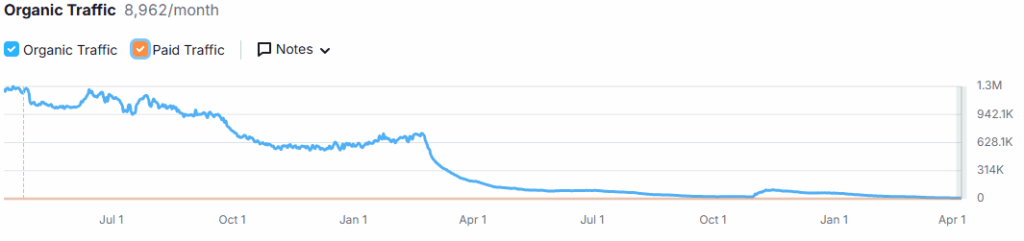
Case Study 2: MailOnline – 5,500 CTR Decline
MailOnline, which is the8th biggest English language news website in the world (260 million website visits per month) experienced a huge drop in CTR due to AI Overviews. For instance, a keyword that previously garnered approximately 6,000 clicks saw a reduction to just 100 clicks after the introduction of an AI Overview. Their website visits have dropped by 19.5% year on year too.
Case Study 3: Chegg – 49% Decline in Non-Subscriber Traffic
Chegg, an online education platform, reported a 49% decrease in non-subscriber traffic in January 2025 compared to the previous year. This decline is attributed to the rise of AI Overviews, which provide users with direct answers, reducing the need to visit external websites.
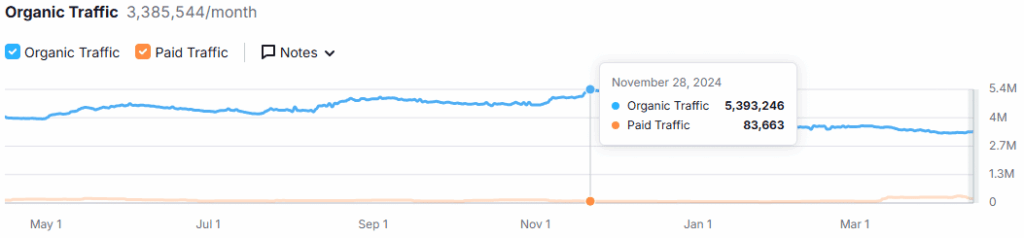
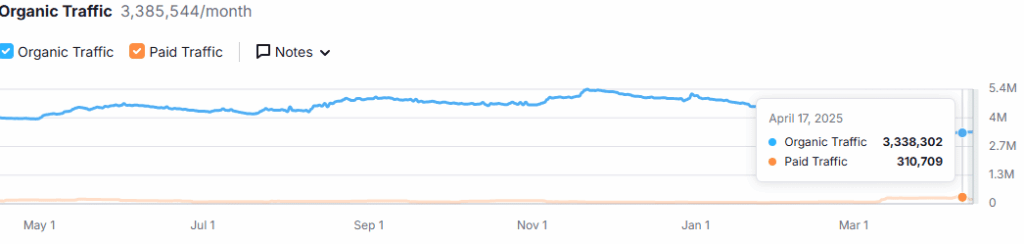
This led to a 24% drop in revenue in Q4 to $143.5 million, and the company posted a net loss of $6.1 million. It didn’t stop there, market capitalisation crashed by over 90%, from $2.18 billion to just $110 million. To put the cherry on top, subscriber numbers also dropped by 14%.
Is SEO Still About Ranking First?
It used to be simple: ranking first meant winning. The top spot in search results drove the highest share of clicks, visibility, traffic, and revenue. But the AI features implemented and those to come in the future could be changing the importance of SERP positioning as we know it. My opinion is that SEO is, or will, transition to be ‘optimize for visibility’ instead which could follow the same principles, but it will impact research, planning, implementation, and definitely tracking.
There’s growing debate within the SEO community about what the ‘top’ position even is anymore. In some SERPs, the first organic result now sits below paid ads, an AI Overview, a featured snippet, and possibly even a map pack or video carousel. In others, it’s folded into an AI-generated summary where the user doesn’t visit a site.
That doesn’t mean rankings don’t matter anymore, just to be clear. The foundational logic of search still applies: if you’re not present in search results at all, you’re not in the conversation. But being present is no longer solely about ‘only’ securing the top spot. Your content might rank first and still be invisible if the AI summary box doesn’t include you. At the same time, your page might rank fifth and still be cited in an AI answer, indirectly changing the user’s experience. There’s a separation now between where a URL sits on the page and how its content influences the response.
I think the shift here is going to be targeting AI queries and optimizing to show in AI search results, but what that looks like is unknown. With no performance metrics to track, how can SEO’s effectively implement SEO tactics?
What Marketers Should Be Doing Now
Search is still here, I’m not sure for how long, but it’s here. The only thing that’s changed is how results are delivered and the value they provide to the user. The key focus initially is to optimize to appear in AI, regardless of how poor the data and tracking is. That starts with on-page SEO.
AI systems prioritize content that is easy to parse, summarize, and contextualize; we should be focusing even more on clarity and intent. (Using subheadings that match user intent, embedding clear definitions, and including question-answer formats that map to AI queries). Every piece of content should include a summary, lists or tables where appropriate, and structured data markup.
Performance tracking needs to be adjusted, too; you can’t rely on Google for accurate tracking, or AI tools for that matter. Maybe some SEO tools could help, but they are not entirely accurate either. Use Search Console to identify informational queries showing strong impression growth without clicks, these are likely a source of AI Overviews or zero-click summaries. Don’t rely on one dataset or source; combine that with GA4 data on direct traffic and branded search increases, which may be indirect outcomes of untracked impressions. Set up custom dashboards to keep a closer eye on changes in performance too.
As seen in the case studies I mentioned, the impact of AI on SEO has already happened to many sites, causing major losses in metrics and revenue. I still believe there’s more to come over the next couple of years, as more AI features are rolled out and models become even smarter and useful.
What does that mean for SEO?
What the Future of SEO Might Look Like
Monetised AI results are almost certainly coming, Google needs to prioritize its revenue! Google has already tested ads inside AI Overviews, which appear within suggested follow-up questions or are embedded directly in the summary. This might help with freeing up some of that real estate, it might be an added option, it might be great for ad performance, only time will tell. If this does roll out effectively, we can expect fewer organic links and more paid placements inside AI responses.
At the same time, AI Overviews are changing who gets seen. Smaller brands with clear, well-structured content can now appear in summaries, even if they don’t rank in the top ten. A study by Seer Interactive found that over 70% of cited content in AI Overviews came from pages outside the top 10 rankings. This opens the door for niche businesses to earn visibility through ‘AI optimized’ content, not just domain authority. Algorithms still consider E-E-A-T as a priority, but the playing field seems to be opening up.
Of course, as AI platforms continue to evolve in the coming years, more users could end up shifting habits and using the likes of ChatGPT and Perplexity without even going through a search process. There are even rumours of ChatGPT launching a search engine, which could disrupt SEO massively. One thing I am certain of, there will be new features, there will be advancements in AI’s capabilities, and users will begin to rely on and trust these platforms more than themselves performing search queries.
I believe SEO is in for a turbulent few years, and it’s already been rocked quite heavily.
Sources Used