
Every few years, someone declares SEO dead. Each time, SEO has simply adapted to new marketing challenges. However, with AI impacting SEO, click-through rates have now decreased by 34.5% on position-1 results with AI Overviews and driven 58.5% of U.S. Google searches to end without a click (source). Calling for fresh new claims that ‘SEO is dead’.
It happened when Google nuked low-quality content with Panda, when Facebook became a traffic firehose, when mobile search overtook desktop, and when voice assistants started reading answers aloud. Each time, SEO didn’t die, it adapted.
But the last two years have been different. Google’s AI Overviews now answer many queries directly on the results page, reducing the need to click. At the same time, generative platforms like ChatGPT, Perplexity, and Gemini are taking informational searches entirely out of Google’s ecosystem.
This is a change in where attention lands. For example, in mobile results, AI Overviews now sit above ads, maps, videos, and organic results, often resolving a query before a user ever scrolls.
So is SEO finally dead?
The short answer is no. But it has changed, and marketers need to know how.
It now spans across three layers: SEO to earn clicks from rankings, AEO to win zero-click featured answers, and GEO to be cited in AI-generated responses. Missing one layer means losing visibility where audiences now get their answers.
Why Have People Long Claimed ‘SEO Is Dead’?
For more than two decades, people have predicted the end of SEO every time search technology evolved. Panda, Penguin, mobile-first indexing, voice search, each major change triggered claims that SEO was finished. None of them killed it. They changed the rules, and marketers needed to adapt with stronger content, better links, and sharper user experience.
Google’s Panda update in 2011 demoted thin, low-quality content across millions of domains. Penguin followed, targeting spam-heavy links. Many said SEO was broken. What really happened: Google shifted focus to quality and relevance. Sites that improved content and built authentic links recovered or even outperformed their peers (source).
In 2015, mobile-first indexing hit. Rankings for non-mobile-friendly sites dropped an average of 0.21 positions (source). Some feared mobile would bury SEO entirely. Instead, the real impact was not as serious, with data showing a 21% reduction in non-mobile URLs across the first three pages. Not a collapse, but a signal that adaptability mattered.
Voice search triggered the next alarm. If people spoke their queries, did keywords die? No. Voice changed phrasing and length, but it still leaned on keyword signals and structured content. SEO adjusted to a new input style, not a new reality (source).
Then came social media. Headlines declared search was dead again. It wasn’t. Discovery expanded to platforms like Facebook and Twitter, and SEO evolved into broader content distribution that blended search with social reach (source).
Every shift, Panda, Penguin, Mobile-First, voice, social, brought fear. Each one was a wake-up call, not a tombstone. SEO didn’t die. It got smarter.
Why Do People Say SEO Is Dead Today?
Claims that SEO is dead today come from falling organic traffic. AI Overviews, zero-click growth, publisher traffic losses, and crowded SERPs have pushed frustration higher. These aren’t signs of death. They signal that SEO now demands new approaches, like AEO and GEO, to stay visible.
AI Overviews are stealing clicks
These summaries pull content from multiple sites and answer queries directly on the results page, cutting out the click. Even the top result loses a third of potential traffic before a user ever reaches the page. CTR for position one drops by 34.5% when AI Overviews appear (source).

AI Overviews give a full answer, often pulling from multiple sites, which means users have less incentive to click through to a single source. For informational queries, the answer is often complete enough that the search journey ends before a visit happens.
Zero-click growth is accelerating
In 2024, 58.5% of U.S. Google searches ended without a click (source). On mobile, AI Overviews and SERP features fill the screen above the fold and answer questions before a user scrolls. The trend has been rising for years, but AI Overviews are speeding it up. The effect is worse on mobile, where limited space lets AI summaries dominate the view.
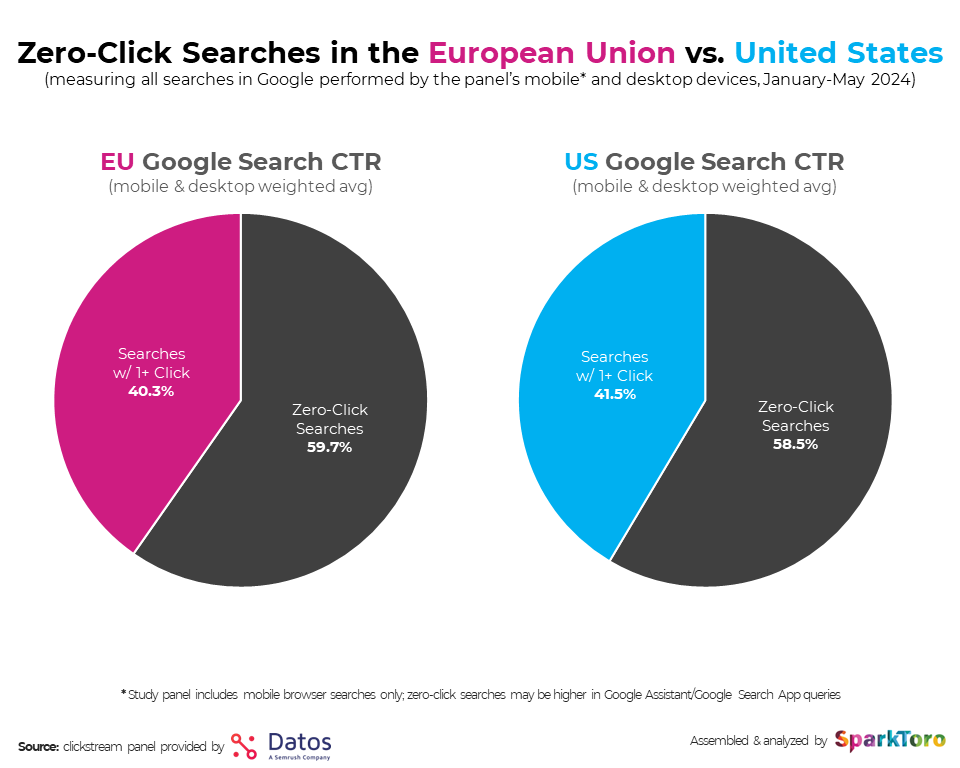
Zero-click doesn’t just mean fewer visits, it means fewer opportunities for brands to get in front of potential customers, unless they’re part of the AI-generated content being displayed.
Publishers have seen steep traffic losses
Some news publishers lost up to 40% of search traffic after AI Overviews rolled out (source). For publishers that rely on ad impressions, that drop turns directly into lost revenue. The hit is harder on breaking news and trending topics, where Google’s AI can summarize multiple sources instantly and leave users with no reason to click. This is zero-click at scale, applied to high-value keywords that once drove millions of visits.
Google controls more SERP real estate
Ads, maps, videos, People Also Ask boxes, shopping carousels, and AI summaries now crowd modern results pages. Analysis shows that the share of SERPs with at least one feature has risen year over year. That pushes organic listings further down the page, sometimes below the fold. Even a top-three ranking can be buried under interactive elements and visuals that grab clicks first. For some queries, the first organic result doesn’t appear until halfway down the page.
Perceived cost inflation is rising
SEO campaigns face higher competition, longer timelines for ROI, and in paid channels, rising CPCs. As more brands chase the same high-intent keywords, the resources required to stay visible increase. For smaller businesses, SEO looks less cost-effective. What’s overlooked is that SEO compounds over time, while paid traffic stops the moment spend stops. Still, the perception of rising costs and slower wins fuels the ‘SEO is dead’ belief.
AI assistants are siphoning early-stage traffic
ChatGPT passed 1.6 billion visits in June 2025 (source), with tools like Perplexity and Gemini drawing millions more. These platforms answer questions directly without sending traffic to external sites. For research and informational queries, they replace the need to even open a browser. The challenge changes from ranking in Google to being cited or paraphrased inside an AI answer, which demands different tactics than traditional SEO.
SEO skill requirements have become more technical
Visibility now often requires schema markup, structured Q&A formats, and AI-friendly content blocks, far beyond keyword targeting. Success also depends on site performance, entity-level optimization, and data-layer integrations. For teams without dedicated SEO expertise, the field feels inaccessible and reserved for larger players with bigger budgets.
Algorithm fatigue is real
Google has released multiple broad core updates in short spans, often without clear explanations. Ranking volatility feels unpredictable, and many marketers believe large, authoritative domains are favored over smaller niche sites, regardless of content quality. For brands already fighting to keep traffic, these swings reinforce the belief that SEO is unreliable and unwinnable without deep pockets.
Every one of these points explains the frustration. But frustration isn’t final. These are challenges to adapt to, not signs of death.
| Argument | Support / Data point |
|---|---|
| AI stealing traffic | CTR drops up to 34.5 % for top results |
| Zero-click surge | 58.5 % zero-click searches in the U.S. |
| Publishers losing audience | Up to 40 % traffic drop |
| SERP crowding | AI Overviews, ads, snippets push organic links below the fold |
| Declining ROI | Longer to see returns, especially for new sites |
| Rise of AI chat tools | ChatGPT at 1.6B+ monthly visits; many skip Google entirely |
| Algorithm volatility | Multiple core updates in 12 months |
Did AI Make The ‘SEO Is Dead’ Claims Louder?
AI has sparked new ‘SEO is dead’ claims as a result of serving full answers on the search page and moving discovery into generative platforms. CTR losses, zero-click dominance, and publisher declines gave old predictions new weight. But transactional and local queries remain stable. SEO isn’t disappearing, it’s changing.
AI Overviews replacing clicks
AI Overviews take the top of the results page and answer many queries without a site visit. Similarweb reports organic CTR on informational queries fell 18% year over year after these summaries rolled out at scale. (source).

That’s millions of lost visits across entire industries. For brands relying on non-branded discovery, the playbook changes: visibility alone no longer converts into traffic.
CTR drops and zero-click growth
Semrush found zero-click searches in the U.S. climbed to 59.7% in Q2 2024, up from 54% a year earlier (source). Generative answers push this even higher by resolving user intent directly on the page. The change forces a new mindset. For some keyword classes, the win isn’t the click, it’s earning placement inside the AI answer so the brand stays visible when traffic doesn’t follow.
Publishers and niche sites losing visibility
Chartbeat data shows news and reference publishers lost 27% of search visits within three months of Google’s AI Overviews expansion (source). Evergreen explainers and how-to content took the biggest hit because the SERP now delivers the full answer instantly. Survival means turning content into what AI either can’t replicate, such as proprietary data, unique visuals, or interactive formats, or into content purposely for AI engines.
Google pushback tempers the doom narrative
Google says billions of clicks still leave Search daily and high-intent queries remain stable (source). That matters. AI is draining attention at the top of the funnel, but transactional and local intent remain fertile ground for organic growth. Declaring SEO dead ignores this split, and that’s where smart strategies will still win.
How Is SEO Changing In 2026?
SEO still delivers high ROI, organic discovery, and measurable growth. The change is in how tactics stack together: earning rankings, winning featured snippets, and being cited inside AI answers. This layered approach keeps SEO central to visibility.
SEO still delivers ROI
SEO produces the highest average marketing ROI in recent benchmarks, 748%, with positive returns usually appearing in 6 to 12 months and compounding in years two and three (source). Payback builds as rankings stabilize and content portfolios mature, which is why sustained programs outperform short campaigns.
Organic search remains a primary traffic source
Across seven major industries, organic search generated 33% of total website traffic in 2024, based on an analysis of 800 enterprise domains (source). Google still holds 89.6% of global search share across desktop and mobile (source). That dominance keeps SEO central to discovery and demand capture at scale.
The SparkToro chart below shows the scope. Google handles roughly 14 billion searches a day, compared with Bing’s 613 million and ChatGPT’s 37.5 million. Even with AI summaries and SERP features competing for clicks, the organic audience is unmatched. Well-structured SEO captures a slice of the largest discovery channel in the world, which is why it remains at the core of high-return marketing strategies.

Content optimization still moves numbers
Incremental on-page changes still drive organic traffic. In retail tests, adding ‘Best’ to title tags delivered an 11% increase in organic sessions at 95% confidence. Removing the word ‘Compare’ from titles drove a 24% uplift, showing that tighter alignment with user intent wins more clicks.
Exposing hidden intro content on mobile increased organic traffic by 7.5% on mobile and 7.4% overall, proof that visibility and usability cues still drive rankings and clicks (source).
Freshness and structured updates still work
Canonical cleanup and better content structure continue to pay off. Pointing canonicals to product variations increased organic traffic to those pages by 22%, while showing product specs in a dedicated section produced a 5.5% lift (source).
By contrast, removing a self-referential breadcrumb link cut traffic by 5.5%, underlining how consistency between UX elements and structured data still affects rankings.
Organic performance remains resilient at scale
Most sites didn’t collapse in 2024. Web analysts reported traffic was steady or growing for 87% of properties, with 43% showing year-over-year gains despite algorithm turbulence (source). That resilience explains why SEO stays in the plan even as AI changes top-of-funnel behavior.
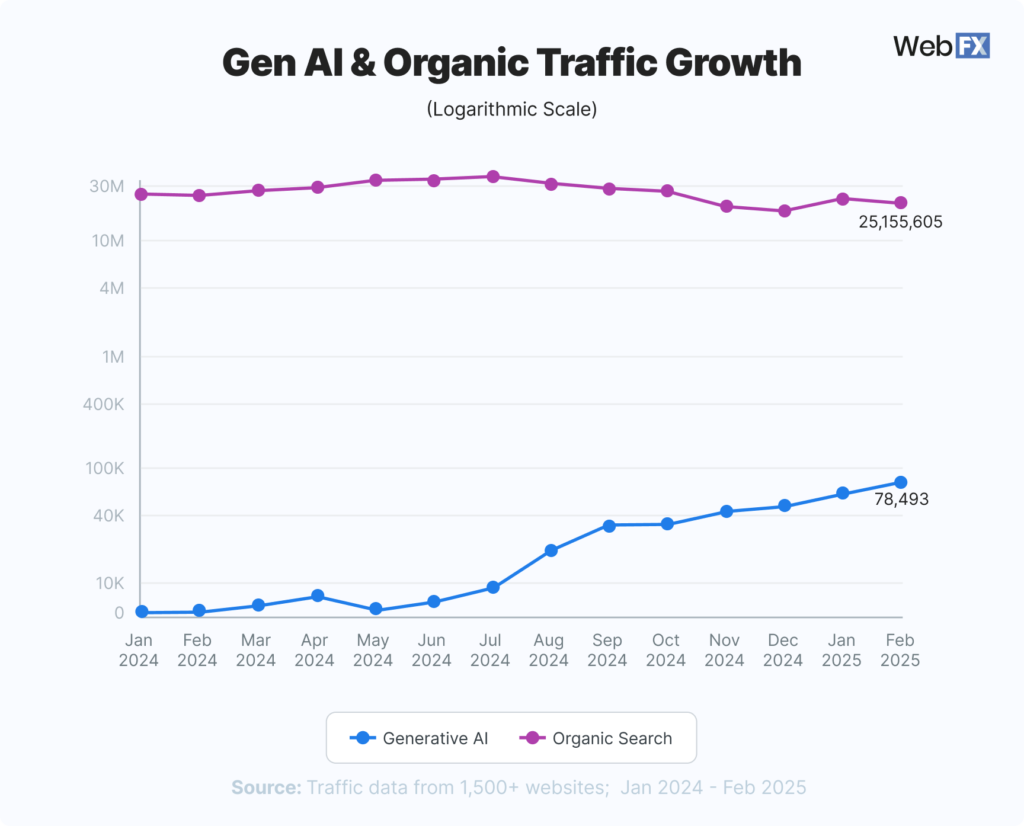
The WebFX data below reinforces the point. Across more than 1,500 sites, organic search still drove over 25 million visits in February 2025, while generative AI referrals reached only 78,493.
AI-driven traffic is rising, but it remains a fraction of organic volume. For marketers, search is still the largest-scale channel for capturing demand, and pulling back risks handing that reach to competitors.
Local and vertical search still drive action
Local intent continues to run through Google. 83% percent of consumers use Google to find local business reviews, keeping Google Business Profiles and review SEO central to conversion paths. Review habits are consolidating too, with 27% of consumers using only one review site before deciding. That concentration increases the impact of local SEO work (source).
Multi‑layered strategies are winning
Modern programs mix SEO with answer-engine and generative-engine tactics without dropping fundamentals. People Also Ask appeared as a top result type in 24 of 26 subindustries, making Q&A formatting and entity-rich answers a reliable way to win visibility above standard listings.
Teams that invested through the AIO rollout saw gains, with 63% reporting that AI-powered search improved organic traffic, visibility, or rankings. That validates a layered approach over replacement strategies (source).
SEO tactics are adapting to AI-driven search
The fundamentals remain the same: keyword targeting, link equity, and technical stability still anchor performance, but execution has changes. Schema markup is no longer optional. Entities, structured data, and clear topical clusters help search engines and AI models interpret and show content across contexts.
SERP monitoring now includes AI Overviews, video carousels, and visual snippets, so rankings extend beyond ‘blue links.’ Content is also being built for multiple entry points. A page may target organic search, feed snippet answers, and provide fact blocks that AI engines can cite.
Where Does GEO and AEO Fit Into SEO?
GEO and AEO aren’t the new SEO. They’re additional layers that work alongside it. If you drop SEO and go all-in on GEO or AEO, you’ll miss the biggest slice of traffic: organic clicks from search. If you ignore them, you’ll disappear from the answer-first experiences AI and voice tools deliver.
What is GEO?
GEO, or Generative Engine Optimization, is about making your content usable by AI models like ChatGPT, Gemini, and Perplexity. The goal isn’t ranking in a SERP, it’s getting cited inside AI-generated answers. That means clean structure, factual accuracy, and schema markup that machines can parse. A study found content with strong structure and citations was 40% more likely to appear in AI outputs (source).
What is AEO?
AEO, or Answer Engine Optimization, targets direct answers like featured snippets and voice search. It focuses on Q&A formatting, concise answers, and schema so search engines can display your content above organic results. Featured snippets appear in 19% of Google searches, and over 70% of voice queries use this format (source).
Why they improve visibility
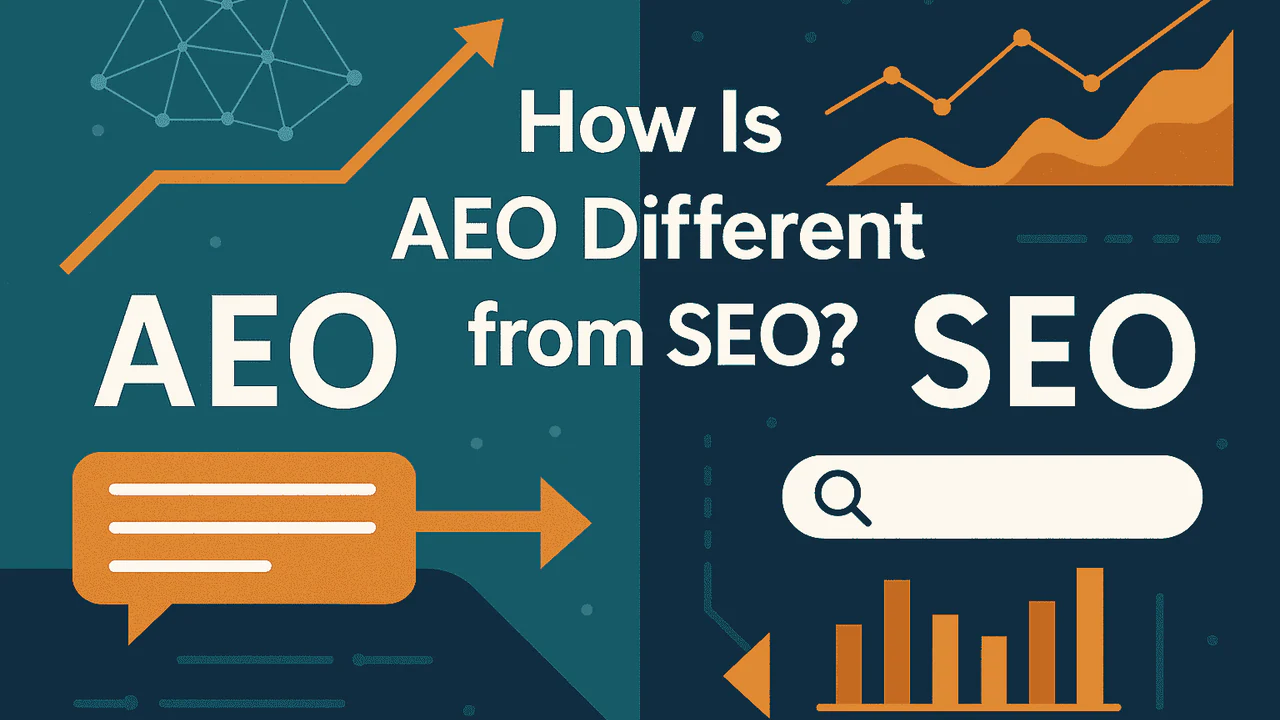
SEO gets the click. AEO wins zero-click placements. GEO gets your information embedded in AI answers where there’s no link at all. Each layer increases your brand’s presence in different discovery moments. Together, they create a multi-touch visibility footprint that follows your audience across platforms. It requires a hybrid optimization strategy.
Example of a hybrid strategy
- Use SEO to target high-value keyword clusters and drive organic traffic.
- Apply AEO to capture snippets and voice responses for those same topics.
- Structure and cite content so AI tools can use it in generative answers.
This approach means your content ranks, gets read aloud, and appears in AI responses, covering all search formats without competing against yourself.
| Channel | Core goal | Where it wins | Limitations | Best use in a hybrid strategy |
|---|---|---|---|---|
| SEO | Drive clicks from search results | High-intent organic traffic | Lower visibility in zero-click SERPs | Target valuable keyword clusters, build authority content |
| AEO | Win answer boxes and voice responses | Featured snippets, voice queries | Fewer direct clicks | Secure position zero for top queries, support brand recall |
| GEO | Appear in AI-generated answers | AI assistants like ChatGPT, Gemini, Perplexity | No guaranteed attribution or traffic | Provide structured, factual content that AI can use and cite |
Does Zero-Click Harm SEO?
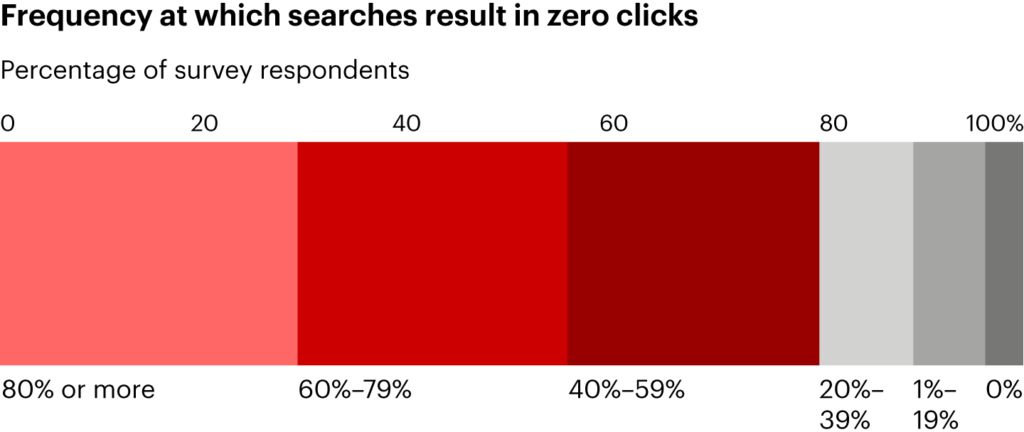
Zero-click searches cut the number of visitors reaching a site, but they don’t remove SEO’s value. They change success metrics from clicks to visibility, impressions, and brand presence in snippets or AI answers.
Treated as branding opportunities, zero-click results still deliver impact. Optimizing content for featured snippets and AI summaries ensures businesses benefit even without the traditional traffic.
Capture impressions and citations
Treat impressions as branding opportunities. Schema, structured headings, and authoritative sources increase the odds of your content being shown in snippets, knowledge panels, and AI answers. A 2024 Databox survey found 61% of marketers now track impressions as a primary SEO KPI (source).
Optimize for snippets and AI answers
Concise, 40–60 word answers, followed by deeper content, win a higher share of featured snippets and AI citations. Backlinko’s SERP study showed Google displays featured snippets for 19% of queries, and those placements capture most above-the-fold attention (source).
Target zero-click keywords deliberately
Identify keywords that generate high impressions but low CTR, then design pages to convert from secondary calls-to-action, such as brand queries or direct visits. This turns visibility into measurable engagement, even when the click happens later in the user journey.
Is SEO Dead?
SEO isn’t dead, it has evolved with technology and user behavior. While AI Overviews, zero-click searches, and generative platforms have changed how people find information, organic search still delivers the highest ROI of any digital marketing investment and drives a massive share of web traffic.
What’s changed is the way success is measured: clicks are no longer the only win. Visibility in featured snippets, AI-generated answers, and impressions across SERPs now matter alongside rankings and traffic.

Brands that adapt by layering SEO with AEO and GEO ensure they hit all touchpoints across user search, while those that walk away risk losing both attention and market share.
FAQ – Is SEO Dead?
Yes. Benchmarks show SEO delivers an average ROI of 748 % with compounding returns over time. It remains one of the highest-performing marketing channels when executed consistently.
AI has shifted focus from pure rankings to multi-surface visibility. Success now means earning clicks, winning snippets, and being cited in AI-generated answers — not relying on one type of placement.
AEO (Answer Engine Optimization) targets direct answers and voice results, while GEO (Generative Engine Optimization) focuses on getting content into AI assistant responses. Both work best as layers on top of traditional SEO.
Yes, but they must prioritize niche authority, local SEO, and structured content. Smaller teams can outrank bigger brands in targeted segments by focusing on depth, relevance, and user intent.
Alongside clicks and conversions, impressions, brand mentions, and AI citations are becoming essential KPIs. They reflect visibility across the full search journey, even when a user doesn’t click through immediately.