
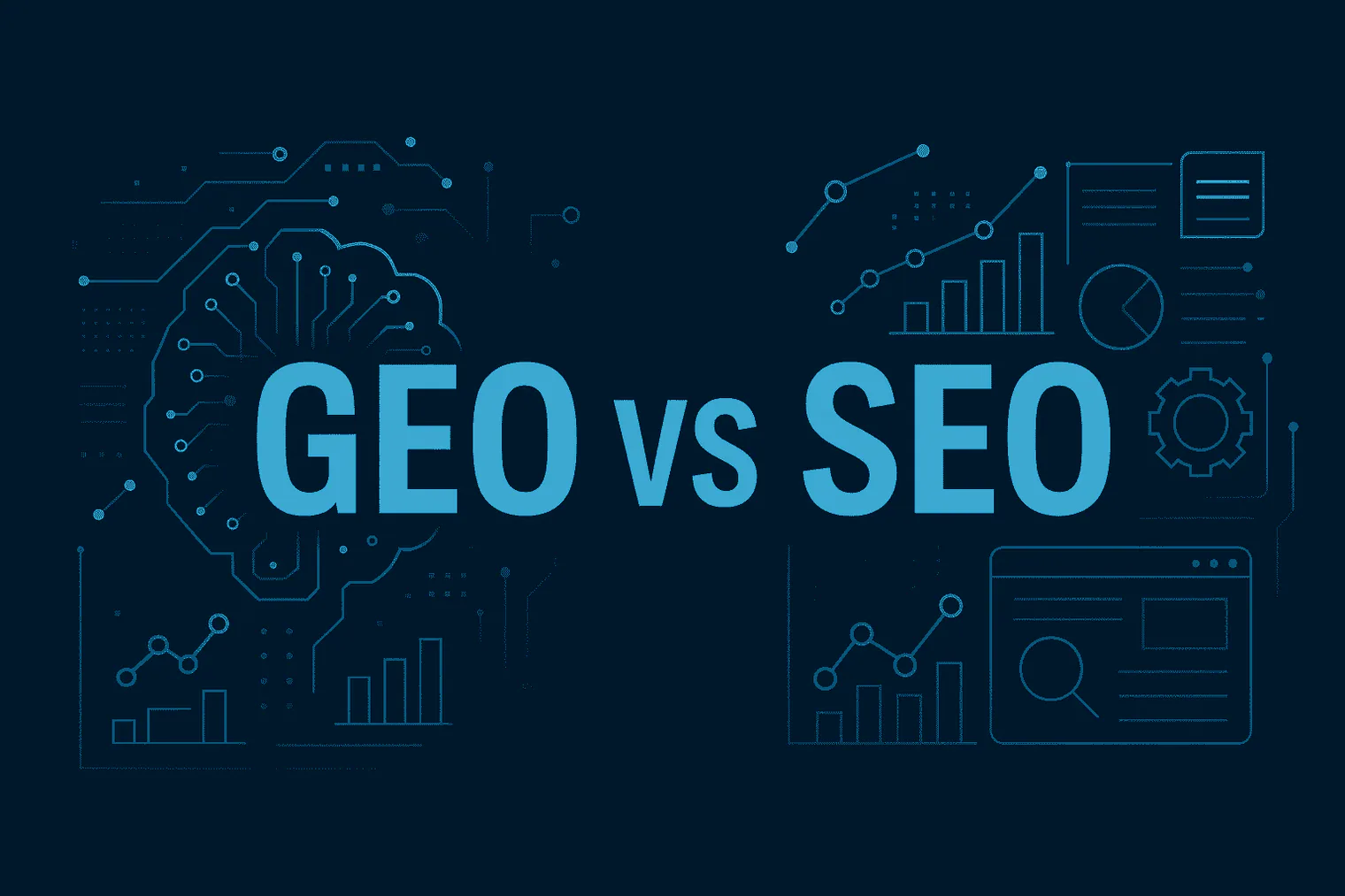
Search engines are no longer the only path to discovery. AI assistants like ChatGPT, Perplexity, Gemini, and Claude are delivering answers directly, without links, without clicks, and without sending traffic back to your site. That shift has introduced a new layer of optimization: Generative Engine Optimization (GEO).
Where SEO aims to rank content on traditional search engines, GEO focuses on getting your content used inside generative answers. It’s not about position one, it’s about inclusion in the response itself.
For marketers, this changes the rules. Your content might be informing millions of AI answers, but if it’s not being cited, recognized, or structured correctly, your brand remains invisible.
This article breaks down how GEO is different from SEO, why it matters, and what to focus on if you want your content to show up where the links are disappearing.
What Is GEO vs SEO?
Generative Engine Optimization (GEO) is the practice of structuring and publishing content so it gets included in AI-generated answers across tools like ChatGPT, Perplexity, Gemini, and Claude.
Search Engine Optimization (SEO), by contrast, focuses on helping your content rank higher in traditional search engine results pages (SERPs), primarily Google.
The key difference is output. SEO aims for blue-link visibility. GEO targets text inclusion inside AI answers, where users don’t click, they read.
GEO content needs to be structured, direct, and recognizable by large language models (LLMs). It rewards clarity, citations, and answer-first formatting.
SEO content is broader: it needs keyword relevance, backlinks, metadata, and crawlability to drive organic traffic to your site.
The most effective marketers aren’t choosing one; they’re building content that supports both.
- SEO = Optimizing for traditional search rankings and organic traffic
- GEO = Optimizing for inclusion inside AI-generated responses
Why Should You Care About GEO Today?
As AI chat tools become first-stop discovery, you either get cited, or you vanish. GEO isn’t optional anymore.
Traditional SEO focuses on where your content ranks. GEO is about whether your content is used. As tools like ChatGPT, Perplexity, Gemini, Claude, and Meta AI become default discovery platforms, your brand visibility increasingly depends on whether these engines pull your content into their answers.
How Are Users’ Behaviors Changing?
Marketers have already started feeling the impact of answer-first platforms, with the latest AI marketing statistics showing:
- Google’s AI Overviews appear in 13–15% of search results, often above all organic links (Semrush, 2025). These aren’t experiments, they’re defaults.
- Perplexity serves over 1.1 billion queries per month and cites sources inline, making it a major citation opportunity or blind spot (Perplexity Blog, June 2025).
- 80% of search users now rely on AI summaries for at least 40% of their searches, and 60% of those searches end without ever clicking a link (Bain & Company, 2025).
That’s a massive behavioral shift. Even if your content ranks, you may be invisible where users are actually consuming answers.
What Tactical Edge Does GEO Give You?
GEO gives you a tactical advantage across the entire funnel:
- Branding at the top: If AI cites your content, you shape the narrative, even without a click.
- Trust through structure: Answer engines favor content with schema, tables, and prompt-aligned summaries.
- Reach without rankings: GEO opens the door for small teams to compete with large brands by surfacing highly structured, clear information.
Is AEO Enough, or Do You Need Full GEO?
AEO (Answer Engine Optimization) is one piece; full GEO means citations, paraphrases & iterative tuning across all LLMs.
AEO is part of the GEO equation, but GEO goes further. It’s not just about optimizing content format. It’s about getting used, cited, and paraphrased across different LLMs. And the only way to get there is by monitoring performance, iterating, and aligning with what AI engines value.
Key Differences Between GEO and SEO
GEO and SEO serve different discovery environments. Understanding their differences helps you build content that performs in both.
SEO is about rankings in search engines like Google and Bing. GEO is about visibility inside AI-generated answers, like ChatGPT, Perplexity, Gemini, and SGE. The two approaches overlap, but their optimization levers, outputs, and success metrics are not the same.
Here’s what GEO and SEO each optimize, and where they overlap.
| Aspect | SEO | GEO |
|---|---|---|
| Core Format | Full-page articles, landing pages, blog posts | Summarized answers, excerpts, tables, bullet points |
| Primary Goal | Rank high in organic search results | Be cited, paraphrased, or extracted into AI-generated answers |
| Optimization Signals | Backlinks, keyword relevance, content depth, mobile UX | Clarity, structure, schema markup, prompt-aligned headings |
| Measurement | SERP rankings, clicks, impressions, bounce rate | AI citation presence, paraphrase detection, zero-click impressions |
| Key Platforms | Google, Bing | ChatGPT, Perplexity, Gemini, Claude, SGE |
Why this matters: SEO gets you in the search results. GEO determines whether AI tools pull your content into their answers. If your content isn’t built to be parsed, summarized, and reused, you’ll be left out, regardless of how well it ranks.
How Can You Nail Both GEO and SEO?
SEO builds discoverability. GEO builds visibility inside answers. Together, they future-proof your content.
Search engines and AI engines may evaluate content differently, but they value many of the same things: clarity, authority, and structure. This is why a well-optimized page for SEO can also perform well in GEO environments if built intentionally.
Here’s where the two strategies align:
- Entity Optimization: Clearly defined topics, brands, and people help both Google (via Knowledge Graph) and LLMs (via embeddings) understand your content context.
- Structured Data: FAQPage, Article, HowTo, and Table schema improve crawlability and AI parseability. Both engines rely on structure to interpret content accurately.
- Internal Linking: Logical linking reinforces site hierarchy for SEO and improves topical reinforcement for AI crawling agents.
- E-E-A-T Principles: Experience, Expertise, Authoritativeness, and Trustworthiness are foundational for SEO, and increasingly, AI models prefer content with verifiable signals like author bios, publication dates, and references.
SEO and GEO aren’t competing strategies. Pages built for both will attract search rankings and AI citations, driving visibility from both traditional and emerging discovery channels.
When Should You Lean on GEO vs. SEO?
Use GEO to get cited. Use SEO to get clicked. Smart marketers do both.
If your goal is traffic, SEO still rules. But if your goal is presence in AI-generated summaries, like in ChatGPT, Gemini, Perplexity, or SGE, then GEO needs to be part of your playbook.
Use GEO when you’re targeting:
- Zero-click environments like AI chat, search assistants, or smart devices.
- Answer boxes, overviews, or inline citations in tools like Perplexity or SGE.
- Brand authority via direct quote, paraphrase, or mention in AI answers.
Use SEO when:
Best practice: Don’t split the strategy. Create unified content assets that front-load AI-optimized summaries and structure while layering in SEO-driven detail below. Think of your content as a hybrid: fast answers for AI engines, full depth for searchers.
What Are the Biggest GEO/SEO Mistakes?
Even well-optimized sites often fall short when it comes to serving both search engines and generative AI tools. Failing at either can mean you’re invisible to both humans and AI.
Here are some of the most common mistakes marketers make that damage performance across both GEO and SEO:
- Ignoring AI visibility signals: Many marketers don’t test prompts, track citations, or monitor AI usage. If you’re not watching where and how your content shows up in tools like Perplexity or SGE, you’re missing key visibility data.
- No
llms.txtor AI-specific metadata: Without clear AI directives (robots.txt, llms.txt, meta tags), models might bypass or misread your content, resulting in lost opportunities or unauthorized use. - Burying structured answers: Hiding the core answer under long intros, fluff, or excessive storytelling makes your content harder to parse for both AI engines and Google.
- Over-prioritizing backlinks and ignoring clarity: Backlinks still matter, but without clear, structured, and credible content, you’ll rank without being used, or worse, get skipped by AI models altogether.
- Lack of schema or formatting: Missing out on schema types like FAQPage, Article, and HowTo limits both your search snippet potential and your chance of being pulled into AI summaries.
Avoiding these mistakes means you’re not just findable, you’re usable.
Which Tools Track Both GEO and SEO Success?
You can’t improve what you don’t measure, especially when AI is silently using your content.
Tracking both search visibility and AI inclusion requires a hybrid approach. Traditional SEO tools show rankings, links, and keyword gaps. But GEO demands specialized platforms that track citations, paraphrased usage, and AI model behavior.
Here’s a quick comparison of the best tools to monitor both:
| Tool | What It Tracks | Best For |
|---|---|---|
| Otterly.ai | GEO visibility, AI answer audits | Detecting if/where AI tools cite you |
| SkaFlow | AI snapshot testing, prompt-based tracking | Monitoring GEO-specific exposure |
| Profound | Paraphrase & hallucination detection | Spotting indirect AI usage |
| Ahrefs | Keyword ranking, backlink profiles, traffic | Standard SEO visibility + gap analysis |
| Google Search Console | SERP impressions, click-through rates, zero-click signals | Identifying SEO drops or no-click spikes |
These tools complement each other: Otterly and SkaFlow tell you if you’re in AI-generated answers, while Ahrefs and GSC show where you stand in traditional search, Profound bridges the two, detecting AI usage even when you’re not cited by name.
If you’re serious about GEO, integrate at least one AI visibility tracker into your content workflow.
How to Get Started Right Now
- Run a GEO Audit of your top 5 pages for AI-readiness (headings, schema, summary)
- Layer in AI-friendly metadata (llms.txt + prompt hints)
- Run a weekly GEO report via Otterly/SkaFlow
- Iterate: tweak summaries, monitor citation share, repeat
FAQ – Understanding GEO vs SEO
Generative Engine Optimization (GEO) is the practice of optimizing content so it appears in AI-generated answers across tools like ChatGPT, Gemini, Claude, and Perplexity. Rather than aiming for traditional rankings, GEO ensures your content is used, cited, or referenced in real-time outputs by generative engines.
SEO focuses on ranking in Google Search. AEO targets structured answers for engines like Google’s SGE. GEO is broader, it’s about being included in responses across all AI platforms. While AEO is often schema-first and SERP-bound, GEO includes dynamic LLMs, zero-click models, and assistant-style interfaces.
Yes, and you should. One well-structured asset can serve both. Use a clear summary or TL;DR at the top, then build out SEO-rich body content. Add FAQ, table, or HowTo schema, include credible sources, and use headings that mimic real AI prompts. This dual-format structure works across both ecosystems.
Absolutely. Generative engines prioritize clarity and structure, not just domain authority. A well-formatted blog post from a niche site can appear in Perplexity or ChatGPT answers ahead of large brands, if it’s AI-parsable and well-positioned. GEO is a visibility equalizer.
AI engines look for:
– Clear question-based headings
– Accurate, short summaries early in the page
– Schema markup (FAQ, Article, etc.)
– Authorship, timestamps, and source credibility
– Internal and external linking that reinforces topic clarity
These aren’t guaranteed citations, but they significantly boost inclusion odds.
You can, but it’s a risk. Schema markup makes it easier for LLMs and answer engines to interpret your page sections. Without it, your content may be paraphrased with no attribution, or skipped entirely in favor of cleaner alternatives. Schema improves both readability and citation potential.
Direct traffic may not always spike, but brand exposure will. Many AI answers are zero-click by nature. However, if your name, phrasing, or source URL appears in AI responses, you gain trust, authority, and downstream visibility. GEO isn’t about clicks, it’s about being the reference AI engines trust.